.png?width=500&height=250&name=%E7%9F%A5%E7%9A%84%E8%B2%A1%E7%94%A3%E4%BA%8B%E5%8B%99%E6%89%80%E3%82%A8%E3%83%9C%E3%83%AA%E3%82%AF%E3%82%B9%20(500%20%C3%97%20250%20px).png)

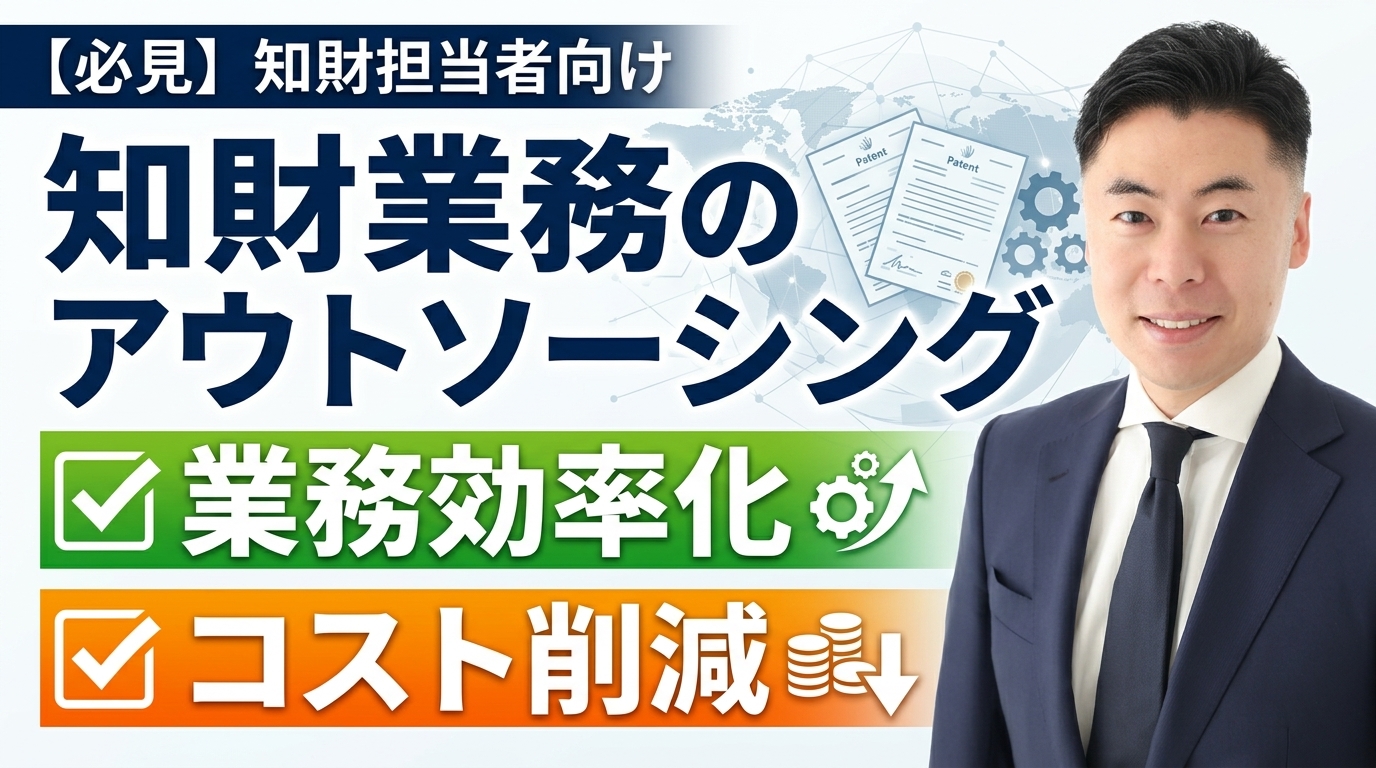 ``I want to make intellectual property operations more efficient'' and ``I want to reduce patent costs'' - there are many companies that have such issues. Work related to intellectual property (IP), such as patent applications, trademark registration, and rights maintenance and management, is an important management resource that supports a company's competitiveness.However, it is highly specialized, and attempting to handle it in-house alone will result in more time, cost, and risk than expected.
In this article, we will explain a specific method for simultaneously achieving work efficiency and cost reduction by outsourcing your intellectual property work to a patent attorney or patent office. We will provide you with comprehensive information that will be useful in practice, from the risks of managing intellectual property solely within your company, to successful cases of external utilization, and key points for choosing a firm that will ensure you do not fail.
Table of Contents
- Why doing intellectual property work alone is inefficient and costly
- Three points to make intellectual property work more efficient by utilizing patent attorneys and patent offices
- Four reasons why requesting a patent attorney will lead directly to "cost reduction"
- Examples of companies that succeeded in improving operational efficiency and reducing costs
- Don't fail! How to choose the right patent firm for your company
- Summary: Achieve aggressive management through external utilization of intellectual property
1. Why doing intellectual property work alone is inefficient and costly
Many companies think that ``if we do all the intellectual property work in-house, it will be cheaper,'' but the reality is the opposite. If you try to manage intellectual property using only in-house resources, hidden costs and risks will accumulate. Here we will explain three typical problems.
1-1. Frequent rework and mistakes due to lack of specialized knowledge
Preparing documents for patent applications requires deep knowledge of patent law and examination standards. If in-house engineers and back-office personnel respond by "seeing and imitating", problems such as costs of responding to a notice of reasons for refusal and reduction of the scope of rights may arise due to incomplete claims, inadequate explanations in the specification, insufficient prior art searches, etc.
As a result, you will have to submit amendments many times, which not only costs more money and time, but it is also not uncommon for you to lose the broader scope of rights you could have originally obtained.
1-2. Pressure on core business ─ ``Unable to concentrate on core business'' problem
There are many cases where human resources who should be focusing on core business activities such as research and development and sales are overwhelmed with creating intellectual property-related documents and managing deadlines. Intellectual property work is not something that can be done in one day, but requires continuous support from application preparation to rights acquisition, as well as maintenance and management.
When engineers and managers who should be focusing on their core business take up time on intellectual property work, opportunity losses such as reduction in research and development speed and delays in new business occur. Although this is hard to see, it is a factor that greatly hinders a company's growth.
1-3. Risk of personalization - work stops due to transfer or retirement of the person in charge
Companies that entrust intellectual property work to a specific employee run the risk of a complete stoppage of work if that person is transferred or retires. In fact, it is not uncommon for information such as the progress status of pending cases, expiration information for each right, past history and reasons for decisions to exist only in the head of the person in charge or in local files.
Caution: Risk of loss of rights due to personalization
There have actually been cases where the patent or trademark renewal deadline was missed and the rights extinguished due to the sudden resignation or long vacation of the person in charge. Once rights have expired, it is difficult to restore them and can lead to large losses. The individualization of intellectual property management is a management risk that companies cannot overlook.
Beware of "hidden costs"
The cost of in-house support is not only personnel expenses. When you add up hidden costs such as additional costs due to rework, lost opportunities, and reduced future licensing income due to a reduction in the scope of rights, there are many cases where the cost is higher than outsourcing. It is important to make decisions based on the total cost, rather than focusing on immediate cost reductions.
2. 3 points to make your intellectual property work more efficient by using patent attorneys and patent offices
By outsourcing your intellectual property work to a patent attorney or patent office, you can significantly improve the quality and speed of your work while freeing up internal resources. Here, we will introduce three points that are the core of efficiency.
2-1. Optimizing the application process ─ Achieving both speed and quality with professional knowledge
Point: Optimizing the application process
Patent attorneys are familiar with the entire application process, from invention hearings to prior art searches, specification preparation, and intermediate processing (handling reasons for refusal). Based on our extensive practical experience, we can plan and implement strategies to acquire high-quality rights in the shortest route. The biggest advantage is that it is much faster than trial and error in-house, and you can secure a wider range of rights.
2-2. Externalizing deadline management ── Eliminate human error
Point: Externalizing deadline management
Patent offices centrally manage complex deadlines for applications, examinations, pension payments, etc. using a dedicated system. With double check system and system alert, it is possible to bring the risk of forgetting deadlines to as close to zero as possible. This will definitely prevent the worst case scenario, where you accidentally forget to renew and your rights expire.
2-3. Systematizing in-house education and discovery of inventions
Point: Systematizing in-house training
Patent attorneys can also support in-house IP training and invention discovery sessions. By understanding what constitutes a patent, engineers can prevent inventions from falling through the cracks and strategically strengthen their intellectual property portfolio. The continued involvement of external experts raises the level of internal intellectual property literacy within the company and improves the intellectual property capabilities of the entire organization.
Summary of the core of efficiency
The essence of improving efficiency through outsourcing to patent attorneys lies in the appropriate division of roles: ``Leave specialized work to professionals and concentrate on core work within the company.'' As a result, the three effects of improving application quality, stabilizing deadline management, and raising the level of in-house intellectual property capabilities can be obtained at the same time, greatly improving the productivity of the entire company.
3. 4 reasons why requesting a patent attorney will lead directly to "cost reduction"
There is an impression that "outsourcing to an outside company costs money," but in reality, in most cases, when you look at the total, it leads to cost reduction. We will explain the mechanism in detail for the following four reasons.
3-1. Prior art search to eliminate "things that should not be applied for" in advance
By conducting a highly accurate prior art search before filing an application, a patent attorney can identify inventions that are unlikely to be patented. By preventing unnecessary applications, you can significantly reduce application costs, examination request costs, and intermediate processing costs.
Cost reduction effect: Just by preventing one unnecessary application, you can save hundreds of thousands of yen to more than 1 million yen in costs from filing to patenting. For companies that file multiple applications per year, the accuracy of preliminary searches is directly linked to costs.
3-2. Cut unnecessary pension payments by taking inventory of intellectual property
As the number of patents you own increases, it is often the case that you continue to pay annuities (patent maintenance costs) even for rights that are no longer relevant to your business. By helping your patent attorney take inventory of your intellectual property portfolio and sorting out the rights you should keep and the rights you can let go, you can optimize your annual maintenance costs.
Cost reduction effect:Patent annuities become more expensive over time. In some cases, maintenance costs can be reduced by hundreds of thousands of yen or more per year just by reviewing five unnecessary patents.
3-3. Support for utilization of subsidies and subsidies
For small and medium-sized enterprises and startups, the Japan Patent Office and local governments have prepared intellectual property-related subsidies and subsidy systems. Patent attorneys are familiar with these systems and can provide assistance ranging from introducing systems available to your company to assisting with the preparation of application documents.
Cost reduction effect:By utilizing the reduction/exemption system and subsidies, there are cases where application costs and examination request costs can be reduced to up to 1/3 to 1/2. If your company is unknowingly paying the full amount, please consult a patent attorney.
3-4. Converting fixed costs into variable costs - only what you need when you need it
When you hire in-house personnel dedicated to intellectual property, personnel costs are incurred monthly as fixed costs. On the other hand, outsourcing to a patent attorney is a case-based cost, so it can be managed as a variable cost depending on the number of applications and work volume. This flexibility is a huge benefit for companies with fluctuating workloads.
Comparison of in-house management vs. outsourcing
| Comparison item | Managed by your company | Outsourcing to a patent attorney |
|---|---|---|
| Required time | Long (lots of trial and error) | Short (Efficiency based on experience) |
| Total cost | Expensive (including hidden costs) | Appropriate (investment worth the results) |
| Risk | High (personalization/deadline management mistakes) | Low (system management/double check) |
| Right quality | Unstable (reduced rights due to lack of experience) | High quality (wide range of rights secured) |
| Cost structure | Fixed costs (mainly labor costs) | Variable costs (project basis) |
| Scalability | Low (needs more staff) | High (flexible to the number of projects) |
4. Examples of companies that succeeded in improving operational efficiency and reducing costs
We will introduce a case study of a company that actually achieved operational efficiency and cost reduction by outsourcing to a patent attorney.
Case 1: Manufacturing company A (50 employees)
Challenge:The general manager of the technology department was also in charge of intellectual property work, but the preparation of application documents took up a huge amount of time, which was interfering with the original development management work. Deadline management was also based on Excel, so there was always a risk of missing updates.
Countermeasure:Outsource all application work and deadline management to a patent office. We have established a system in which patent attorneys conduct hearings regarding inventions through regular visits.
Results:Reduced intellectual property-related work for general managers from approximately 40 hours to 5 hours per month. The progress of the development project has accelerated, and the launch of new products has been brought forward by three months. Furthermore, due to the patent attorney's preliminary research, two applications with low prospects were avoided, resulting in an annual cost reduction of approximately 1.5 million yen.
Case 2: IT startup company B (15 employees)
Challenge:In the rapidly growing SaaS business, there was an urgent need to obtain software patents in order to differentiate from the competition, but the company had no knowledge of intellectual property and did not know where to start.
Countermeasure:Select a patent firm that is strong in the IT field as your partner. We outsourced everything from planning an intellectual property strategy to discovering inventions, filing applications, and acquiring rights. Utilization of subsidies was also realized through suggestions from patent attorneys.
Achievements:Obtained 3 patents related to core technology in one year. Utilize subsidies to reduce application costs by approximately 40%. Obtaining a patent served as a basis for persuading investors, and the company succeeded in raising Series A funding. We have achieved a high-quality intellectual property management system at about 1/3 of the monthly labor cost without having to have an in-house person specializing in intellectual property.
5. Don't fail! How to choose the right patent firm for your company
Outsourcing to a patent attorney or patent office has great benefits, but if you choose a firm that is not suitable for your company, you will not get the results you expected. Please consider the following three points when making your selection.
Point 1: Are you familiar with your company's technology field
Each patent office has its own specialty. The most important thing is to choose a firm that has a proven track record in your technology field, such as mechanical, chemical, IT/software, etc. During your initial consultation, check the applicant's application history in similar fields and areas of expertise. The quality of the rights depends on whether the essence of the technology is understood.
Point 2: Quality and frequency of communication
Intellectual property work requires close collaboration with a patent attorney. The quality of communication is extremely important for long-term partnerships, such as ``Are they quick to respond to questions?'' ``Do they explain technical terms in an easy-to-understand manner?'' ``Do they provide regular reports and suggestions?'' It is important to judge not only the impression made during the first interview, but also the speed and politeness of the actual interaction.
Point 3: Transparency of cost structure
Avoid agencies with unclear fee structures. Choose an office that clearly presents costs for each process, such as application fees, intermediate processing fees, pension management fees, etc. It is a sign of trust that the advance estimate is detailed and the conditions for additional costs are clear. Also, from a cost-effectiveness perspective, it is important to evaluate not only the price but also the "return on investment."
6. Summary: Achieve aggressive management with external utilization of intellectual property
Let's look back at the main points of this article.
- Managing intellectual property in-house alone has three risks: lack of specialized knowledge, pressure on core operations, and individualization
- By outsourcing to a patent attorney, you can simultaneously achieve optimization of the application process, stabilization of deadline management, and improvement of in-house intellectual property capabilities
- By eliminating unnecessary applications through advance research, taking stock of pension funds, utilizing subsidies, and converting fixed costs into variable costs, total costs can be significantly reduced
- When choosing a firm, focus on three points: track record in the technical field, quality of communication, and cost transparency
- Using intellectual property as an "offensive" rather than "defensive" management resource will dramatically improve a company's competitiveness
Outsourcing intellectual property operations is not just a cost-cutting measure, but astrategic business decision that allows companies to make the most of their limited resources and accelerate business growth. Why not start with a free consultation and discuss your company's intellectual property issues with an expert?
About increasing intellectual property business efficiency and reducing costs
Please consult us for free first
We will listen to your company's intellectual property issues and propose the optimal external utilization plan.
Please feel free to contact us using the form below.