.png?width=500&height=250&name=%E7%9F%A5%E7%9A%84%E8%B2%A1%E7%94%A3%E4%BA%8B%E5%8B%99%E6%89%80%E3%82%A8%E3%83%9C%E3%83%AA%E3%82%AF%E3%82%B9%20(500%20%C3%97%20250%20px).png)


Introduction: That "Chinese patent" may be a piece of paper in Hong Kong Hong Kong, the gateway to...
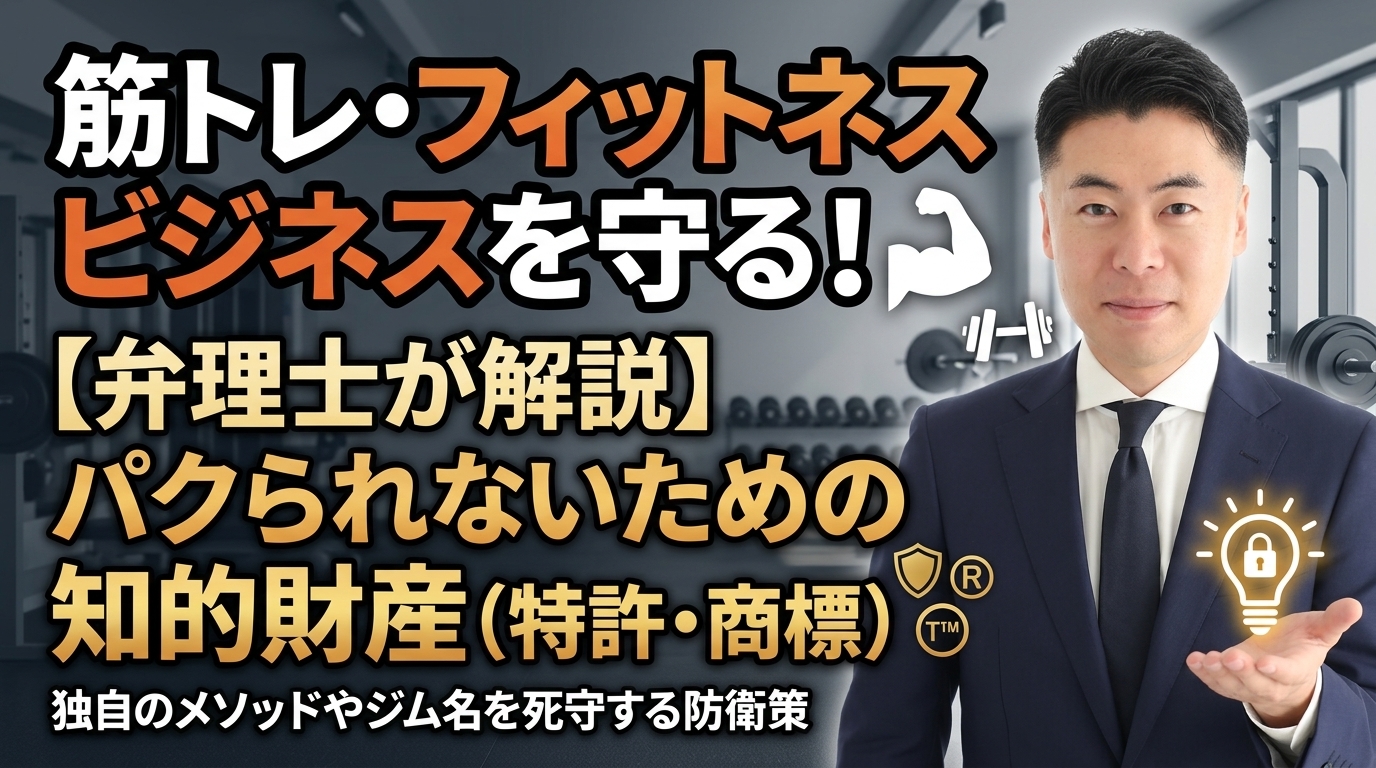 In recent years, the Japanese fitness market has experienced unprecedented activity. New business formats are emerging one after another, such as personal gyms, 24-hour fitness, online fitness, and dark fitness, and many entrepreneurs and trainers are entering this growing market.
However, the more your business grows and attracts attention, the greater the risk that your unique method, brand name, or training program will be copied. Many fitness business owners have these questions: ``Can I protect my training methods with a patent?'' ``What should I do if someone uses my gym's name without permission?''
In this article, for everyone involved in the muscle training and fitness business, we will provide a thorough explanation of Intellectual Property Protection Strategies in an easy-to-understand manner, using the analogy of muscle training. Strengthen the core of your business and build a strong business foundation that will stand out from the competition.
📋 Table of contents
- Is the muscle training industry easy to "imitate"? The “core” of business brought about by intellectual property
- Biggest question: Can a unique "muscle training method" be patented?
- Four intellectual properties to boost your fitness business
- Learn about common intellectual property problems in muscle training businesses through case studies
- A patent attorney is your business's "personal trainer"
1. Is the muscle training industry susceptible to "imitation"? The “core” of business brought about by intellectual property
By its very nature, the fitness business is an industry that is easily imitated. Training methods are visible and easy to observe, and successful gym concepts and programs quickly emerge as similar services. We live in an era where posting on Instagram and YouTube is essential to attracting customers, so your know-how is always being seen.
Let's use the analogy of muscle training.
💡 The "core" of business = intellectual property
In strength training, outer muscles determine the appearance. In the fitness business, store design, website, SNS communication, etc. are the "outer muscles". On the other hand, the core (inner muscles) are not visible from the outside, but they are the foundation for stability and performance in all movements. Intellectual property rights are the "core" of business. Trademarks, patents, design rights, copyrights—if you don't have strong intellectual property rights, your business will remain vulnerable to competitors' imitations and problems, no matter how good it looks.
Just as a weak core can cause you to lose your balance when lifting a heavy barbell, the more your business grows, the more risk you'll be exposed to if you're unprepared for your intellectual property rights. Conversely, if you have a strong core of intellectual property, you will be able to confidently assert your rights against counterfeiters, protect your brand value, and gain the trust of investors and franchise partners.
Now, let's explain what kind of intellectual property is specifically related to the fitness business, starting with the most frequently asked questions.
2. Biggest question: Can a unique "muscle training method" be patented?
The most common question asked by fitness business owners is Can I patent my training methods? I will be frank with my conclusion.
⚠️ Important conclusion
Pure "muscle training methods" or "training methods" themselves cannot be patented in principle under Japanese patent law. This may come as a surprise to many trainers and gym owners, but it's a very important point.
Why? To understand why, let's go back to the basics of patent law.
📘 Definition of "invention" under patent law
Article 2, Paragraph 1 of the Japanese Patent Law defines an invention as a highly advanced creation of a technical idea that utilizes the laws of nature. The key points are two requirements: ``use of natural laws'' and ``technical thinking.'' A pure muscle training method -- for example, a program that says ``do this number of exercises in this order three times a week'' -- is rules and procedures for human behavior and exercise, and is likely to be judged as not falling under ``technical ideas that utilize natural laws.'' This is the same reason why business models and mathematical formulas are not subject to patents.
However, there's no need to give up. Even if the ``method itself'' cannot be patented, there are cases in which the path to patenting can be opened by combining the method with ``technology''.
For example, you can consider the following approach.
- Combine with AI and algorithms: If you develop an AI system that automatically generates training plans based on your own method, you may be able to apply for a patent as a "software-related invention."
- Combine with IoT devices: A system that acquires user movement and physical condition data using sensors and wearable devices and provides real-time feedback based on a method can be the subject of a patent as a technical idea.
- Develop your own training equipment: Unique equipment or machines designed to maximize the effectiveness of a method can be patented as an ``object invention.''
In other words, the key to obtaining a patent is to sublimate an "idea" into a "technology." And this strategy becomes even more powerful when combined with other intellectual property rights discussed in the next section.
3. 4 intellectual properties that will strongly pump up your fitness business
Just as muscle training trains your entire body in a well-balanced manner, it is important to combine multiple rights for your fitness business's intellectual property strategy. Here, we will provide a detailed explanation of four types of intellectual property rights that are particularly relevant to the fitness business.
3-1. Trademark rights—“Squat” to protect your brand
Just as the squat is called the "King of Exercises" in muscle training, trademark rights are the most fundamental and important rights in intellectual property protection for fitness businesses.
✅ What can be protected by trademark rights
- Name of gym/studio (e.g. "RIZAP", "Curves", "Anytime Fitness")
- Name of the training program (e.g. "BODYPUMP" "Les Mills GRIT")
- Logo/symbol mark
- Service Tagline (e.g. “Committed to Results”)
- Brand name of original supplements and goods
The key to trademark registration in the fitness industry is choosing the appropriate "classification". Trademarks are registered for each category of goods and services, so it is necessary to cover multiple categories depending on the scope of your business.
📘 Main classifications related to fitness business
- Category 41: Fitness guidance, training services, provision of sports facilities, provision of online fitness programs
- Category 5: Supplements, proteins, nutritional supplements
- Class 29: Protein bars, processed foods
- Class 25: Training wear, fitness apparel
- Class 28: Training equipment, fitness equipment
For example, if you are running a personal gym and also selling original protein, you will need to register under at least Class 41 (gym services) and Class 5 (supplements). If you are considering expanding into apparel in the future, you should obtain Class 25 as soon as possible.
💡 Learn from examples
``RIZAP'' has obtained trademarks in multiple categories, including the tagline ``Committed to results.'' Les Mills has trademarked program names such as "BODYPUMP," "BODYCOMBAT," and "BODYBALANCE." This brand protection strategy is the basis for franchising and global expansion.
3-2. Patent rights and utility model rights—"Bench press" to protect technology
Just as the bench press generates "power" in the upper body, patent rights are a powerful weapon to protect the technological superiority of fitness tech. As mentioned above, pure methods cannot be patented, but they can be patented when combined with technology.
✅ Technology that can be patented in the fitness industry
- AI personal training app: A system where AI automatically generates an optimal training plan based on the user's body shape, goals, and past data
- IoT fitness machine: A smart machine that detects user movements with sensors and gives instructions to correct form in real time
- Wearable device collaboration: A system that optimizes exercise intensity by integrating heart rate, electromyogram, and acceleration sensor data
- Uniquely designed training equipment: Equipment with unconventional structures and mechanisms (new load adjustment mechanisms, safety devices, etc.)
- Nutritional management system: Application that proposes an optimal nutritional intake plan in conjunction with training data
In recent years, the field of fitness tech (FitTech) has been rapidly growing, and the number of patent applications is increasing. Peloton holds numerous patents for its interactive exercise bike system, which is a major competitive advantage for the business. In Japan, patent applications related to smart gyms are increasing.
📘 Utility model right is also an option
If the "sophistication" of patents is not required, Utility model rights are also an effective option. Small improvements or innovations to training equipment (such as changing the shape of the grip or simplifying the angle adjustment mechanism) may be registered as a utility model. The examination period is short and the cost is lower than patents, making it a realistic option for small and medium-sized gyms and trainers.
3-3. Design rights—"Deadlift" to protect your design
Just as a deadlift determines the "back view", design rights protect the "appearance" of your business. In the fitness business, design is an important element of the customer experience.
✅ Design that can be protected by design rights
- Training machine design: machine and dumbbell shapes with unique appearance
- Gym interior design: In the 2020 Design Law revision, "interior design" was added to the scope of protection. This includes studio interiors with a sense of unity, locker room designs, etc.
- App UI/UX design: Screen design of fitness apps can also be protected as "image design".
- Design of clothing and goods: Original training wear, shape of protein shaker, etc.
💡 Key points of the 2020 Design Law Amendment
According to the revised Design Law in April 2020, "interior design" has become a new protection target. This makes it possible to register uniform interior designs for gyms and studios. For example, the design of the space as a whole, such as a distinctive lighting design, wall design that utilizes brand colors, and the layout of the training area, will be protected. This is a very useful right for businesses where spatial design is a differentiating factor, such as high-end personal gyms or boutique studios.
3-4. Copyright—“Plank” to protect content
Just as a plank supports your core on a daily basis, copyright automatically protects the content you create every day. A major feature of copyright, unlike other intellectual property rights, is that it arises automatically without registration.
✅ Copyright protected content
- Training manual/text: Instruction manual for trainers, program guide for members, etc.
- Video content: YouTube training videos, online lesson videos, form explanation videos
- Photos/Illustrations: Before and after photos (copyright to the photographer), exercise illustrations
- Music/Choreography: Group lesson choreography may be protected as a "work of dance." The original BGM is also a copyrighted work.
- Blog articles/SNS posts: Explanatory articles on nutrition, explanatory posts on training, etc. are also copyrighted works
- Program design materials: Detailed illustrations and explanatory documents of the training program
📘 Copyright notice
Copyright protects expression, notidea. For example, a training sequence (idea) such as ``push-ups, sit-ups, and squats'' itself is not protected by copyright, but a manual that expresses that sequence using original diagrams, illustrations, and detailed explanatory text is protected as a copyrighted work. Similarly, training videos are copyrighted works, but the movements shown in the videos themselves are not protected.
Let's compare the four intellectual property rights in the table below.
| Intellectual property rights | Protected target | Fitness example | Registration required | Protection period |
|---|---|---|---|---|
| Trademark rights | Brand name/logo/slogan | Gym name, program name, tagline | required | 10 years (renewable and semi-permanent) |
| Patent rights | Technical invention | AI apps, IoT machines, and unique equipment structures | required | 20 years since application |
| Design rights | Product/Space Design | Machine appearance, gym interior, app UI | required | 25 years since application |
| Copyright | Creative expression | Manuals, videos, choreography, photos | Unnecessary (automatically generated) | 70 years after the death of the author |
4. Common intellectual property troubles in muscle training businesses learned from case studies
To help you realize the importance of intellectual property, let's take a look at examples of problems that can occur in the fitness business. These are case studies based on real cases.
Case 1: "Brand takeover" caused by unregistered trademark
🚨 Trouble example: Gym name was trademarked by a third party
Mr. A operated a popular personal gym "MUSCLE FACTORY" (tentative name) in Tokyo for five years. Our reputation spread through word of mouth and social media, and one day when we were planning to open a second store, we received a certified mail from an unknown company saying, ``Please immediately stop using the word ``MUSCLE FACTORY,'' which we own the trademark rights to.''
When we investigated, we discovered that another company, which had heard of Mr. A's gym's reputation, had registered "MUSCLE FACTORY" as a trademark. Japan's trademark system is based on the first-to-file system—the right is granted to the person who files the application first. Even if Mr. A used the trademark first, as a general rule, he cannot claim rights unless it is registered as a trademark.
[Result] Mr. A was forced to change the name of the gym at great expense, and the brand value and customer base that he had built up so far were seriously damaged. Changes to signboards, website renewal, SNS account migration, and notifications to customers—the damage amounted to several million yen.
Lesson:It is a golden rule to file a trademark registration application for your gym name or service name before or immediately after starting your business. The cost of registering a trademark is a much smaller investment compared to the cost of losing your brand. The cost required for filing an application, including the stamp fee to the Japan Patent Office and the fee to a patent attorney, ranges from tens of thousands of yen to hundreds of thousands of yen.
Case 2: "Trade secret" taken out by former trainer
🚨 Trouble example: Original method and customer information leak
Mr. B, who runs a popular personal gym, has spent many years developing his own dietary guidance program and body shaping method. These were systematized as internal manuals and trained by trainers. However, ace trainer C becomes independent and opens a new gym nearby. I used Mr. B's method almost exactly as it was, and even took Mr. B's gym customer list with me and started sales.
Mr. B considered taking legal action for ``illegal acquisition of trade secrets,'' but there was a problem. There was noing ``confidential'' in the company's manual, and there was noing confidentiality clause in the trainer's employment contract. In order to be protected as a trade secret under the Unfair Competition Prevention Act, it is necessary to meet three requirements: (1) secrecy control, (2) usefulness, and (3) non-public knowledge. However, due to insufficient secret management measures, it was difficult to obtain legal protection.
[Result] Mr. B lost approximately 30% of his main customers, and his unique method was imitated by competitors, resulting in a significant loss of differentiation.
Lesson:The following measures are essential to protect your unique methods and know-how.
- The in-house manual should clearly indicate "Confidential"
- Include non-disclosure clauses (NDAs) in contracts with employees and trainers
- Include non-compete clauses in the contract to a reasonable extent
- Restrict access so that only necessary people can view the manual
- Establish a management system for customer information and create a system that prevents taking it out
5. Patent attorneys are the "personal trainers" of your business
Just as you rely on the help of a personal trainer to efficiently achieve results with muscle training, the support of an expert patent attorney is essential for the protection of intellectual property.
A patent attorney will provide "counseling" about the current state of your business, assemble an intellectual property "training menu," provide "form guidance" for filing, and provide "continuous support" for maintaining and utilizing rights. Intellectual property strategy for fitness businesses is like a "compound event" that appropriately combines trademark rights, patent rights, design rights, and copyrights. Rather than trying to do everything on your own, leveraging the power of experts is the fastest way to get the most results.
Would you like to train the "core" of your fitness business?
At the intellectual property firm EVORIX, our patent attorneys who are familiar with fitness and sports business will propose the best intellectual property strategy for your business.
Please feel free to contact us regarding trademark registration, patent applications, building a trade secret management system, etc.
The first consultation is free. Please feel free to contact us.
#Intellectual Property #Fitness Business #Trademark registration #Patent #Personal Gym #Strengthening #Patent attorney #EVORIX #Brand protection #FitTech

AUTHOR
Takefumi SUGIURA (杉浦 健文)
EVORIX Intellectual Property Law Firm Managing Patent Attorney
Supports clients across IT, manufacturing, startups, fashion, and medical industries, covering patent, trademark, design, and copyright filings through trials and infringement litigation. Specialized in IP strategy for AI, IoT, Web3, and FinTech. Member of the Japan Patent Attorneys Association (JPAA), Asian Patent Attorneys Association (APAA), and Japan Trademark Association (JTA).