.png?width=500&height=250&name=%E7%9F%A5%E7%9A%84%E8%B2%A1%E7%94%A3%E4%BA%8B%E5%8B%99%E6%89%80%E3%82%A8%E3%83%9C%E3%83%AA%E3%82%AF%E3%82%B9%20(500%20%C3%97%20250%20px).png)

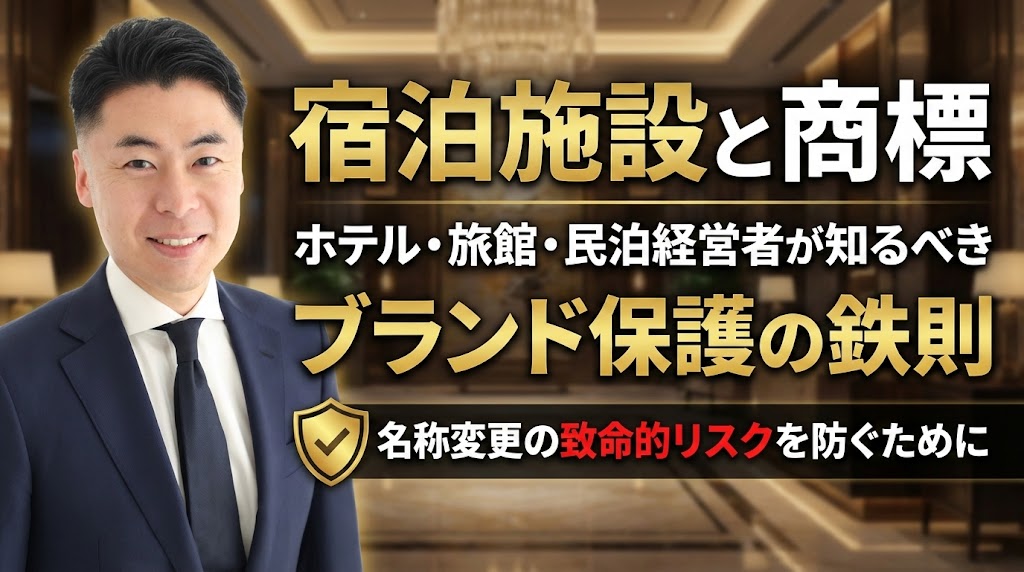
The accommodation industry is regaining vitality due to the V-shaped recovery in inbound demand and the establishment of microtourism. A variety of lodging experiences are now being offered, including newly opened hotels, inns renovated from old folk houses, guesthouses with unique concepts, and glamping facilities.
However, the reality is that even though many business owners invest heavily in facility interiors, services, and web marketing, "trademark registration" is something that they put off or don't consider at all.
"We are a small privately run inn, so it doesn't matter."
"The company name is registered at the Legal Affairs Bureau, so the name should be protected."
"It's posted on Booking.com and Rakuten Travel, so there's no problem."
If you think that way, your facility is running the extremely serious risk of having to one day suddenly remove the signboard and change the name.
In this article, for owners and managers of accommodation facilities, we will thoroughly explain why trademark registration is essential now, the specific troubles that may occur if you do not register, and the strategic benefits of hiring a patent attorney.
📑 Table of contents of this article
- The name is the biggest asset for an accommodation facility
- Common misconception: The decisive difference between "trade name registration" and "trademark registration"
- "Three tragedies" that can occur if you neglect trademark registration
- "Categories" that accommodation facilities should strategically register
- Notes on naming hotels and inns
- What are the benefits of hiring a patent attorney?
- Trademark registration cost and period
- Q&A: Frequently asked questions from property owners
- Summary: Trademark registration is an "offensive" and "defensive" business strategy
1. "Name" is the biggest asset for accommodation facilities
For hotels and inns, the facility name is not just a "name". It is a ``vessel of trust'' for customers to search on OTAs (online reservation sites), check reviews on SNS, and actually visit the facility, and an ``identification sign'' to distinguish it from other facilities.
Start of search and reservation
Most modern accommodation reservations are made via the Internet. The names “〇〇Hotel” and “Ryokan〇〇” are search keywords, and being displayed in the search results is the first step in attracting customers.
If you do not have the rights to this "name" (trademark rights), you will not be able to complain if another company uses the same name, and in the worst case scenario, you will be deprived of search traffic.
Value as "goodwill"
If it is a long-established inn, the name itself is a brand that proves its history and formality. Even if it is a newly opened guest house, trust (goodwill) will accumulate in the name by accumulating good reviews.
Trademark registration is the only means to protect this "invisible asset" that you have accumulated through your daily efforts in the strong safe of the law.
2. Common misunderstanding: The decisive difference between "trade name registration" and "trademark registration"
This is the biggest misconception that many business owners tend to fall into. This is a case where people think that this name is unique to them because they have submitted a business opening notification to the tax office (trade name) or have registered a company establishment at the Legal Affairs Bureau (trade name).
In conclusion,Even if you register your trade name or trade name, you cannot avoid the risk of trademark infringement.
| Item | Business name registration (trade name) | Trademark registration |
|---|---|---|
| Based law | Company Law/Commercial Law | Trademark law |
| Jurisdiction | Legal Affairs Bureau | Patent Office |
| Efficacy range | Registration is possible as long as the addresses (lot numbers) are not the same | Effective throughout Japan |
| Rights | Right to use company name | Right to exclusive use for goods and services |
| Exclusion from other companies | Cannot be stopped unless it is the same address | Including similar namesCan be suppressed |
In other words, even if you are registered as "XX Hotel Co., Ltd.", if someone in a neighboring town (or a distant prefecture) registers "XX Hotel" as a trademark, you may not be able to use the name "XX Hotel" on your signboard or website.
As long as you are putting up a signboard as a business and attracting customers, Trademark registration is an essential procedure.
3. "Three tragedies" that can occur if you neglect trademark registration
Here are some examples of actual troubles that have occurred as a result of postponing trademark registration. These are never someone else's problems.
⚠️ Risk ①: One day you will suddenly receive a "warning letter"
One day, a pension that has been in business for many years may suddenly receive a certified mail from an unknown company (or its patent attorney).
"The facility name you are using infringes our trademark rights. Please stop using it immediately and pay ¥0,000,000 as past usage fee."
If the other party has registered the trademark first, there are many cases where even if you were the first to do business, you will be at a disadvantage under trademark law. (*The hurdles for prior user rights to be granted are very high)
⚠️ Risk ②: Huge cost of forced "rebranding"
If your facility is found to be infringing on trademark rights, you will be forced to change your facility name. The costs incurred in this case are as follows.
- Removal and new construction of building signs and entrance signs
- Disposal and reprinting of pamphlets, business cards, envelopes, in-house wear, and amenity goods
- Modification of website, change of domain (URL)
- Procedure for changing registration to OTA
- Decrease in customer recognition and loss of repeat customers due to "name change"
The direct costs of these can range from millions of yen to tens of millions of yen. Furthermore, since the search ranking (SEO) evaluation will be reset, the damage to attracting customers will be immeasurable.
⚠️ Risk ③: Removal from OTA (digital trouble)
Platforms like Booking.com, Expedia, and Airbnb are strict about protecting intellectual property rights. If a third party with trademark rights reports to OTA that ``this facility is using my trademark without permission,'' there is a risk that your facility's listing page will be suddenly deleted (made private).
In today's world, where OTA is the lifeline for attracting customers, cutting off the reservation line could directly lead to business closure. On the other hand,if you own trademark rights, it becomes a powerful weaponto force the removal of counterfeit sites and spoof accounts.
4. "Categories" that accommodation facilities should strategically register
Trademark registration is divided into categories called "classifications". If you do not choose the appropriate category, you may end up in a situation where your souvenirs are not protected even though you have registered them, or your sauna business is not protected.
[Required] Category 43: Provision of accommodation facilities, provision of food and drink
Hotels, inns, private lodging, pensions, glamping facilities, etc. are definitely required to register under Category 43. In addition to accommodation services, this includes food and beverage services at on-site restaurants and bars. This is the basis of everything.
[For business expansion] Peripheral divisions that are often overlooked
Recently, lodging facilities have diversified beyond just lodging, including selling original goods, spas, and weddings. There are areas that cannot be covered by Category 43 alone.
| Division | Target | Specific example |
|---|---|---|
| Class 30 | Sweets/Bread/Tea | Original steamed buns and special cookies sold as souvenirs |
| Class 32/33 | Beverage/Alcohol | Original craft beer, sake, and juice sales |
| Category 3 | Cosmetics/Soap | Create an original brand of guest room amenities and sell them at shops and EC |
| Class 25 | Clothing | Sale of original T-shirts, yukatas, caps, and tote bags |
| Class 44 | Beauty/Medical | Providing beauty salons, massages, sauna facilities, and hot spring facilities |
| Class 41 | Education/Entertainment | Holding experience classes (pottery, soba making, etc.), events, and seminars |
💡 Point:The question of "how much should I take in balance with the budget?" is closely related to the business plan. This judgment is where a patent attorney's skill lies. There is no need to create unnecessary categories, but you should take steps to protect future hit products.
5. Notes on naming hotels and inns
If you are opening a new facility or rebranding it, what should you name it? There are some points that should be avoided or devised from the perspective of trademark registration.
Place names + common names are difficult to register
For example, names that consist only of a place name and industry (general name), such as Tokyo Hotel, Hakone Ryokan, and Izu no Yado, cannot be trademarked as a general rule. These are words that everyone wants to use, and they shouldn't be monopolized by one company.
However, it may be possible to register it by combining it with a distinctive logo mark or adding your own words.
Naming with inbound in mind
If you are targeting foreign tourists, you should consider registering your trademark not only in Japanese (kanji/hiragana) but also in "European alphabet". For reservation customers from overseas, search by alphabet. It is necessary to thoroughly investigate not only the Japanese pronunciation (pronunciation), but also the appearance and similarities in alphabetical notation.
Risk of "misappropriated application" overseas
If you are looking to expand overseas in the future or aim to become a famous luxury inn overseas, you must also consider the risk of having your trademark taken without permission (misappropriated application) in China, Taiwan, Southeast Asia, etc.
Japanese trademark rights are valid only within Japan. If necessary, it is also necessary to consider filing an international registration application (MadPro) based on the Madrid Protocol.
6. What are the benefits of hiring a patent attorney?
Recently, there has been an increase in the number of low-cost online application services that use AI, but for businesses that require huge capital investment such as lodging facilities, we strongly recommend that you hire a professional patent attorney.
✅ Benefit 1: Highly accurate prior trademark search (similarity judgment)
Whether a trademark can be registered depends on whether there are no similar trademarks in the past. This ``similarity'' (judgment of similarity) is highly specialized and is comprehensively judged based on three factors: ``appearance (appearance)'', ``pronunciation (pronunciation)'', and ``idea (meaning)''.
For example, "HOTEL SUN" and "Taiyo Hotel" have different characters but have the same meaning (idea), so they may be considered similar. If you don't look at it from a professional point of view, there are many cases where you think it's okay, but it turns out to be rejected.
✅ Benefit ②: Close examination of "designated goods and services" with an eye on business expansion
A patent attorney will listen not only to the current business content of the owner, but also to the owner's vision, such as "Do you want to run an e-commerce site in the future?" "Is there a franchise development?"Then, we will design the optimal application scope to ensure that no rights are left out and that no unnecessary costs are incurred.
✅ Advantage 3: Ability to respond to notices of reasons for refusal (increase pass rate)
After filing an application, you may receive a notice from the Patent Office stating that your application cannot be registered as is (notice of reasons for refusal). When the general public receives this, they tend to give up and think, ``This is no good.''
However, if you have a patent attorney, you can create a rebuttal (opinion) using past precedents and examination standards, or make partial corrections (amendments) to the scope of rights, increasing the chances of overturning the refusal and leading to registration. The strength of a patent attorney is the ability to carry out tenacious negotiations.
7. Cost and period for trademark registration
Estimated cost
The cost of trademark registration is the sum of the "stamp fee paid to the Patent Office" and the "fee to the patent attorney." Generally, the total cost for application and registration in one category is approximately 100,000 to 200,000 yen (including 10 years' worth of registration fees).
Converting a right valid for 10 years to a monthly amount...
Only 1,000 yen to 2,000 yen per month
This is "management insurance" that protects tens of millions of yen in renovation costs and brand trust.
Estimated period
It usually takes about 6 to 10 months from application to registration (*varies depending on the examination status). However, if you use the "accelerated examination" system and meet the requirements, it may be possible to shorten the time to about 2 to 3 months.
⏰ Golden rule: Start making a move ``six months before opening'' or ``immediately after the naming is decided'' at the latest. Trademarks are a "first come first served" world.
8. Q&A: Frequently asked questions from property owners
Q. I have been in business for many years, can I register now?
A. Yes, it is possible. You can register now unless you have already been registered by another company. In fact, the longer the business history, the higher the brand value, which increases the risk of being stolen by another company (trademark trolling). We recommend that you apply as early as possible.
Q. Which should I register, the logo or text?
A. "Both" if the budget allows, but "text" is the basics first. Registering incharacters (standard characters) is the most versatile, as the rights are easily protected even if you change the font or design. However, if the logo mark itself has strong characteristics, or if it is difficult to register as a character because it is too general, it is effective to register it as a graphic trademark (logo).
Q. What will be the cost if my application is rejected?
A. Application fees are not refundable. That's why "preliminary research" before filing is extremely important. Our office puts a lot of effort into conducting preliminary research to avoid unnecessary applications.
9. Summary: Trademark registration is an "offensive" and "defensive" business strategy
In the management of accommodation facilities, investing in the brand (name) is as essential as paying attention to the building and interior design. It is far too risky to make a business decision to pay tens of thousands of yen to tens of thousands of yen for application costs, only to end up incurring millions of yen in losses due to the removal of signboards and compensation for damages.
🛡️
Defense
Protecting customer trust
⚔️
Attack
Eliminate copycats and establish your own brand
📈
Capitalization
Increase future business value (appraisal value at the time of M&A/succession)
Start with a free consultation
Our office has extensive experience in registering trademarks in the lodging industry, including hotels, inns, private lodging, and glamping. It doesn't matter if you're still at the stage where you don't have a specific name decided yet or you don't know which category to submit it in.
Let's protect and nurture the important name of your facility together with us.

AUTHOR
Takefumi SUGIURA (杉浦 健文)
EVORIX Intellectual Property Law Firm Managing Patent Attorney
Supports clients across IT, manufacturing, startups, fashion, and medical industries, covering patent, trademark, design, and copyright filings through trials and infringement litigation. Specialized in IP strategy for AI, IoT, Web3, and FinTech. Member of the Japan Patent Attorneys Association (JPAA), Asian Patent Attorneys Association (APAA), and Japan Trademark Association (JTA).