.png?width=500&height=250&name=%E7%9F%A5%E7%9A%84%E8%B2%A1%E7%94%A3%E4%BA%8B%E5%8B%99%E6%89%80%E3%82%A8%E3%83%9C%E3%83%AA%E3%82%AF%E3%82%B9%20(500%20%C3%97%20250%20px).png)

Introduction: Design is a "corporate asset." Are you ready to protect? "I'm confident in the design...
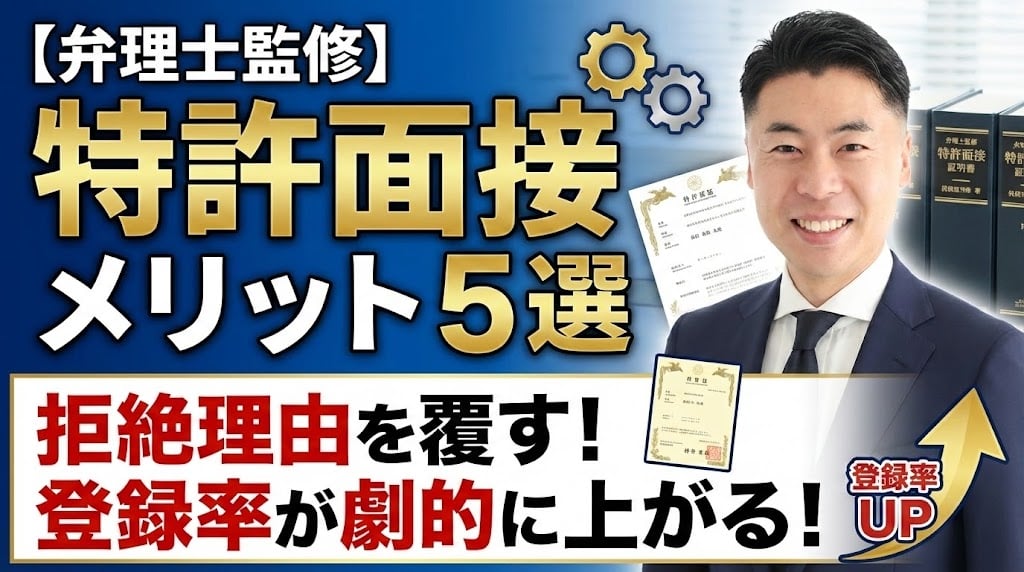
Introduction: A notice of reasons for refusal is not an "end" but an "invitation to dialogue"
"Even though I applied for a patent with confidence, I received a 'Notice of Reasons for Refusal' from the Japan Patent Office..."
"The examiner's points are harsh and I'm worried about whether I should give up."
“Can our intentions really be conveyed with just a written opinion and a written amendment?”
It is not uncommon to encounter such obstacles during the patent application process. When many applicants see a notice filled with difficult legal terminology and negative words, they feel as if they have been told that their invention is worthless, and they feel like they are about to break down.
However, as an active patent attorney, I can confirm this.
A notification of reasons for refusal is an "adjustment process" toward obtaining a patent, and is not a stage to give up.
Rather, it can be said that the examiner is throwing the ball at you, saying, ``If you fix this, you might be able to patent it,'' or ``I don't have enough explanation here, so please let me know.'' The most powerful means of turning this crisis into an opportunity and leading to a rebirth and registration is the "patent interview (examiner interview)" explained here.
Usually, patent examination is centered around written communication, but this procedure, in which you interact directly (or online) with the examiner and discuss the essence of the technology and the scope of rights, can be a trump card that can support the patent registration process if used appropriately.
In this article, from the perspective of a patent attorney who has attended many patent interviews, we will thoroughly explain the unknown benefits and risks of patent interviews, as well as the reasons why you should use a patent attorney. By the time you finish reading this, you should be able to see the notice of reasons for refusal in your hand as a "ticket to obtaining rights."
1. What is a patent interview (examiner interview)?
First, let's summarize the basics of the special interview.
A patent interview (official name: interview examination) is a procedure in which the applicant (or the patent attorney representing him/her) directly communicates with the patent office examiner in charge of the case.
Japanese patent examination is based on the "written document" principle. The examination progresses through the back and forth of "documents" such as application documents, notice of reasons for refusal, and written opinions and amendments. However, there are limits to conveying 100% of cutting-edge technology, complex mechanisms, or subtle differences from existing technology (such as a "moist feel" or "intuitive operability") through text alone.
Therefore, this system has been established to eliminate the differences in mutual understanding and to proceed with the examination smoothly and accurately.
Today's mainstream is "online interview"
In the past, ``face-to-face'' interviews, in which interviews were conducted at the Patent Office in Toranomon, Tokyo (currently, the office may be temporarily relocated due to renovations, etc.), were the norm, but now ``online interviews'' using Microsoft Teams have become commonplace.
As a result, even local companies and busy development staff can easily participate from their own company without incurring travel time or travel costs. Since drawings and experimental data can be shared and discussed on a PC screen, communication is as efficient as, or even more effective than, face-to-face communication.
2. Is writing alone not enough? 5 major benefits of conducting a patent interview
Why do I need to go to the trouble of talking to the examiner? Is it not enough to just write a carefully written opinion?
In conclusion, the interview surpasses other methods in that it allows you to instantly form a common understanding with the examiner. The five specific benefits are as follows.
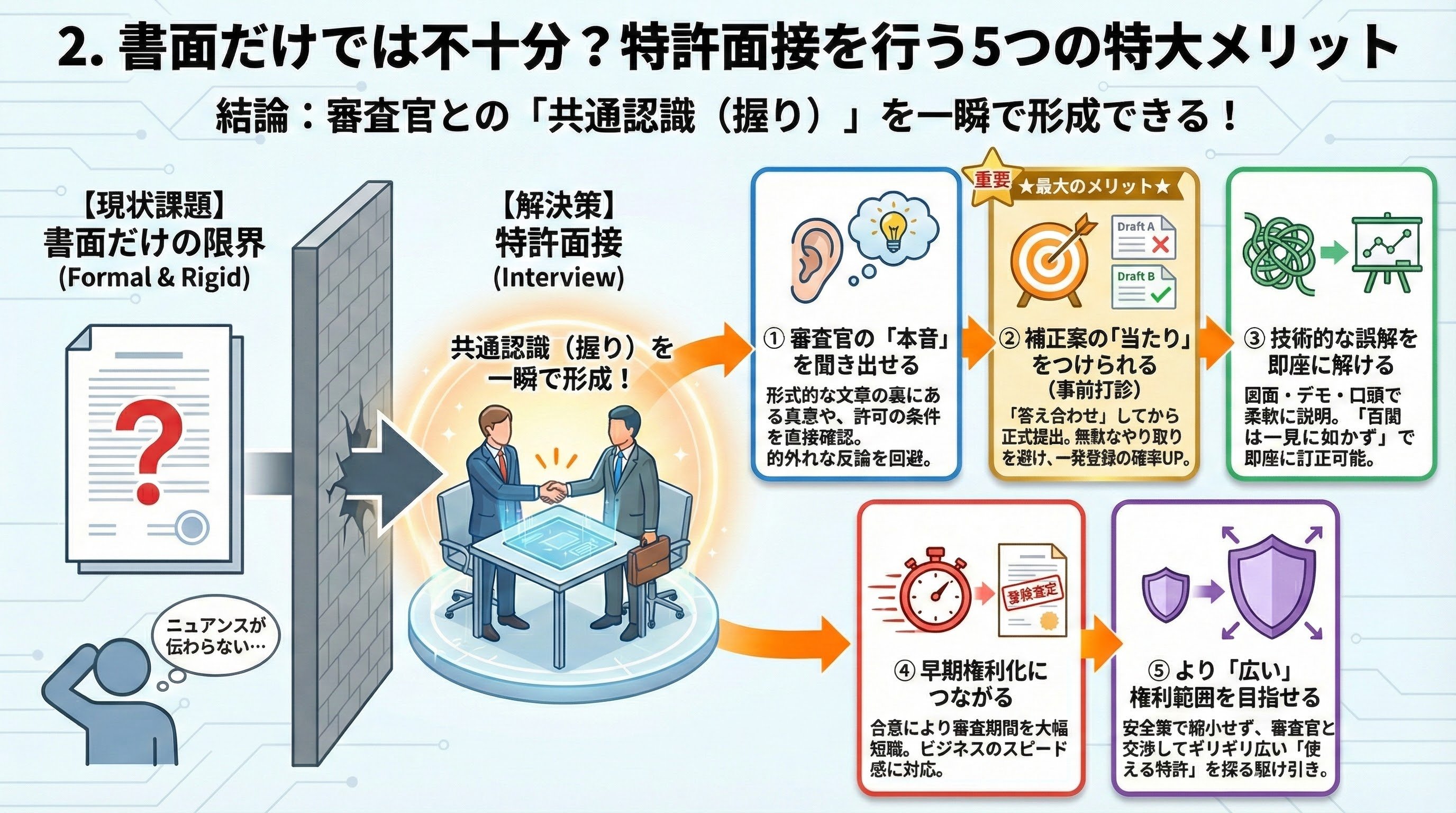
Advantage 1: You can hear the examiner's "true intentions"
A notice of reasons for refusal is an official document based on law. As a result, the writing is stiff and often uses formulaic expressions.
For example, suppose it is pointed out that there is no inventive step (a person skilled in the art could have easily invented the invention). However, there are many cases where it is not possible to read the detailed nuances such as ``Which part specifically did you think was easy?'' and ``What changes do you need to make in order to be approved?'' from the text of the notification.
When conducting an interview, you may be able to elicit the following ``true feelings'' from the examiner.
-
"Actually, I didn't really understand the technical significance of this part."
-
"I would like you to clarify the difference between this description in the cited document and your invention"
-
"Frankly, I think that as long as the definition of this term in the claim is clear, registration can be approved."
In this way, you can directly check the "examiner's opinion" that is not written in writing, thereby avoiding the risk of making irrelevant rebuttals.
Advantage 2: You can make a "hit" on the amendment proposal (preliminary consultation)
It is no exaggeration to say that this is the biggest practical advantage.
Normally, once you formally submit a written opinion/amendment, if the content is insufficient, you will be notified of the reasons for refusal again (or a decision of refusal will be issued), making it difficult to go back.
However, if it is an interview, you can ask in advance (present a draft), ``What do you think if we make this correction?''
In response, the examiner will give you feedback on the spot, such as ``That amendment will eliminate the reason for refusal,'' or ``That's still not enough,'' although it is not legally binding.
In other words, since you can submit official documents after "matching your answers," you can avoid unnecessary battles and help reduce rework and keep the process running smoothly.
Advantage 3: Immediately resolve technical misunderstandings
Especially in the case of niche fields or cutting-edge technologies, even examiners may not have perfect expertise in the field. Even if you write a long and complex technical explanation in writing, there is no point in writing it unless it is understood by the reader.
For interviews, you can flexibly explain verbally using drawings, samples, videos, whiteboards, etc. The unique strength of dialogue is that it allows you to notice ``points that the examiner misunderstood'' on the spot and correct them immediately.
As ``a picture is worth a thousand words'', there are many cases where the examiner's attitude softens the moment you show him the actual demo, and his understanding immediately improves.
Advantage 4: Leads to early acquisition of rights
Repeated communication in writing can result in losses ranging from several months to years, including the mailing period and waiting period for review.
If a policy is agreed upon during the interview, a formal amendment is submitted immediately afterward, and in many cases, a registration decision is promptly issued. Interviews are a powerful time-saving tool in situations where business speed is important, such as when a product release date is set or when you want to quickly keep a check on competitors.
Advantage 5: Aim for a "broader" scope of rights
A patent is not something that just needs to be registered. If the scope of rights is too narrow (limited), it will become an "unusable patent" that can be easily circumvented by other companies.
If you try to take security measures only in writing, your rights tend to be significantly reduced. However, during the interview, you can negotiate with the examiner and find out how far you can go.
The best part of the interview is being able to negotiate things like, ``I want to leave this broad concept in place in exchange for giving up on this part.''
3. Why do we need a patent attorney? The dangers of “going on your own”
"Since you (the inventor) know the details of the invention best, wouldn't it be okay to go to the interview yourself?"
Some people may think so. Of course, the presence of the inventor himself would be very helpful and welcome. However, the reality is that interviews without a patent attorney (individual interviews) are risky.
This is because a patent interview is not a "technical presentation" but a "place to negotiate the scope of legal rights."
Risk ①: "Estoppel" trap
This is the scariest point.
Although not everything said during the interview will be recorded, it will remain in the examiner's memory and notes (response record).
Suppose that, in the atmosphere of the situation, you blurt out something like, ``This technology is actually the same as 〇〇, which has been around for a long time...'' or ``This part is not important.''
If that part later becomes a key point in obtaining rights, it will become a logical contradiction (estoppel), saying, ``Didn't you say it wasn't important at the time?'' and you'll end up strangling yourself.
This will be a fatal weakness in the future when a rival company requests a patent invalidation trial, or when you try to exercise your rights, you may be refuted by saying that your patent is "outside the scope of your rights."
Patent attorneys are fully aware of what not to say, and proceed with negotiations while avoiding statements that would be legally disadvantageous.
Risk ②: "Translation" of technology and law is necessary
Examiners are both "technicians" and "lawyers." They make decisions based on the rulebook of patent law.
No matter how passionately the inventor says, "This technology is amazing! We worked hard!", unless it is translated into the logic of "inventive step (easily arrived at)" under patent law, it will not resonate with the examiner.
A patent attorney plays the role of an interpreter who translates the inventor's "technical passion" into "legal logic" that will satisfy the examiner. Without this translation function, time would pass without any meaningful discussion.
Risk ③: Timing to cut negotiation cards (pine, bamboo, plum)
An interview is a negotiation. If you try to pass all of your arguments, things will fall apart, and if you listen too much to what the other side has to say, your rights will fall apart.
An experienced patent attorney will prepare multiple amendment plans (plans) in advance.
-
[Matsu] Plan: Bullish wide range of rights
-
[Bamboo] Plan: Realistic pitfalls
-
[Plum] Plan: Minimum defense line that you want to secure
The system reads the examiner's facial expressions and the nuances of his/her comments, and instantly makes decisions such as, ``Let's try using pine trees first,'' or ``Let's switch to bamboo because the clouds are looking suspicious.'' This sense of balance is a skill unique to professionals who have experienced many situations.
4. Example: Responding to a refusal notice in the interview
We would like to introduce actual cases handled by our office (*partially modified due to confidentiality obligations).
[Case A: IT startup company (software patent)
-
Situation: Invented an app using a unique algorithm. However, the patent was rejected as ``no inventive step (it is just a combination of existing technologies)'' because it cited an existing patent of a major company.
-
Compatible with: Conducted online interviews. We shared a demo screen of an actual app (currently under development) and visually explained the unique processing flow that cannot be realized using existing patents. Furthermore, the patent attorney logically argued, ``There is no motivation to solve this problem in the cited documents.''
-
Result: The examiner was convinced, ``I see, so this difference in processing procedure has such an impact on the user experience.'' After gaining agreement on the proposed amendment, the patent was successfully registered.
[Case B: Machinery manufacturer (manufacturing equipment)]
-
Status: Invention of metal processing equipment. Drawings alone did not convey the uniqueness of the structure, leading to the misunderstanding that it was ``same as conventional technology.''
-
Correspondence: During the interview, explain the problems (inhibiting factors) of the conventional technology using a comparison diagram prepared by the patent attorney. The inventor presented experimental data on machining accuracy on the spot.
-
Result: Examiner's confidence improved. By drawing out the idea that "patentability is recognized by adding numerical limitations to the claims," the patent was registered while maintaining a wide scope of rights.
5. Flow of patent interview (from request to registration)
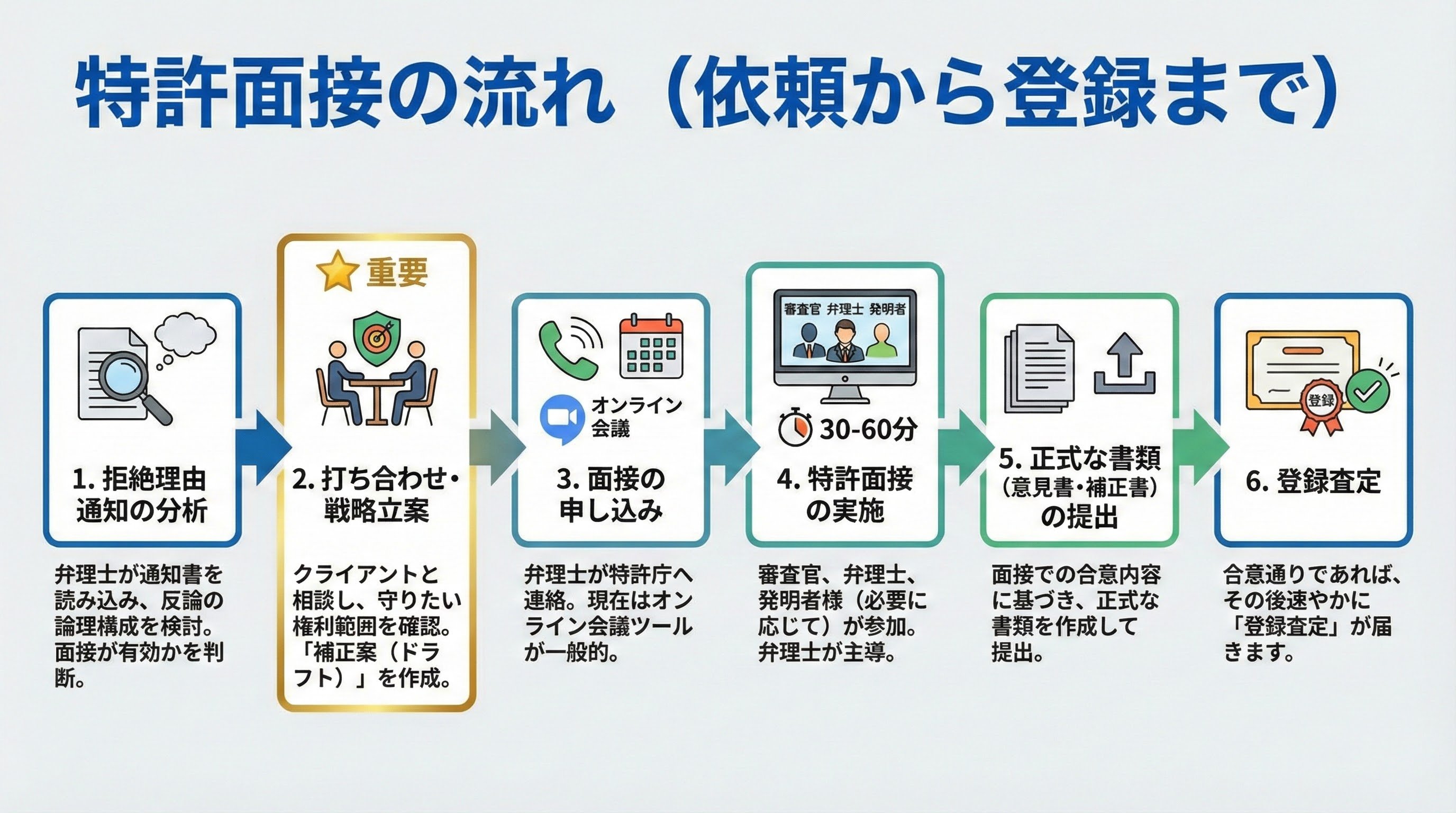
We will introduce the general flow when actually requesting a patent attorney for an interview.
-
[Analysis of notification of reasons for refusal]
A patent attorney will read the notice and consider the logical structure of the counterargument. At this stage, it is decided whether the interview is effective or not.
-
[Meeting/strategy planning]
Consult with the client and confirm the scope of rights they wish to protect. Create an “amendment proposal (draft)”. This is the most important preparation phase.
-
[Application for interview]
A patent attorney will contact the Japan Patent Office and request an interview. Currently, online conferencing tools are commonly specified.
-
[Patent interview conducted]
Examiners, patent attorneys, and, if necessary, inventors will participate. The time required is usually about 30 to 60 minutes. A patent attorney will lead the discussion.
-
[Submission of formal documents (written opinion/amendment)]
Based on the agreement reached during the interview, we will create formal documents and submit them to the Patent Office.
-
[Registration assessment]
If everything is agreed, you will receive a "Registration Assessment" immediately thereafter.
6. Frequently asked questions (FAQ)
Q. How much does it cost?
A. It varies depending on the agency, but in addition to the normal opinion writing fee, there is generally an interview response fee (time charge or fixed fee). However, considering the cost of going back and forth with documents and the risk of losing rights, the total cost-effectiveness can be said to be very high. We will give you a detailed estimate.
Q. Do I need to speak English?
A. Interviews with examiners at the Japanese Patent Office will be conducted in Japanese.
Q. I have not received the reason for rejection yet, can I still have an interview?
A. Basically, the response will be after the notification of reasons for refusal, but in cases of accelerated examination or specific circumstances, technical explanations may be provided before the examination begins. Please contact us first.
Summary: Patent interview is an "offensive" method
A patent interview is not just a "procedure". This is an ``offensive method'' to get the examiner on your side and win better rights.
It's easy to feel depressed when you receive a notice of reasons for refusal, but think of it as ``I got a ticket to talk to the examiner.'' With proper preparation and the support of a patent attorney skilled in negotiation, you can turn a crisis into an opportunity.
At our firm, we have a large number of professionals, including former engineers and experienced patent attorneys, who are well versed in the key points of examination.
If you have a case where you have been told that it is impossible elsewhere, or you really want to get this patent approved, please feel free to contact us. We will directly convey to the examiner the value of your invention that cannot be conveyed in writing alone.
The deadline for responding to a notification of reasons for refusal is fixed. Before it's too late, please use our contact form to request a free consultation. Let's work together to create the strong patent to protect your business.
tag
#Patent interview #Examiner interview #Notice of reasons for refusal #Patent examination #Patent attorney #Intellectual property #Patent application #Online interview #Early acquisition of rights #Patent strategy #For development personnel #Support for small and medium-sized enterprises #Estoppel #Intellectual property consulting #Success case studies

AUTHOR
Takefumi SUGIURA (杉浦 健文)
EVORIX Intellectual Property Law Firm Managing Patent Attorney
Supports clients across IT, manufacturing, startups, fashion, and medical industries, covering patent, trademark, design, and copyright filings through trials and infringement litigation. Specialized in IP strategy for AI, IoT, Web3, and FinTech. Member of the Japan Patent Attorneys Association (JPAA), Asian Patent Attorneys Association (APAA), and Japan Trademark Association (JTA).