.png?width=500&height=250&name=%E7%9F%A5%E7%9A%84%E8%B2%A1%E7%94%A3%E4%BA%8B%E5%8B%99%E6%89%80%E3%82%A8%E3%83%9C%E3%83%AA%E3%82%AF%E3%82%B9%20(500%20%C3%97%20250%20px).png)

.jpg?height=200&name=unnamed%20(2).jpg)
📌 For those reading this article: If you are considering IT patents for software, SaaS, IoT, etc.,...
.jpg?width=1024&height=572&name=unnamed%20(98).jpg)
"A certified copy of the patent decision has arrived. Congratulations!"
Many business owners and intellectual property personnel will be deeply relieved when they receive this message from the patent attorney who represents them. After a long examination period, dealing with notices of reasons for refusal, and an anxious waiting period, this was the moment when our technology was finally recognized by the government.
However, if you stop thinking at this point and immediately decide to just pay the patent fee (registration fee) and get the patent certificate quickly, it may actually be a very dangerous opportunity loss.
This is because the timing immediately after receiving the patent decision is an extremely important strategic opportunity to consider a Divisional Application to protect your business from competitors.
If you miss this timing, you have the right to never get it again.
On the other hand, if you use this system strategically, you will be able to not only ``hold a patent'' but also build a ``strong patent network that your competitors will hate.''
In this article, from the perspective of a patent attorney who is a professional patent attorney, we will explain in more detail than anywhere else the mechanism of filing a divisional application after a patent is granted, its specific merits, criteria for judgment, and the strict deadlines that must be met.
"I have obtained a patent, but can I really beat the competition with this?"
"I want to utilize the rights more greedily"
If you are a business owner or someone in charge of intellectual property, please read this article to the end before transferring the stamp duty.
Table of Contents
- 1. First of all, what is "divisional application after grant of patent"?
- 2. Why is it divided into "after patent grant"? Five strategic benefits
- 3. [Most important] "30 days" and "before payment" rules that you can't miss
- 4. Cost and return on investment (ROI) for divisional applications
- 5. [Case study] Specific situations in which divisional applications "transform"
- 6. Judgment criteria checklist for "to divide or not to divide" taught by a patent attorney
- 7. Frequently asked questions (FAQ)
- 8. Summary: Granting a patent is not the goal, but the starting point for the next strategy
1. First of all, what is "divisional application after grant of patent"?
First, let's organize the basic mechanism.
A divisional application is a procedure in which, when multiple inventions are included in one patent application (parent application), a part of them is extracted and made independent as a new separate patent application (child application).
The biggest feature is that the filing date of the new application goes back to the filing date of the parent application (retroactive effect). In other words, even if you file a new application now, it will be legally treated as having been filed several years ago (the date of the parent application). As a result, there is no need to worry about novelty or inventive step being denied by another company's technology or paper published after the parent application.
Why is this done "after the patent is granted"?
Normally, there may be a strong impression that divisional applications are filed during the examination process, especially when a "notice of reasons for refusal" is received. This is to separate out parts that are difficult to obtain rights for, and to resolve violations of unity (points out that the inventions belong to different groups).
However, Article 44, Paragraph 1, Item 2 of the Patent Law clearly states that a divisional application can be filed within 30 days from the date of delivery of a certified copy of the decision to grant a patent.
The fact that a patent has been granted means that the examiner has already given approval that the patent is acceptable. So why go through the trouble of going through the trouble of filing separate applications?
The reason is to use the following "dual sword" strategy.
- Parent application (protection): First, ensure that a patent right is generated within the scope approved by the examiner.
- Divisional application (aggressive): Aim to obtain rights by continuing to bring patents for parts that could not be obtained in the parent application or inventions from new perspectives to the stage of examination.
In other words, the granting of a patent is not the ``goal'', but can also be ``the starting line for further territorial expansion after securing certain rights''.
2. Why is it divided into "after patent grant"? Five strategic benefits
Large companies with strong intellectual property capabilities and rapidly growing startup companies actively file divisional applications at this timing. There is a clear "management strategic intention" in this.
① Collect "leftovers" in the scope of rights and thicken the defense network
.jpg?width=1024&height=572&name=unnamed%20(97).jpg)
In the field of patent examination, in order to obtain a patent quickly, it is often the case that the scope of rights (claims) is narrowly limited by accepting the points made by the examiner. This is called "reduction correction."
For example, let's say you filed an application for a "chair with a spring," but because there was prior art, the patent was granted for a "chair with a conical coil spring."
In this case, we were able to secure the right to ``Chair with Conical Coil Spring'' as the parent application. However, this alone is not enough to compete with other companies that come out with chairs using leaf springs.
Therefore, after the patent is granted, we will file a divisional application and once again aim to obtain rights for ``chairs with springs (broad concept)'' and ``springs of different shapes (parallel concept).''
- Parent application: Narrow but certain rights (core of defense)
- Child application: Broad but challenging rights (the cornerstone of attack)
This two-stage approach can strengthen the barrier to entry for other companies.
② Maintain "Keep Pending" effect on competitors
.jpg?width=1024&height=572&name=unnamed%20(99).jpg)
Once a patent right is established and registered, the scope of the right is fixed. Competitors analyze published patent publications and create avoidance designs (patent clearance) that say, ``If we remove Constituent Feature A of this claim, there will be no patent infringement.'' In a sense, having a fixed scope of rights gives a sense of security to competitors.
However, what happens if you file a divisional application and leave the "application under examination at the Patent Office"?
Competitors are left in an unstable situation where they do not know what rights will be available in the future.
This is called“maintaining a pending relationship.”
By making other companies think, ``We're fine now, but if a patent covering our product is granted through a divisional application, we might be sued,'' this has the effect of discouraging them from releasing counterfeit products or introducing new products. This "creepyness" is the best defense without any cost.
③ "Pinpoint attack" on competing products
.jpg?width=1024&height=572&name=unnamed%20(100).jpg)
Competitors may release new products during the several years between filing and granting a patent. If the product's specifications are on the edge of the scope of your company's patent rights, it may be difficult to enforce your rights (claim for an injunction or claim compensation for damages) if the parent application remains unchanged.
This is where divisional applications come into play.
We will file a child application with the claims rewritten to match the product specifications of our competitors, within the scope of the matters stated in the specification of the parent application.
In industry terminology, this is called “applied splitting”.
If you can establish the right to pinpoint the other party's products in a game of rock-paper-scissors, you will be in an overwhelmingly advantageous position in licensing negotiations and litigation.
④ Acquisition of rights in different categories (multifaceted protection)
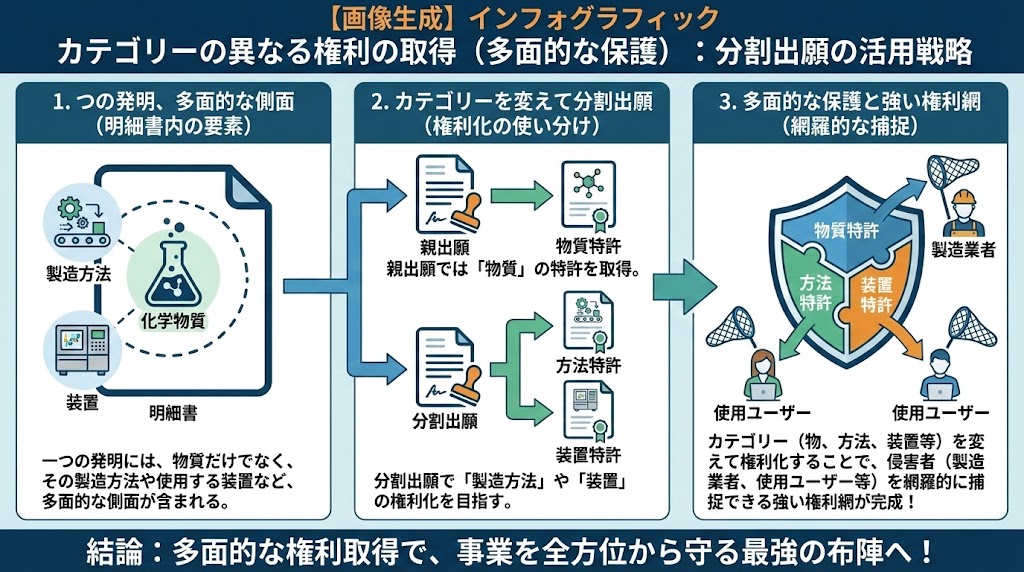
One invention has multiple aspects.
For example, suppose a patent has been granted for a certain chemical substance. However, suppose that the specification also includes a description of the "manufacturing method" of the substance and the "device" that uses the substance.
The parent application aims to obtain a patent for the "substance," and the divisional application aims to obtain a patent for the "manufacturing method."
In this way, by changing categories (products, methods, programs, etc.) and acquiring rights, a strong rights network is created that can comprehensively catch infringers (whether they are manufacturers or users).
⑤ Consistency with global strategy (US continuing application)
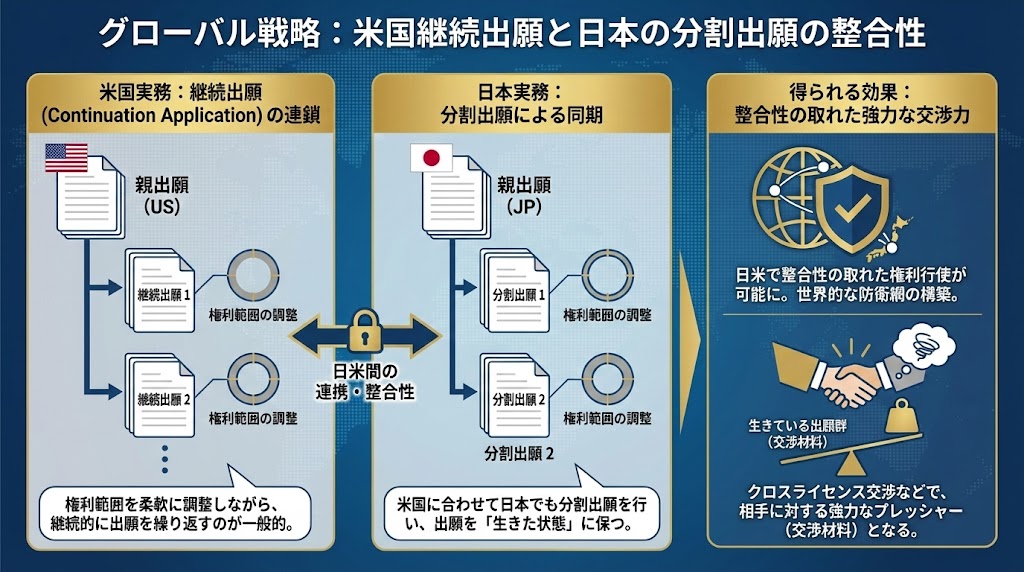
If your company has also filed an application in the United States, it is common practice in the United States to adjust the scope of rights by repeating "Continuation Applications."
By filing a divisional application in Japan as well, it will be possible to exercise rights consistently in Japan and the US. In addition, maintaining a "living application" for the entire patent family provides pressure (bargaining material) on the other party in cross-license negotiations, etc.
3. [Most important] ``30 days'' and ``before payment'' rules that cannot be mistaken
There are strict time limits stipulated by law for filing divisional applications after a patent is granted. If even one day passes this point, no matter how good your strategy is, it will be impossible to implement.
Strictly adhere to "within 30 days"
Legally, divisional applications can be filed during the following periods.
Within 30 days from the date of delivery of a certified copy of the grant of patent
The "date of delivery of certified copy" usually refers to the date on which the patent attorney (representative) receives the patent decision online or by mail. It's been 30 days since then. Considering the time required for internal approval and consideration, there is almost no grace period.
(*In exceptional cases, you may be able to request an extension, but as it is costly and time-consuming, in principle it should be considered within 30 days.)
Special note: Relationship with patent fee payment
This is the biggest pitfall.
Even if it is within 30 days, if you first pay the patent fee (registration fee) and register the establishment of the patent right, you will no longer be able to file a divisional application at that point.
A common failure example is the case where
``The president rushed to make the decision, and the accountant immediately transferred the registration fee.The next day, the intellectual property department realized the need for a split, but it was already too late.''
The moment you pay the patent fee, there is an extremely high risk that you will be deemed to have waived your right to file a divisional application. Once paid, it cannot be canceled.
For this reason, we as patent attorneys follow the following flow as a golden rule.
- A patent decision is received.
- First, consider whether or not to file a divisional application.
- When filing a divisional application, first go through the divisional application procedures.
- After confirming that the procedure is complete, pay the patent fee for the parent application.
4. Cost and return on investment (ROI) for divisional applications
Of course, there will be costs involved in filing a divisional application.
- Stamp fee to the Japan Patent Office (application fee + examination request fee)
- Patent attorney fees (divisional application fee + intermediate processing fee, etc.)
In particular, the examination request fee varies depending on the number of claims, so the total cost can be in the hundreds of thousands of yen.
It's natural to wonder, "Is it worth paying that much to get another patent?"
However, think about it from the following perspective.
1. As an "insurance premium" to protect your business
If you skimp on filing a divisional application and a competitor creates a similar product that is "outside the scope of the parent patent's rights" and loses 30% of your market share, how much will the damage be? If the loss is millions or tens of millions of yen, the application fee of several hundred thousand yen is an extremely low "insurance premium."
2. It is OK to request an examination "later"
Just because you have filed a divisional application, there is no need to immediately request examination (pay expensive stamp fees).
You can choose when to request an inspection within three years from the filing date of the parent application (or within 30 days from the date of division).
It is also effective to file only a divisional application first (only the application fee will be charged), and to wait until the last minute of the examination request deadline. If your business doesn't grow during that time, you can simply withdraw it, and if a competitor appears, you can file a request for review and fight.
5. [Case study] Specific situations in which a divisional application "transforms"
Let's look at how it is useful in concrete business situations, rather than just an abstract explanation.
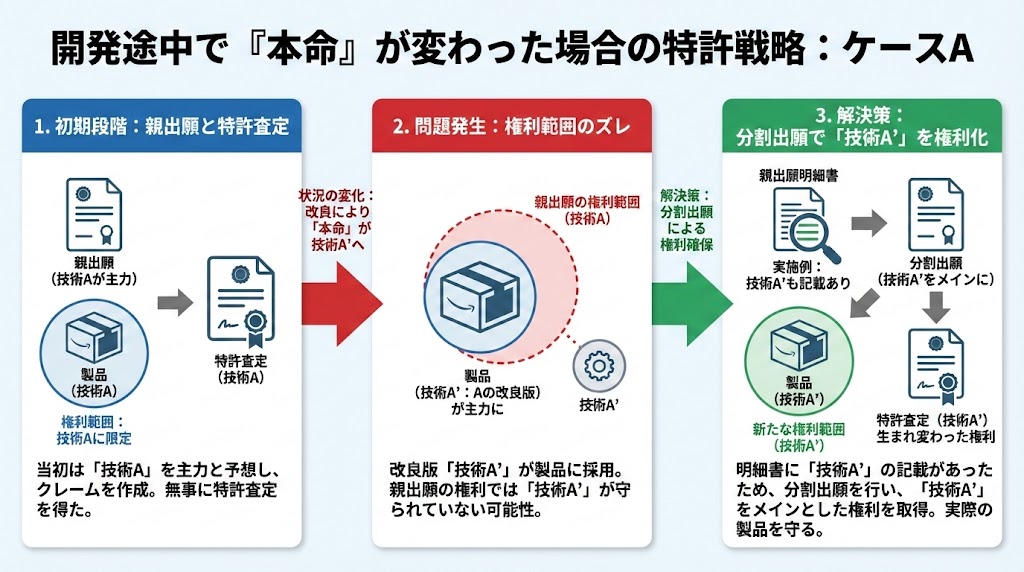
Case A: When the "favorite" changes during development
Situation: At the beginning of the application, we wrote the claims expecting that "Technology A" would be the mainstay, and obtained a patent grant. However, with subsequent improvements, "Technology A' (an improved version of A)" was adopted in the product.
Problem: The scope of rights in the parent application is limited to “Technology A,” and the current main product “Technology A’” may not be protected.
Solution: Since elements of "Technology A'" were also described in the specification (as an example), a divisional application was filed and the aim was to obtain rights mainly based on "Technology A'." This ensures the right to protect the actual product.
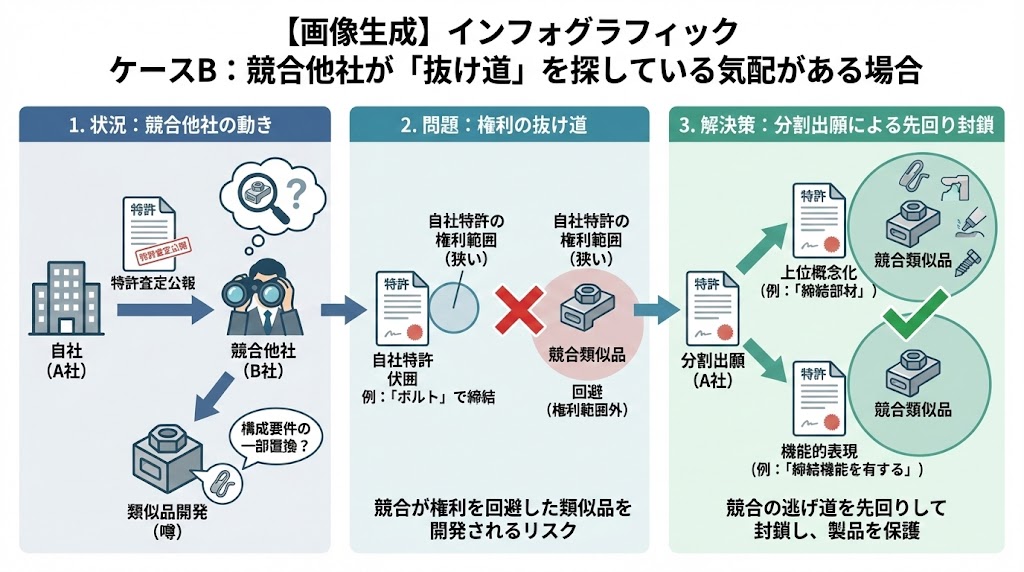
Case B: If there are signs that your competitors are looking for a "loophole"
Situation: After looking at your company's patent grant announcement, you heard rumors that a competitor was developing a similar product with some of the constituent elements replaced.
Solution: File a divisional application immediately. At that time, create claims that conceptualize components that are likely to be replaced by competitors (e.g., "bolts" → "fastening members") or claims that use functional expressions to proactively block potential escape routes for competitors.
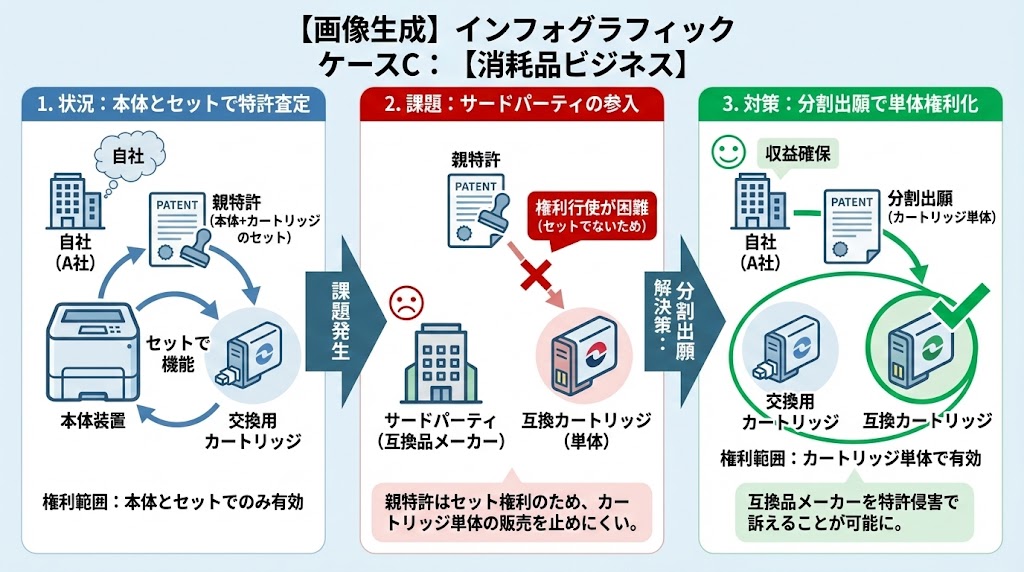
Case C: [Consumables business]
Status: Granted a patent for a set of main unit and replacement cartridge.
Challenge: Third parties have started selling cheap "compatible cartridges". Since the parent patent is a right that comes as a set with the main body, it is difficult to stop selling the cartridge alone.
Countermeasures: File a divisional application and aim to obtain rights for the "cartridge alone." This makes it possible to sue manufacturers of compatible products for patent infringement.
6. Judgment criteria checklist for "to divide or not to divide" taught by a patent attorney
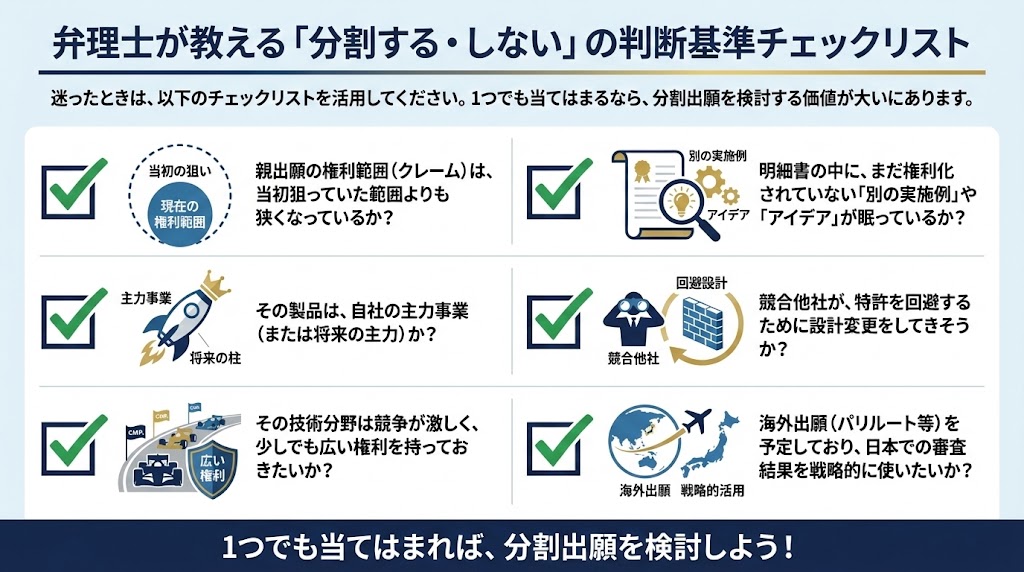
When in doubt, please use the checklist below. If any of these apply to you, it is well worth considering a divisional application.
- ✔ Is the scope of rights (claims) of the parent application narrower than the originally intended scope?
- ✔ Are there "another embodiments" or "ideas" that have not yet been patented in the specification?
- ✔ Is the product your main business (or future mainstay)?
- ✔ Is a competitor likely to change the design to get around the patent?
- ✔ Competition is fierce in that technical field, so do you want to have as much rights as possible?
- ✔ Are you planning to apply overseas (Paris route, etc.) and want to strategically use the examination results in Japan?
7. Frequently asked questions (FAQ)
Q. Will filing a divisional application delay the registration of the parent application? A. No, I won't be late. As for the parent application, if you pay the registration fee as usual, the patent right will be granted immediately. The parent application (registered) and divisional application (under examination) exist independently.
Q. How many times can I file a divisional application?
A. In principle, there is no limit to the number of times. It is also possible to further divide a divisional application (grandchild application). In fact, some companies continue to apply for important basic patents with their grandchildren and great-grandchildren, leaving them pending for nearly 10 years.
Q. Can I complete the procedure myself? A. Although it is technically possible, we do not recommend it. The requirements for divisional applications (such as being within the scope of the specification, not being identical to the parent application, etc.) are very specialized, and failure to do so will not only result in rejection, but will also result in wasted costs. Additionally, there is a high risk of managing deadlines, so it is safe to leave this to a professional.
Q. If I request a divisional application, by when should I contact you? A. Ideally, you should contact us within two weeks of receiving the patent decision. Physically, there is a grace period of 30 days, but it takes time to prepare the documents for a divisional application (amend the specification and reconstruct the claims). There is a risk that sufficient consideration may not be possible if the deadline is at the last minute.
8. Summary: Granting a patent is not the goal, but the starting point for the next strategy
To everyone who received a notice of patent decision.
First of all, let's be happy that the invention has been officially recognized.
However, before you stop thinking and transfer the stamp fee, please stop and think about it just once.
"Can you really compete with your competitors for the next 10 years with just this patent?"
"Isn't there a treasure trove hidden in your statement that you can still use?"
"Don't you want to have another card that will make your competitors think you don't like it?"
A divisional application after a patent is granted is your last chance to maximize your intellectual property.
How you use these 30 days will greatly affect your future business competitiveness.
At our office, we provide total support for planning strategies for divisional applications after a patent is granted, diagnosing the merits and demerits, and expediting application procedures.
We also welcome inquiries such as ``I want to know whether it makes sense to split the cost in my case'' or ``I would like an estimate of the cost-effectiveness.''
Since the deadline is often approaching, please contact us as soon as possible before paying the registration fee when you receive the notice of decision to grant a patent.
Let's work together to build a "strong intellectual property network" that will protect your business.
Inquiry/Consultation
If you are worried about the strategy after the patent is granted, please contact us as soon as possible before the deadline approaches.
(*It will be smoother if you have the notice of patent examination ready at hand before contacting us)
#Patent assessment #Divisional application #Intellectual property strategy #Patent application #Patent attorney #Patent office #Intellectual property rights #Small and medium-sized enterprises #Start-up #Patent utilization #Competitive measures #Patent deadline #Notice of reasons for refusal #Certification of rights #Patent network #Patent portfolio #Patent fee payment

AUTHOR
Takefumi SUGIURA (杉浦 健文)
EVORIX Intellectual Property Law Firm Managing Patent Attorney
Supports clients across IT, manufacturing, startups, fashion, and medical industries, covering patent, trademark, design, and copyright filings through trials and infringement litigation. Specialized in IP strategy for AI, IoT, Web3, and FinTech. Member of the Japan Patent Attorneys Association (JPAA), Asian Patent Attorneys Association (APAA), and Japan Trademark Association (JTA).
.jpg?height=200&name=unnamed%20(5).jpg)