.png?width=500&height=250&name=%E7%9F%A5%E7%9A%84%E8%B2%A1%E7%94%A3%E4%BA%8B%E5%8B%99%E6%89%80%E3%82%A8%E3%83%9C%E3%83%AA%E3%82%AF%E3%82%B9%20(500%20%C3%97%20250%20px).png)

.jpg?height=200&name=Gemini_Generated_Image_i9fiqai9fiqai9fi%20(1).jpg)
📌 To those reading this article: Please also take a look at IT Intellectual Property Portal, which...
.jpg?width=1024&height=572&name=unnamed%20(92).jpg)
Railroads have now gone far beyond being a mere means of transportation and have established themselves as powerful content.
Operation of luxury cruise trains, collaboration with anime works, development of commercial facilities inside stations, and sales of a wide variety of goods for avid fan base. Did you know that underlying all of these business activities is an intellectual property called Trademark?
For railway operators, related manufacturers, or local governments considering regional revitalization using railways, trademark strategy is both a "shield" to protect their brand, and at the same time an "offensive" weapon to generate licensing income.
However, if you neglect to properly protect your rights, there is a hidden risk that your brand may be imitated by a third party, or that you may unknowingly infringe on the rights of another company.
In this article, we will thoroughly explain the importance of trademarks in railway business from the perspective of a patent attorney.
We have covered everything from vehicle naming to the pitfalls of ``classification'', the possibility of registering station names, and even the latest trends such as the Metaverse, to safely and maximally accelerate your business.
Table of Contents
- 1. The railway business is a mass of "intellectual property"
- 2. The trap of "classification" that goods producers and sellers fall into
- 3. Who does the station name belong to? “Discernment” barriers and exceptions
- 4. "Trademark use" and "descriptive use" that creators should be aware of
- 5. How license agreements work to make your business successful
- 6. Metaverse/NFT and the future of railway trademarks
- 7. Benefits of hiring a patent attorney ~To protect your railway business~
Chapter 1: Railway business is a mass of "intellectual property"
First, let's clarify what railway-related things are protected as trademarks.
Many people think of vehicle names and company logos, but in reality, rights cover a much wider area.
1. Train nickname (naming)
This is the most representative trademark asset. Train nicknames such as ``Nozomi'', ``Hayabusa'', ``Romance Car'', and ``Shimakaze'' are strongly protected as the face of the railway company.
Passengers choose a service by specifying the name of the train itself, such as ``I want to ride Romance Car,'' rather than just knowing ``〇〇 Dentetsu Limited Express.'' This means that the train name has become a "brand" that has the power to attract customers.
💡 Point
Once it has been decided that a new rolling stock or sightseeing train will be introduced, it is essential to promptly apply for a trademark for the name.
2. House mark/symbol mark
The "JR mark" of JR companies and the company emblems and symbol marks of private railway companies are also trademarks. These trademarks are registered as graphic trademarks and are used not only on station signboards and vehicle bodies, but also on ticket backgrounds, uniform patches, websites, and other places to indicate the ``indication of origin'' (which company).
3. Sound trademark (sound logo)
With the revision of the Trademark Law in 2015, "sound" can now be registered in Japan. The railroad industry was sensitive to this move.
For example, ``departure melodies'' that symbolize a particular railway company, ``in-train chimes'' of limited express trains, or ``music horns'' are registered trademarks.
Audible branding that says, ``When I hear that melody, I remember that railway company,'' is one of the advanced strategies to increase customer loyalty.
4. Color-only trademark
Certain color combinations (such as vehicle line colors) can also be trademarked.
However, in Japan, the registration hurdle for "color only" is extremely high, and it is necessary that "the color be widely recognized by the public as belonging to the company through long-term use (distinctiveness through use)." Although there are only a few registered examples at present, it will become increasingly important in the future as a means to exclusively protect a company's corporate color and vehicle color scheme.
Chapter 2: The "classification" trap that goods producers and sellers fall into
The following are extremely practical points to note for companies and individual business owners who wish to manufacture and sell railway goods.
Registering trademark rights does not give you exclusive rights in all fields. You need to specify in which field (category) you want to use it. This is called“classification”.
1. "Class 39 (Transportation)" alone cannot protect it
When a railway company acquires a trademark for its main business, it first specifies ``Class 39 (Transportation by railway)''. This will prevent other companies from running a railway under the same name without permission.
However, it may be difficult to stop unauthorized sales of "railway goods" with this alone. This is because goods are not "transportation services."
2. Essential classification for railway goods business
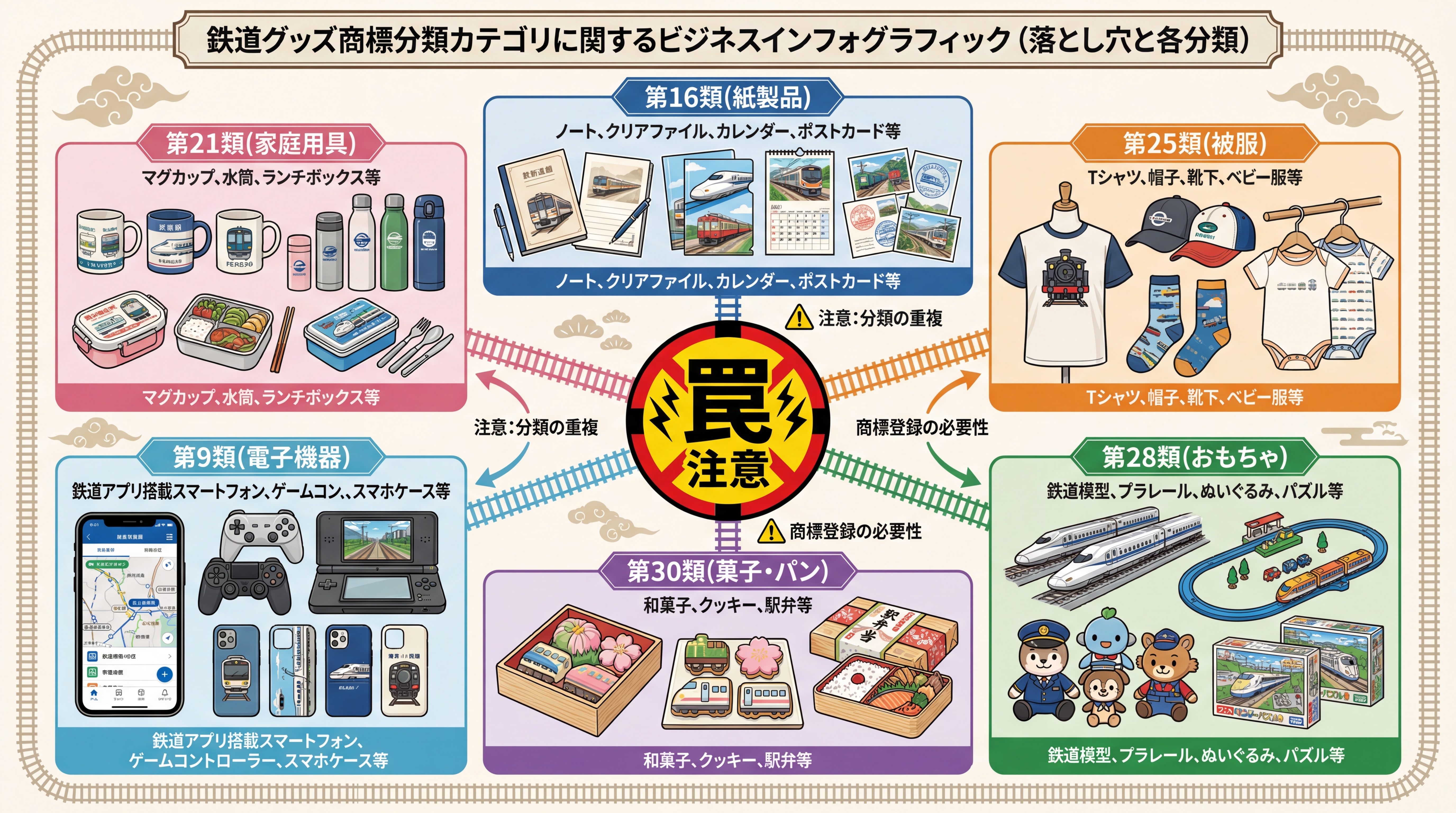
In order to prevent brand damage or to conduct their own licensing business, most railway companies register trademarks for major train names, including the classification of peripheral businesses. Conversely, those selling goods need to check whether trademark rights have been taken in the following categories.
- Category 16 (Paper products):
Notes, clear files, calendars, postcards, timetables, etc. It is a mainstay of low-priced products that are most likely to be sold at station kiosks and events. - Category 25 (Clothing):
T-shirts, hats, socks (such as iron bottoms), baby clothes. We cover a wide range of apparel from children to adults. - Category 28 (Toys):
Railway models such as Plarail and N gauge, stuffed animals, games, puzzles, etc. Railway toys are extremely important because the market size is large and the risk of counterfeiting is high. - Category 30 (Sweets/Bread):
Souvenirs such as steamed buns, cookies, sables, and ekiben named after station or train names. - Category 9 (Electronic devices):
Railway simulator games, smartphone apps, smartphone cases, electronic publications, etc. - Class 21 (Household Utensils):
Mugs, water bottles, lunch boxes, chopsticks, etc.
3. Common mistakes
For example, suppose a business wants to sell cookies named "〇〇 Express."
``Railway companies' job is to transport goods (Class 39), so if it's sweets (Class 30), they probably don't care.''
It's extremely dangerous to think this way.
If the name is registered as a "Class 30" trademark, using it without permission is a trademark infringement, and there is a risk of being required to recall or dispose of the product or claim compensation for damages.
Trademark investigation (clearance investigation) at the planning stage is a lifeline for ensuring business safety.
Chapter 3: Who owns the station name? “Discernment” walls and exceptions
"I would like to use the name of a local station as a product name. Can I register it?"
We often receive inquiries like this, but there are unique difficulties in registering station names as trademarks. Here, we will explain the barrier of "distinctiveness (special salience)" in trademark law.
Principle: Place names cannot be registered
Article 3, Paragraph 1, Item 3 of the Trademark Act states that "a mark that indicates the place of origin, place of sale, quality, etc. of a product in a commonly used manner" cannot be registered. This also includes common "place names."
For example, names such as "Tokyo Station," "Shinjuku Station," and "Osaka Station" are just "place names + stations" and are words that everyone wants to use. Since a trademark should not be monopolized by one company, registration as a word trademark is generally not allowed.
Exceptionally registered case
However, not all station names cannot be registered. The possibility of registration opens up in the following cases:
- If it is a coined word or a unique name
For example, if the name is unique and goes beyond a mere place name, such as "Takanawa Gateway," it will be more likely to be judged as having distinctiveness and increase the possibility of registration. - When combined with a logo mark
Although it may be difficult to combine text with a logo mark by itself, there are cases where the entire design can be registered if it is combined with a distinctively designed logo mark. - Relationship with designated products
Although it is difficult to use the name "Tokyo Station" as a product name for "real estate" or "transportation," it may be possible to register it as a product name for "sweets (class 30)." This is because there is no such thing as a "Tokyo Station" type of sweets, but rather it functions as a brand name.
Use of regional collective trademarks
A powerful weapon for local railways and local governments is the Regional Collective Trademark.
For example, by registering a regional brand product that bears the name "〇〇Tetsuko" (for example, ``Soba along the 〇〇 Line, etc.) as a regional collective trademark, it is possible to eliminate counterfeit products and raise the brand power of the entire region.
Is your company's railway business and rights secure?
From confirming the naming of new products to negotiating complex licensing agreements.
Railway intellectual property professionals will support you.
Chapter 4: "Trademark use" and "descriptive use" that creators should be aware of
``I want to make and sell T-shirts using railway photos I took myself.''
``I want to put the vehicle name on the model train package.''
In such cases, where is safe and where is out? What is important here is the difference between"trademark use" and "descriptive use"in trademark law.
1. What is "trademark use" (high possibility of being out)
Trademark infringement occurs when a trademark is used as a mark (source indication function) to distinguish one's own products from those of other companies.
For example, printing a large "〇〇 line" in a logo style on the chest of a T-shirt, or writing "Limited Express △△ Cookie" in large letters as the product name on the package.
If a consumer sees this and misunderstands it by thinking, ``Ah, this is official goods of 〇〇 Electric Railway,'' there is an extremely high risk of trademark infringement.
2. What is "descriptive use" (possibly safe)
On the other hand, Article 26 of the Trademark Law stipulates that trademark rights do not apply to cases where a trademark is used to describe the content of a product.
For example, on the back of a train model package, there may be a small statement that says, ``This product is a model that reproduces a train on the JR 〇〇 line.'' This is just a description to explain ``what's inside the model'' and is not used as a brand name, so it is generally considered not to be a trademark infringement.
3. Photo copyright and trademark rights
Even if you say, ``I drew the illustration myself, so I own the copyright,'' if the illustration is a copy of a railway company's logo, or if the registered train name is prominently displayed as a product name, there is still a risk of trademark infringement.
In particular, "designs that mislead people into thinking that they are official" may be considered a violation of the Unfair Competition Prevention Act. We recommend that you consult a professional rather than making your own decisions.
Chapter 5: How license agreements work to make your business successful
If you want to develop your railway goods business safely and on a large scale, the most recommended option is a license agreement (commercialization license) with a railway company.
Benefits of license agreement
By signing a contract with a railway company (or a trading company in its group) and paying royalties (usage fees), you will receive the following benefits:
- Zero risk of trademark infringement:
Legal safety is ensured, so you can focus on your business without fear of inventory disposal or the risk of compensation. - "Official/official" certification:
You can affix a stamp (such as a hologram sticker) that says "〇〇 Electric Railway Approved" to the product. Railway fans tend to prefer products that officially cost money, so this is a strong purchasing motive. - Design supervision (supervision):
Since the railway company checks the design, the quality of details that fans care about, such as vehicle details and logo colors, is guaranteed.
The role of a patent attorney
Small and medium-sized businesses and sole proprietors may find it difficult to enter into a licensing agreement with a major railway company.
Patent attorneys don't just file trademark applications; they also provide support for intellectual property contracts. There are many cases where discussions proceed more smoothly when an expert intervenes, such as when conducting legal checks on contracts and negotiating the scope of use.
Chapter 6: Metaverse/NFT and the future of railroad trademarks
A recent trend that cannot be overlooked is the use of railway content in the metaverse (virtual space) and NFT (non-fungible tokens).
There are increasing cases of running trains in virtual space and selling railway uniforms as digital items for avatars.
The question here is, "Do trademark rights for real products extend to virtual products?"
For example, there is an ongoing legal debate as to whether trademark rights in Class 25 (Clothing) can prohibit the use of "digital clothing" worn by avatars on the Metaverse.
As a result, advanced companies are filing additional trademark applications for Class 9 (computer programs, etc.) and Metaverse-related services. If you are considering business development in the digital domain, it is essential to consult a patent attorney who is familiar with the latest intellectual property trends.
Chapter 7: Benefits of hiring a patent attorney ~To protect your railway business~
Trademark registration and resolution of intellectual property problems related to railways are highly specialized fields. Hiring a patent attorney has the following benefits:
① Highly accurate preliminary investigation (clearance investigation)
Even if you think, ``I thought of a cool train name!'' or ``I want to make this goods!'', another company may have already registered a similar name.
Patent attorneys make full use of the Patent Office's database to carefully investigate whether there are any similar trademarks and how likely they are to be registered. This avoids rework after deciding on a name, and the worst risk of receiving a warning letter after release.
② Strategic category selection (creation of application form)
As mentioned above, the railway business encompasses not only "transportation" but also "goods," "events," "IT," and so on.
We will select the most suitable classification to protect your current and future business according to your budget, and support you in acquiring rights without loopholes. In particular, the experience of professionals is important when it comes to selecting "Category XX" products in anticipation of product development.
③ Response to reasons for refusal
Even if you receive a notice from the Japan Patent Office stating that "this name cannot be registered (notice of reasons for refusal)", it is too early to give up.
In particular, in the case of trademarks that include station names or place names, there are many cases in which registration can be won by making legal arguments (written opinions) such as ``the trademark has distinctiveness'' or ``the trademark is dissimilar to previous trademarks.'' This is a demonstration of the skills of patent attorneys who are intellectual property professionals.
Conclusion: Turn risk into a "ticket" for a safe business trip
Railroads carry the dreams and memories of many people. Names and logos that embody these feelings are intangible assets with immeasurable economic value.
Trademark registration is not just for "monopolizing rights."
- “To develop business with peace of mind”
- “To ensure brand reliability and not let down our fans”
- "To protect brand image from counterfeit and inferior products"
This is an investment in the future.
At our office, we provide a wide range of services, from building intellectual property strategies for railway operators to trademark research and applications for companies considering selling goods, and even support for licensing agreements.
Click here for inquiries regarding intellectual property
"I want to consult about the naming of new rolling stock" "I want to make railway goods, but I'm worried about rights" "I'm thinking about using railways in the Metaverse"
If you have any of these concerns, please consult a patent attorney who is an intellectual property expert.

AUTHOR
Takefumi SUGIURA (杉浦 健文)
EVORIX Intellectual Property Law Firm Managing Patent Attorney
Supports clients across IT, manufacturing, startups, fashion, and medical industries, covering patent, trademark, design, and copyright filings through trials and infringement litigation. Specialized in IP strategy for AI, IoT, Web3, and FinTech. Member of the Japan Patent Attorneys Association (JPAA), Asian Patent Attorneys Association (APAA), and Japan Trademark Association (JTA).