.png?width=500&height=250&name=%E7%9F%A5%E7%9A%84%E8%B2%A1%E7%94%A3%E4%BA%8B%E5%8B%99%E6%89%80%E3%82%A8%E3%83%9C%E3%83%AA%E3%82%AF%E3%82%B9%20(500%20%C3%97%20250%20px).png)

📌 For those reading this article: If you are considering IT patents for software, SaaS, IoT, etc.,...
📌 To those reading this article: Please also take a look at IT Intellectual Property Portal, which provides one-stop support for patents, trademarks, and copyrights for IT companies.
Introduction
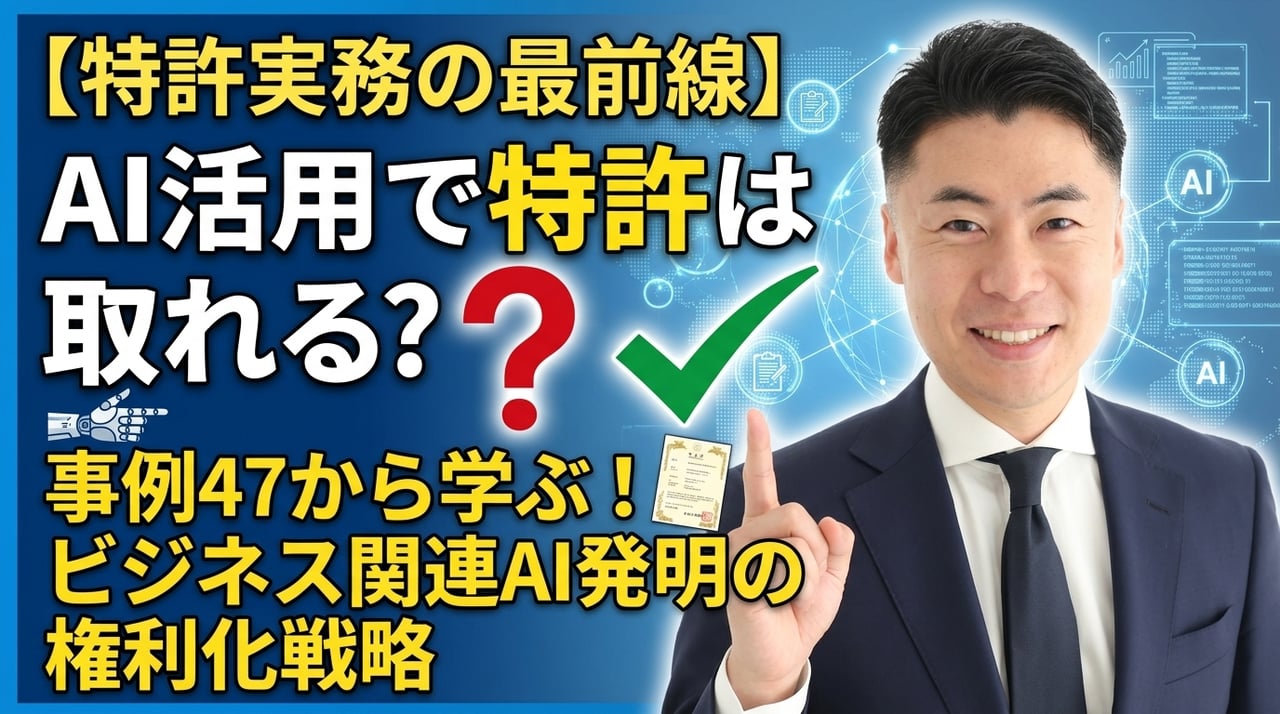
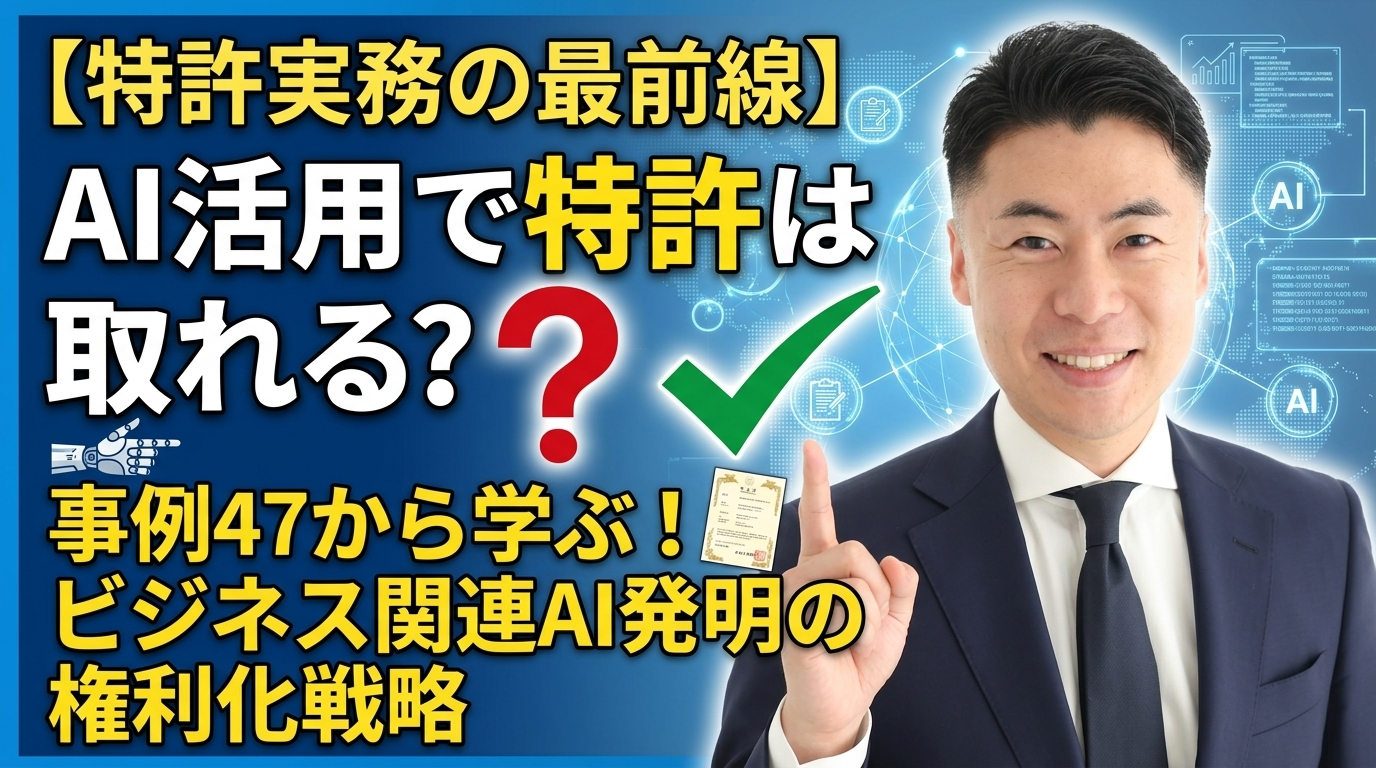
``I want to develop a business prediction tool that utilizes AI, but will this be patentable?'' and ``What requirements are required to obtain a patent for business-related AI technology?'' These are questions that many companies have been asking in recent years.
As the use of AI in the business field accelerates, the need for patent protection is also increasing, but business-related inventions and AI-related inventions have traditionally been considered to have high hurdles to patenting. In particular, it has been difficult to meet descriptive requirements such as enablement requirements and support requirements, and there is a history of many applications being rejected.
In this article, we will analyze in detail Case 47 "Business Planning Support Device" included in the examination handbook of the Japan Patent Office, and explain the specific points for business-related AI inventions to be recognized as patents. This case is an example of a business planning support device that utilizes AI that was determined to meet the description requirements, and is extremely useful for companies and developers aiming to obtain patents in similar technical fields.
1. Overview of case 47 “Business planning support device”
1.1 Scope of claims
Case 47 shows the following claims.
[Claim 1]
Means for storing the inventory amount of a specific product;
Means for receiving advertising activity data and mention data on the web for the specific product;
using a predictive model learned by machine learning using the advertising activity data and mention data on the web regarding similar products sold in the past and the number of sales of the similar products as training data; A business plan support device comprising: means for simulating and outputting the future sales volume of the specific product predicted from advertising activity data and mention data; means for formulating a production plan including the future production volume of the specific product based on the stored inventory amount and the output sales number;
 means for outputting the output sales volume and the formulated production plan.
1.2 Points of detailed explanation of the invention
In the detailed explanation of the invention, the background and problems of the present invention are that, with the spread of the Internet, advertising activities on the web have become an effective means of promoting product sales, but it is difficult to judge the effectiveness of actual advertising activities in real time, and it is shown that there is a risk of missing business opportunities due to lack of inventory due to trial and error.
In order to solve this problem, the present invention aims to provide a business planning support device that estimates the predicted future sales volume of a specific product from advertising activity data and reference data, and presents a production plan including future production volume based on the predicted inventory volume and sales volume.
The following data and functions are described as components of the present invention:
- Advertising activity data: Number of times a specific product is exposed to advertisements on the web (banner advertisements, listing advertisements, email advertisements, etc.)
- Mention data: Evaluation of the product or advertisement in articles on the web, SNS, blogs, etc.
- Prediction model: Generated by supervised machine learning that uses well-known machine learning algorithms such as neural networks to learn the relationship between advertising activity data and mention data regarding similar products sold in the past and actual sales numbers of the similar products as training data
- Production planning: If the number of sales exceeds the inventory amount, a production plan is created to increase the production amount of the product, and if the number of sales is less than the inventory amount, a production plan is created to reduce the production amount of the product.
1.3 Examination results
It should be noted that for claim 1 of Case 47, no reason for refusal was notified for violation of description requirements (violation of enablement requirements/violation of support requirements). In other words, it is shown as an example that satisfies the stated conditions.
2. Key points of examination of case 47 - Determination of description requirements
Let's analyze in detail the reason why Case 47 was determined to meet the description requirements.
2.1 Determining feasibility requirements
The enablement requirement (Article 36, Paragraph 4, Item 1 of the Patent Act) asks whether the description is clear and sufficient to the extent that a person skilled in the art can carry out the invention. Case 47 emphasizes the following points:
-
Clear identification of input and output data:
- The input data specifically includes ``number of advertisement exposures on the web'' and ``evaluation values in articles on the web, SNS, blogs, etc.''
- "Number of sales" is clearly specified as output data
-
Existence of correlation between data:
- Although the detailed description of the invention does not describe a specific correlation between input data and output data, it can be inferred that a correlation exists between them in view of the common general knowledge at the time of filing
- The assumption is that there is a correlation between advertising activity data and subsequent sales, which is widely recognized in business practice.
-
Clear description of machine learning technology:
- It is stated that "well-known machine learning algorithms such as neural networks" are used
- Specific description of supervised learning method
The review handbook's explanation states:
It is well known at the time of filing that it is possible to generate a predictive model that estimates the output corresponding to the input by performing machine learning using a general machine learning algorithm using input data and output data that have a correlation, etc. as training data.
This indicates that since the machine learning technology itself is well known, a detailed explanation is not necessary, and that it can be implemented by a person skilled in the art if a correlation can be inferred between input and output data.
2.2 Determining support requirements
The support requirement (Article 36, Paragraph 6, Item 1 of the Patent Act) asks whether the claimed invention is stated in the detailed description of the invention. In Case 47, it is determined that the invention of claim 1 satisfies the support requirements from the following points:
-
Specific description of problem-solving methods:
- It clearly describes the problem-solving method of predicting future sales of a specific product from advertising activity data and reference data, and presenting a production plan based on the predicted inventory and sales numbers.
-
Specificity of Examples:
- Examples are specifically described, including input data (advertisement activity data, mention data), output data (sales forecast), prediction model generation method, production plan formulation method, etc.
-
Reasonable predictability of effect:
- The effect of predicting the number of sales from advertising activity data and mention data and formulating a production plan based on comparison with inventory quantity is reasonably foreseeable by a person skilled in the art
3. Case 47 and key points for obtaining patents for business-related AI inventions
From the analysis of case 47, let's summarize the important points in obtaining patents for business-related AI inventions.
3.1 Clarification of the correlation between input and output data
The most important thing in business-related AI inventions is to clarify the correlation between input data and output data. In Case 47, it is accepted as technical knowledge that there is a correlation between advertising activity data/mention data and sales numbers.
However, if it is not accepted as common technical knowledge, the following actions are required:
-
Specific explanation of correlation:
- Describe statistical data and analysis results showing correlation between data in the statement
- Support the correlation through specific examples and experimental results
-
Rationale for correlation:
- Explain the rationale for why such data may be correlated
- Cite and support industry knowledge and academic research
3.2 Appropriate description level of AI model
If the AI model itself is not the essence of the invention, a detailed explanation of it is not necessarily necessary. In Case 47, it is sufficient to state "well-known machine learning algorithms such as neural networks."
However, please note the following:
-
When the AI model is the essence of the invention:
- If the structure or learning method of the AI model is the essence of the invention, a more detailed explanation is required
- For example, if special learning methods or loss functions are used, the details should be described
-
When using unknown technology:
- When using new AI technology that is not well known, it must be described in detail to the extent that a person skilled in the art can implement it
3.3 Balancing business and technical effects
For business-related inventions, it is important to demonstrate not only business effects but also technical effects. Case 47 has both the following effects:
-
Business impact:
- Preventing the risk of losing business opportunities due to insufficient inventory etc.
- It is possible for sellers of specific products to review product production plans at an early stage
-
Technical effect:
- Achieving highly accurate sales predictions using machine learning using advertising activity data and mention data on the web as input
- Eliminate variations in human judgment through systemization
In this way, by clarifying the structure in which a business problem is solved by technical means, patentability increases.
4. Differences between case 47 and the contrasting rejection case
While Case 47 was determined to satisfy the description requirements, there are also cases in which similar AI-related inventions violate the description requirements. Let's take a look at the differences by comparing it with other cases in the Examination Handbook.
4.1 Comparison with case 46 “Sugar content estimation system”
Case 46 "Sugar content estimation system" is a system that uses machine learning to predict the relationship between a person's face image and the sugar content of vegetables grown by that person, but it is considered to be in violation of the enablement requirements.
Reasons why case 46 was rejected:
- It is not accepted as common technical knowledge that there is a correlation between a person's face image and the sugar content of vegetables, and no specific correlation is shown in the detailed description of the invention.
- Performance evaluation results of the actually generated judgment model are also not shown
Differences from case 47:
- In Case 47, it is accepted as common knowledge that there is a correlation between advertising activity data and sales
- In the business field, the relationship between advertising and sales is supported by many studies and practices
4.2 Comparison with case 49 “Weight estimation system”
Claim 1 of Case 49, "Weight Estimation System," is a system that estimates a person's weight from their height and features representing the shape of their face, but it is considered to be in violation of support requirements.
Reasons why case 49 was rejected:
- Claim 1 broadly describes "features representing the shape of the face," but the detailed description of the invention supports only the specific feature "face line angle."
- It is not accepted as common knowledge that there is a correlation between facial shape characteristics and weight
Differences from case 47:
- In Case 47, the input data is specifically identified as "advertising activity data" and "mention data"
- The correlation between these data and sales is accepted as technical common sense
5. Practical points for meeting the description requirements for business-related AI inventions
Based on the analysis of case 47, we will summarize practical points for satisfying the description requirements in patent applications for business-related AI inventions.
5.1 Points for creating statements
-
Clarify the technical aspects of the problem:
- Describe it as a technical issue in information processing, not just a business issue
- For example, emphasize the technical problem that "real-time judgment is difficult"
-
Specifically identify input/output data:
- Clearly describe the specific content and format of input and output data
- Show specific examples and numerical ranges whenever possible
-
Explain correlations between data:
- If it is not accepted as common technical knowledge, provide data and analysis results that support the correlation
- Explain the rationale for why such data may be correlated
-
Clarify how to use AI technology:
- What kind of machine learning algorithm will be used
- What kind of data should be used as training data
- How to learn
-
Specific description of effect:
- Describe both technical and business effects in detail
- Show numerical data and comparative experimental results if possible
5.2 Points for creating a claim
-
Clearly describe technical components:
- Specifically describe the hardware configuration (device, means)
- Describe software processing (steps, functions) in detail
-
Appropriately limit input/output data:
- Clearly identify the type and content of input and output data
- In particular, data whose correlation is not recognized as common general knowledge should be limited to the extent that can be supported by a detailed explanation of the invention
-
Specifically describe the functions of the AI model:
- Specifically describe what function the AI model will achieve
- For example, "Use a predictive model to simulate and output"
-
Clarify the relationship between business processes and technical processing:
- Clarify what kind of technical processing realizes the business process (e.g. production planning)
5.3 Points for handling reasons for refusal
Let's also keep in mind the points to be taken in case you receive a reason for refusal:
-
Rejection reasons for correlation:
- Citing academic papers, industry data, etc. to claim the existence of a correlation
- Submit data showing the correlation, such as a certificate of experimental results
-
Reason for refusal regarding enablement requirements:
- Supplementary explanation of specific implementation examples and learning methods of AI models
- Submit program flowcharts, pseudocode, etc.
-
Rejection reasons for support requirements:
- Limit the scope of the claims to what is supported by the detailed description of the invention
- Add limitations, especially regarding data types and correlations
6. Summary: Strategy for obtaining patents for business-related AI inventions
From the analysis of Case 47 "Business Planning Support Device", important points in obtaining patents for business-related AI inventions can be summarized as follows:
-
Clarification of technical issues and solutions:
- Redefine the business problem from a technical perspective
- Specifically describe the solution using technical means
-
Supporting data correlation:
- Clarify the correlation between input and output data
- If it is not recognized as common technical knowledge, support it with specific data and analysis results
-
Selection and description of appropriate AI technology:
- Select AI technology suitable for problem solving
- If it is a well-known technology, a detailed explanation is not necessary, but if it is a new technology, it should be described specifically
-
Specific description of effect:
- Describe both technical and business effects in detail
- Show numerical data and comparative experimental results if possible
Business-related AI inventions are unlikely to be granted patentability if they are simply the systemization of business methods or the simple application of AI, but by clearly demonstrating the solution to the technical problem and appropriately supporting the correlation between input and output data, the possibility of obtaining a patent increases, as in Case 47.
As AI technology advances, its applications in the business field are expanding day by day. If your company has a unique business model or data analysis method, it may be possible to protect it as intellectual property. At our firm, we utilize our extensive experience and expertise in obtaining patents for business-related AI inventions to propose the optimal patent acquisition strategy. Please feel free to contact us.
References
- Japan Patent Office "Patent/Utility Model Examination Handbook Annex A"
- Japan Patent Office “Case studies related to AI-related technologies”
- Japan Patent Office “Examination Guidelines Part II Chapter 1 Enablement Requirements”
- Japan Patent Office "Examination Guidelines Part II Chapter 2 Section 2 Support Requirements"
- Japan Patent Attorneys Association “Research report on patent practices for AI-related inventions”
🏢 Complete intellectual property strategy support for IT companies
Patents, trademarks, copyrights, trade secrets --- One-stop support for the intellectual property necessary for IT business.
From startups to listed companies, we will propose the optimal intellectual property strategy tailored to your business phase.
View IT intellectual property portal (general information) →
AUTHOR
Takefumi SUGIURA (杉浦 健文)
EVORIX Intellectual Property Law Firm Managing Patent Attorney
Supports clients across IT, manufacturing, startups, fashion, and medical industries, covering patent, trademark, design, and copyright filings through trials and infringement litigation. Specialized in IP strategy for AI, IoT, Web3, and FinTech. Member of the Japan Patent Attorneys Association (JPAA), Asian Patent Attorneys Association (APAA), and Japan Trademark Association (JTA).
.jpg?height=200&name=unnamed%20(5).jpg)