.png?width=500&height=250&name=%E7%9F%A5%E7%9A%84%E8%B2%A1%E7%94%A3%E4%BA%8B%E5%8B%99%E6%89%80%E3%82%A8%E3%83%9C%E3%83%AA%E3%82%AF%E3%82%B9%20(500%20%C3%97%20250%20px).png)

Introducing an example of protection for a function. It is often thought that fashion designs...
What is the first thing that comes to mind when you hear the word "design"? If you are an intellectual property person, you may think of design law and design rights, and if you are a designer, you may say that it is a solution to a problem.
" Design is a word that is used not only for decoration, but also in a broader sense such as planning and design (it originates from the Latin word "designare", which means "to express a plan in a symbol"). If we focus on tangible things, there are graphics, products, web, fashion, interior design, etc. On the other hand, there are also designs that do not appear in tangible form, such as UX and concept design.
In this way, the word "design" is not easy to understand. This katakana word is often misunderstood and communicated, and unless the meaning is made clear between the parties involved, it may not be possible to provide appropriate protection.
Table of Contents
"Patent rights" to protect technical ideas
If the design is not just the outer shape of an object, but the mechanism is a technical thought or idea that utilizes natural science, such as the idea that an object will function better if it has a certain mechanism, it is possible to obtain a patent right.
For example, let's say you've made a new knife that has holes in the blade to make it harder for the cut items to stick together (although this is not new at all these days). Although the shape and number of holes will affect the size of the effect, any shape will have the effect of making it difficult to stick. In such cases, patent rights come into play. Patent rights are rights that protect technological "ideas." Ideas are not protected under the Design Law, Trademark Law, and Copyright Law, which will be described later (the Unfair Competition Prevention Law is not a law established from the perspective of protecting intellectual property, but is a different law, so it will be excluded from the explanation). The holes in the blade appear as the outer shape of the product, but if this were to be protected under the Design Law, the scope of protection may be narrowed because the shape and number of holes would have to be specified. If you want to protect your idea, consider obtaining a patent.
Note:A patent right is a right that allows an individual to monopolize the use of an idea for a certain period of time in exchange for releasing the content of the idea to the world. Therefore, if you have an idea that you don't want the world to know about, it may be a good idea to keep it as know-how rather than actively acquiring patent rights (e.g. Coca-Cola recipe).
"Design rights" that protect the shape of things
Design rights protect the shape of the final product (commodity). It is mainly used to protect product designs. Protection includes not only products, but also smartphone app icons, website layouts, and display images of electronic machinery. Due to recent legal reforms, buildings and interiors have been added to the scope of protection.
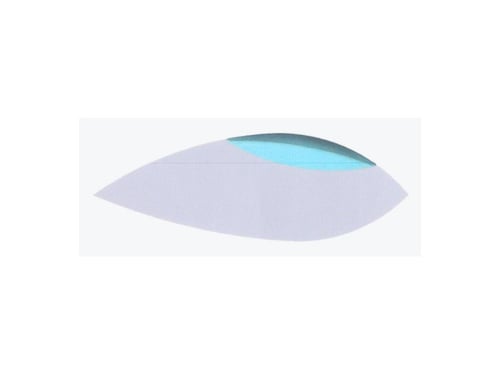
For example, the idea of a knife with a hole in the blade that prevents cut objects from sticking has become completely obsolete, but let's say that the hole had an innovative star-shaped shape. In this case, since the technical idea is no longer new, it is not possible to obtain a patent right, but if the star shape is new, it is possible to obtain a design right. Let's also say that you've created a novel knife that doesn't have any special functions, but has a cute, leaf-shaped appearance. In this case as well, it would be a good idea to consider acquiring a design right (Reference: Design Registration No. 1712808).
[Design Registration No. 1712808]
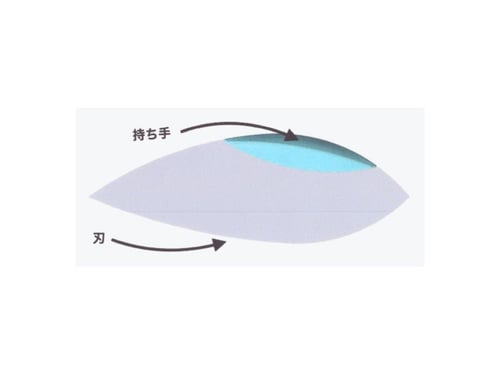
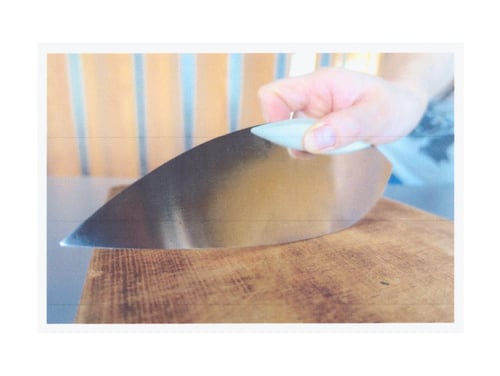
Important:Design rights are only rights that protect visible concrete forms such as shapes, patterns, and colors of objects. Therefore, abstract concepts such as design concepts are not protected. In other words, it is not possible to completely protect the UX and content design.
"Trademark rights" that protect symbolic marks
If you create a logo that makes full use of text and pictures and use this logo as a mark for your business or brand, consider acquiring trademark rights. Trademark law does not provide the right to protect logos (including letters, coined words, and single pictures) themselves. Which product or service the logo will be used for, in other words, the rights that include the logo and the product/service as a whole. If someone else sells the same product with a logo that is the same or similar to the logo you use for business, customers may mistake your product for that other person's product. Trademark rights prevent this situation and make it possible to guarantee that the product bearing your logo is your product. If your creation is a mark of your brand, consider acquiring trademark rights.
For example, if you are selling a kitchen knife with the name "Star Knife", we recommend that you protect this name for the knife as a product under trademark law. These four rights, including the utility model right that protects minor inventions, are rights that can be obtained through procedures at the Japan Patent Office (administrative disposition). With the exception of utility model rights, the Patent Office examines and grants registration in all cases, so it becomes easier to claim infringement because the idea or shape is new and cannot be easily created, there is no similar logo, and it functions as a landmark.This makes it easier to claim infringement.
On the other hand, there are rights that can be acquired without going through any formalities.
'Copyright' to protect cultural designs
Copyright protection is defined as works that express a person's thoughts and feelings and that belong to the literary, academic, artistic, or musical fields (works), but they do not have to strictly belong to the literary arts.
Point:It is an "expression" of thoughts and feelings. In other words, ideas themselves are not protected.
For example, let's say you created a character called Starboy and drew an illustration of it as the image character for the kitchen knife "Star Knife." The existence of the character Starboy itself is an idea and is therefore not protected by copyright, but the illustrations are protected by copyright. Copyright arises the moment the work is completed, and no special procedures are required.
If it is an illustration, text, or one-off work, it is relatively easy to recognize that it is a copyrighted work, so there are situations where it would be appropriate to respond with copyright, but In practice, there is a tendency to dispute whether the object is a copyrighted work, and it is currently difficult to prove this Therefore, it is not advisable to rely on copyright easily. In particular, with regard to product design (referred to as applied art in copyright), the certification of copyrighted works tends to be strict.
Important:We consider that applying copyright to product designs is an emergency evacuation, and we recommend that you obtain design rights whenever possible.
I would like to explain the relationship between applied art and copyright in detail at a later date.
*In the above example, if you use the illustration of the character Starboy as part of your business (as a mark of your business), it is not only subject to copyright protection, but also within the scope of protection under trademark law.
Others - Unfair Competition Prevention Act -
Even if ideas, the appearance of things, and trademarks are not protected, they may be protected by the Unfair Competition Prevention Act. The act of copying a product that looks exactly like the one you made, or the act of selling a product with a mark that looks exactly like the one you put on the product, are both acts of doing business by imitating the appearance without making any corporate efforts. Allowing this kind of behavior to go unchecked will not only nullify the efforts of companies that are serious about development, but will also damage them. For this reason, the law prohibits certain acts, and in the event of a violation, the act will be stopped and criminal penalties will be imposed.
Typical acts of fraud include ① illegal acquisition of trade secrets, ② act of using one's own well-known/famous product display, and ③ imitation of form. In other words, this is used when an idea (know-how) for which you do not have a patent right is stolen, a logo for which you do not have a trademark right becomes a well-known symbol of your business, or the shape of a product for which you do not have a design right is imitated.
However, in practice, ② is extremely difficult in that you have to prove that your product labeling is well-known or famous. ③ is also very difficult to prove due to the time limit of 3 years from the date of sale, and the requirement that the shape of another person's product be similar to your own product, so it is limited to almost the same shape (design rights are protected to the extent of similarity).
Important:We recommend that you view measures under the Unfair Competition Prevention Act as only an emergency evacuation, and protect your rights as much as possible.
Summary of design protection
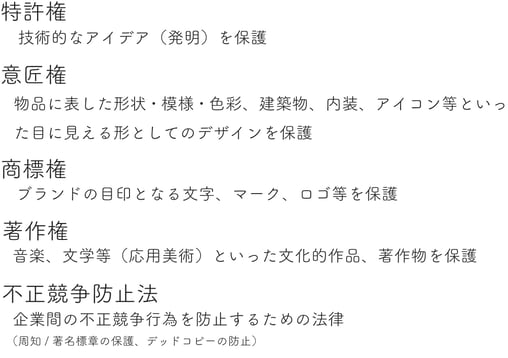
If the design is related to a technical idea, it is a patent right, if it is related to the shape of a thing, it is a design right, and if it is related to a sign, it is a trademark right.By clarifying what your intended design is, you can select the appropriate protection jurisdiction. On the other hand, intellectual property laws have not yet been able to protect abstract concepts such as UX and design concepts. In that sense, intellectual property law is still far from perfect.
However, it is important to consider the minimum rights required to avoid getting involved in unexpected disputes. Be very careful.
If you have any questions about design protection, please feel free to contact us.
Inquiry about this article
Contact form
If you have any questions or concerns regarding design protection, please feel free to contact us here.

AUTHOR
Takefumi SUGIURA (杉浦 健文)
EVORIX Intellectual Property Law Firm Managing Patent Attorney
Supports clients across IT, manufacturing, startups, fashion, and medical industries, covering patent, trademark, design, and copyright filings through trials and infringement litigation. Specialized in IP strategy for AI, IoT, Web3, and FinTech. Member of the Japan Patent Attorneys Association (JPAA), Asian Patent Attorneys Association (APAA), and Japan Trademark Association (JTA).