.png?width=500&height=250&name=%E7%9F%A5%E7%9A%84%E8%B2%A1%E7%94%A3%E4%BA%8B%E5%8B%99%E6%89%80%E3%82%A8%E3%83%9C%E3%83%AA%E3%82%AF%E3%82%B9%20(500%20%C3%97%20250%20px).png)

.jpg?height=200&name=unnamed%20(5).jpg)
Nowadays, the main battlefield of business has shifted from packaged software to SaaS (Software as...
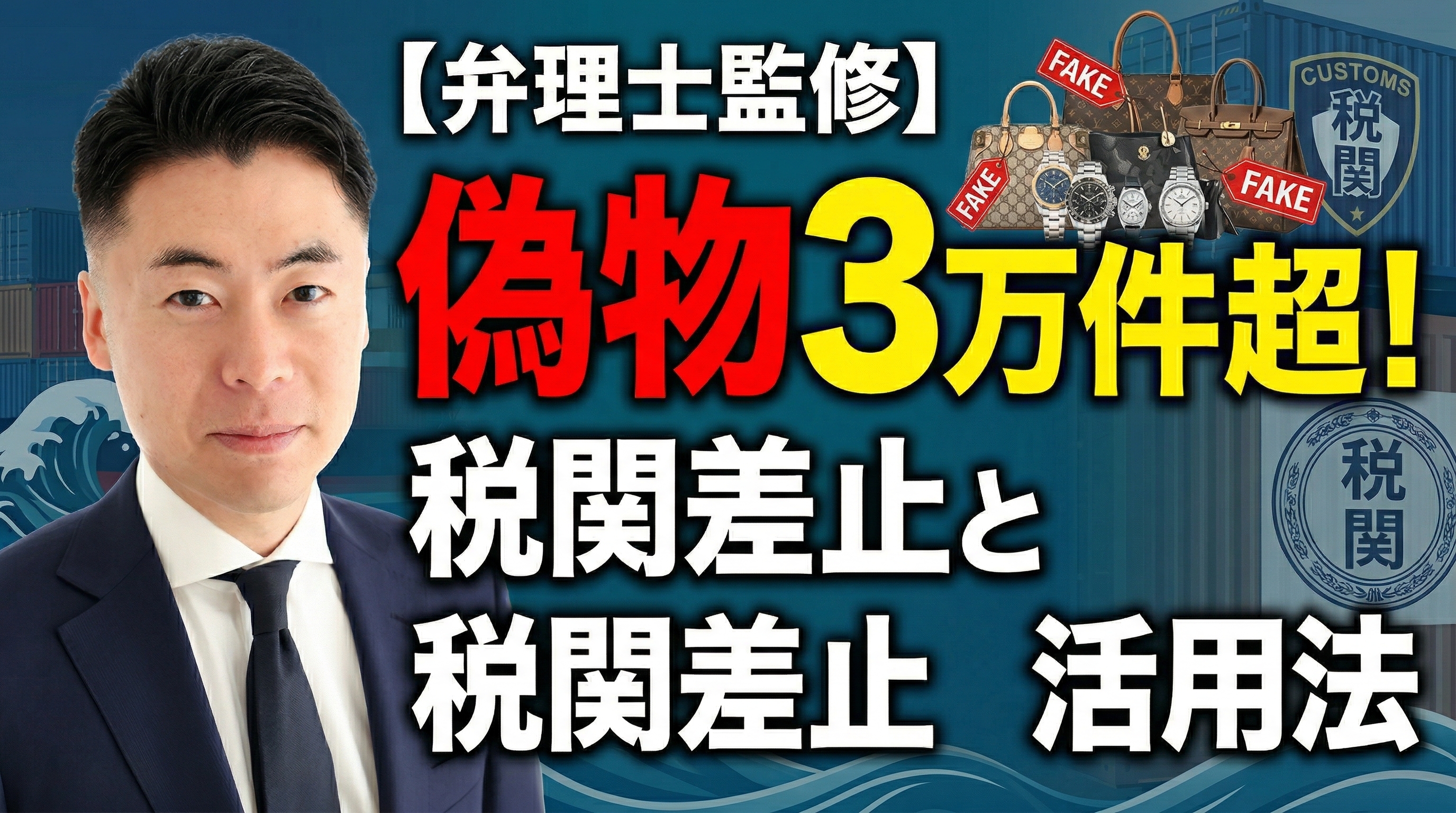 With the rapid expansion of cross-border e-commerce, the threat of counterfeit and pirated products distributed across borders has become more serious than ever. The number of seizures of intellectual property infringing goods at Japanese customs exceeds 30,000 per year, and the amount of damage is estimated to reach tens of billions of yen. For brand owners, countermeasures against counterfeit products are no longer just "a desirable measure," but a management issue that is directly linked to business continuity.
Customs border measures, or the import suspension system, are extremely effective means of blocking counterfeit products before they enter the domestic market. In this article, we will systematically explain the knowledge necessary for countermeasures against counterfeit products, from the latest injunction trends to the system structure, specific steps in the procedure, and the benefits of hiring experts.
Table of Contents
1. Latest trends in customs seizures - The threat of counterfeit products in numbers
1-1. Trends in injunction results
Japanese customs has a world-class track record in controlling goods that infringe on intellectual property rights at the border. The number of seizures in recent years has consistently maintained a high level, reflecting the professionalism of customs officials and the enhancement of the enforcement system.
📊 Injunction status of intellectual property infringing goods (main data)
- Number of injunctions per year: Over 30,000 cases (total of imports and exports)
- Number of injunctions: In some years it reaches millions of points
- Estimated damage amount: tens of billions of yen
- Country of origin: China accounts for approximately 80-90% of the total, followed by Asian countries such as South Korea and Vietnam
- Increasing trend in the detection of small parcels and mail via cross-border e-commerce
What is particularly noteworthy is that with the spread of cross-border e-commerce, the influx of counterfeit products through small parcels addressed to individuals and international mail is rapidly increasing. Unlike traditional large container imports, the number of small cargoes is huge and it takes time to check each one, increasing the burden on customs. Despite this, the fact that we have maintained a high record of injunctions shows the effectiveness of Japan's border measures.
1-2. Types of prohibited items and rights infringed
The items subject to the injunction are wide-ranging, ranging from luxury brand products to daily necessities and electronic devices. The types of intellectual property rights that are infringed are also becoming more diverse, with trademark rights being the most common.
| Item category | Main mode of infringement | Characteristics/Trends |
|---|---|---|
| Bags/Wallets/Clothing | Trademark infringement | Most imitated luxury brands. Elaboration progresses |
| Watches/Accessories | Trademark infringement | Exact copies of expensive brand watches are in circulation |
| Electronic devices/smartphone accessories | Trademark/patent infringement | Many inferior products do not meet safety standards |
| Pharmaceuticals/Cosmetics | Trademark infringement | Directly linked to health hazards. Big risk of unknown ingredients |
| Character goods/toys | Copyright/trademark infringement | Anime/game-related copyright infringement is on the rise |
| Auto parts | Trademark/design rights infringement | Serious safety issue. There is a risk of accident |
| Food/health food | Trademark infringement | Includes falsification of origin. Damage to consumer trust |
Of the rights that are infringed, trademark infringement accounts for the majority, but in recent years there has also been an increase in injunctions based on patent rights, design rights, copyrights, and the Unfair Competition Prevention Act. In particular, injunctions based on patent rights against products that imitate technological inventions are becoming increasingly important in protecting a company's technological superiority.
1-3. Trends in law reform - Counterfeit products for personal use are also subject to regulation
In the past, the act of individuals importing counterfeit products from overseas for their own use was not subject to regulations as it did not fall under "importation as a business." However, with the explosive spread of cross-border e-commerce, the influx of counterfeit products that take advantage of this loophole has rapidly increased, creating a serious problem.
⚠️ Key points of the 2022 Customs Law Amendment
Due to the revision of the Customs Law in 2022 (Reiwa 4), counterfeit products sent directly by overseas businesses to individuals in Japan (those that infringe on trademark rights and design rights) are now subject to confiscation and destruction, even if they are for personal use. This is a groundbreaking amendment to prevent the influx of counterfeit products through cross-border e-commerce, and will come into effect from October 2022. Customs is now able to deal with cases where it was previously argued that there was no problem because it was for personal use.
This legal reform is a huge step forward for brand owners. As the number of consumers purchasing cheap counterfeit products on cross-border e-commerce sites increases, the scope of enforcement at the border has expanded significantly, creating a system that can more effectively block the flow of counterfeit products into Japan. Rights holders should take full advantage of this new legal framework.
2. Three risks of leaving counterfeit products
"We know that counterfeit products are on the market, but we don't have the resources to deal with them." "The damage is small, so let's wait and see." Such decisions can cause serious damage to a company in the long run. We will explain three major risks that arise from leaving counterfeit products unattended.
Risk 1: Decline in brand value and loss of trust
🚨 Chain of brand damage
When inferior counterfeit products appear on the market, consumers mistake them for genuine products and are disappointed by the poor quality. If negative reviews spread on social media, the brand image you have built over many years can be destroyed in an instant. Furthermore, the existence of counterfeit products undermines the ``scarcity'' and ``exclusiveness'' of a brand, weakening the very motivation to purchase genuine products. Brand value is one of the most important intangible assets, and it takes a huge amount of cost and time to restore trust once it is lost.
Risk 2: Sales loss and market share erosion
🚨 Direct economic loss
Counterfeit products steal potential customers from genuine products and cause direct sales loss. Particularly in price-sensitive markets, customers tend to flock to cheap counterfeit products, which visibly reduces the sales volume of genuine products. Even more serious is the "downward spiral" in which counterfeiters reinvest their profits to manufacture more sophisticated counterfeits and expand their distribution networks. The longer the problem is left unaddressed, the more the cost of countermeasures will increase, leading to an irreversible loss of market share. According to estimates by the OECD, global economic losses due to counterfeit and pirated products reach trillions of dollars annually.
Risk 3: Consumer health damage/safety issues
🚨 Risk to human life
Many counterfeit products are dangerous and do not meet safety standards. Counterfeit cosmetics contain harmful substances, counterfeit electronic devices pose a risk of fire and electric shock, and counterfeit car parts cause brakes to be ineffective, causing problems that directly affect consumers' lives and bodies. Counterfeit drugs may not contain active ingredients or may contain harmful ingredients, which poses a serious risk that can be life-threatening. When such a product incident occurs, even if the cause is a counterfeit product, the brand owner may suffer reputational damage and, in some cases, may even be at risk of being sued for product liability (PL).
These three risks are interrelated, and the longer they are left unaddressed, the more the damage will accelerate. The biggest risk is deciding that it's still safe, and taking countermeasures early is the key to minimizing damage. In the next chapter, we will provide a detailed explanation of the "import suspension application system," which is one of the most effective countermeasures.
3. How the import suspension application system works
3-1. Overview of the system - Getting customs on your side
The import suspension petition system is a system in which an intellectual property right holder files a petition with customs to have the importation of goods that infringe on their rights suspended. Based on Article 69-13 of the Customs Law, this applies to patent rights, utility model rights, design rights, trademark rights, copyrights, neighboring rights, and breeder's rights, as well as rights based on the Unfair Competition Prevention Law.
📋 Basic structure of the import suspension application system
- Recipient:Intellectual property investigator at each customs office (one of the 9 customs offices nationwide)
- Complainant:Owner of intellectual property rights such as patent rights and trademark rights
- Validity period:Generally 4 years from the date of receipt (renewable)
- Applicable goods:Imported cargo suspected of infringing rights (including commercial cargo and mail)
- Effect:Monitoring and enforcement will be carried out at all customs offices nationwide based on the complaint
- Cost:There is nofee to file(free)
The biggest feature of this system is thatonce a petition is accepted, customs offices nationwide will carry out monitoringon behalf of the rights holder. There is no need for rights holders to personally patrol ports and airports; professional customs officials discover and detain infringing goods during their daily customs clearance operations.
3-2. Cost-effectiveness - Why is it the most cost-effective anti-counterfeit measure
✅ Overwhelming cost performance
There are various methods to counter counterfeit products, such as raids in the market, requests for removal on e-commerce platforms, civil lawsuits, and criminal prosecution, but filing to stop imports is one of the most cost-effective methods. The application itself is free of charge, and once it is accepted, customs offices nationwide will monitor it for four years. It's much cheaper than civil litigation, and it can block counterfeit products before they hit the market, preventing brand damage.
💡 Image of placing "free monitors" all over the country
Filing for an import suspension has the same effect as deploying ``specialized monitors to protect your brand'' at customs offices across the country for free. Customs officers inspect thousands of shipments every day and identify suspected infringing items based on complaints. The cost of hiring a private investigation or security company to provide equivalent monitoring services would be prohibitive. There is no reason not to take advantage of this system.
However, in order for the petition to be accepted, appropriate documents must be prepared, and even after acceptance, a system is required to promptly respond to inquiries from customs. In the next chapter, we will explain the specific procedure flow and key points for success.
4. Procedures and success points
The procedure for applying for an import injunction is broadly divided into three steps. Let's take a closer look at the points to keep in mind at each step.
Step 1: Acquisition and maintenance of intellectual property rights
✅ Checkpoints for acquiring rights
- Trademark registration:Register a brand name, logo, or product name as a trademark in Japan. The most important foundation for measures against counterfeit products
- Design registration:If a product has a distinctive design, it is protected by a design right. Grounds for prohibiting copying of counterfeit products
- Patent rights:For products that include technical inventions, consider protection through patent rights. Can counter technological imitation
- Review of scope of rights:Check whether existing rights cover aspects of counterfeit products. File additional applications if necessary
- Obtaining rights overseas:If you obtain rights in the countries where counterfeit products are manufactured or exported, local enforcement will be possible
🚨 Unregistered risk
If the intellectual property rights are unregistered, a petition for import suspension cannot be filed. It is not possible to file a petition while a trademark or design is being applied for, and the premise is that the rights have been established and registered. In addition, if the scope of rights is too narrow, there are cases in which counterfeit products with clever changes cannot be stopped. It is essential to strategically acquire rights with an eye toward countermeasures against counterfeit products. When a foreign brand enters the Japanese market, it should give top priority to acquiring rights in Japan.
Step 2: Drafting the petition and preparing evidence
✅ Main matters to be included in the petition
- Contents of rights:Basic information on rights such as registration number, scope of rights, and duration
- Fact of infringement:Concrete evidence of the existence of counterfeit products (photos of counterfeit products, purchase records, listing information on e-commerce sites, etc.)
- Identification points between genuine products and counterfeit products:Specific criteria for customs officials to distinguish counterfeit products during customs inspection
- Information about the infringer:Information about the manufacturer, exporter, or importer of the counterfeit product (to the extent known)
- Expected import route:Information such as country of origin, port/airport used, timing, etc.
💡 "Identification points" are the key to success
One of the most important factors that determines the success or failure of a petition is the quality of the"identification points". Customs officers inspect large quantities of cargo in a limited amount of time, so clear and actionable information is essential: ``This is where you can tell whether the product is genuine or counterfeit.'' For example, provide identification points that are as specific and visually easy to understand as possible, such as sewing quality, subtle differences in logo placement and fonts, tag material and printing method, product number system, etc. Comparative photos of genuine and counterfeit products can further assist customs officials in making decisions.
Step 3: Respond to certification procedures
✅ Certification procedure flow and points to take
When customs finds a suspected infringing item, a "certification procedure" is initiated. In this procedure, customs hears opinions from both the right holder and the importer and determines whether the item in question falls under the category of infringing goods.
- Prompt response to notifications:If you receive a notification of suspicious cargo from customs, promptly submit evidence and opinions. The deadline is usually around 10 business days
- Sample appraisal:Customs may provide images and samples of suspect items, which are then compared with genuine items for appraisal.
- Inquiry on expert advisor opinion:Depending on the proposal, expert advisor opinion may be requested on technical issues
- Measures taken after infringement is determined:Once infringement is determined, the item will be confiscated and destroyed. The process is complete unless the importer files an objection
Prompt and accurate responses in the certification process are directly linked to the success or failure of an injunction. In particular, if the importer claims that there is no infringement, the rights holder must submit a convincing counterargument and evidence. If the countermeasures at this stage are insufficient, counterfeit products that have been discovered may be allowed to clear customs.
5. 4 benefits of hiring a patent attorney
Although the right holder can file an application for an import injunction himself/herself, it is possible to maximize the effectiveness of the system by requesting apatent attorney who is familiar with both intellectual property law and customs practice. Below, we will explain the four main benefits of hiring a patent attorney.
Advantage 1: Strategic rights acquisition design
Patent attorneys can help you build a strategic rights portfolio with an eye to countering counterfeit products. We can make optimal proposals from a professional perspective, such as which rights should be acquired and to what extent, and what kind of filing strategy is effective depending on the nature of the counterfeit product. Designing rights to maximize the effectiveness of border measures, such as selecting goods and services designated by a trademark, utilizing partial designs and related designs, and writing patent claims, is an area that is difficult for anyone but an expert.
Advantage 2: Creating high-quality petitions
The quality of the petition is directly linked to the acceptance decision by customs and the effectiveness of subsequent enforcement. A patent attorney accurately describes the content of the right, establishes the fact of infringement in a legally appropriate manner, and creates identification points that are easy for customs officials to use in practice. In particular, creating identification points requires a deep understanding of the manufacturing process and quality control system of genuine products, as well as specialized knowledge based on trend analysis of counterfeit products. Involvement of a patent attorney increases the acceptance rate of applications and increases the effectiveness of injunctions.
Advantage 3: Quick and accurate response in certification procedures
Once the certification process begins, appropriate evidence and opinions must be submitted within a limited period of time. By hiring a patent attorney, you can respond quickly and accurately to notifications from customs, increasing the accuracy of determining infringement. Particularly in cases where the importer contests infringement, the ability to construct a legal defense is essential. In addition, the support of a patent attorney can be of great help when referring to the opinions of expert committees when a technical issue arises.
Advantage 4: Comprehensive measures against counterfeit products
Patent attorneys have the ability todesign and implement overall anti-counterfeiting strategiesnot just filing an import injunction. We can plan and promote comprehensive enforcement strategies that combine all channels, including border measures at customs, enforcement in the domestic market, eliminating infringements on e-commerce platforms, and enforcing rights overseas. It is not enough to use just one method to combat counterfeit products; great effects can only be achieved by organically linking multiple methods.
Summary
Counterfeit countermeasures, particularly the import injunction system, are one of the most cost-effective anti-counterfeit measures available to brand owners. As evidenced by over 30,000 seizures per year, Japan's customs authorities are actively working to protect intellectual property and welcome complaints from rights holders.
Now that the scope of enforcement against counterfeit products via cross-border e-commerce has been expanded due to the revision of the Customs Law in 2022, the significance of utilizing this system is greater than ever. If counterfeit products are left unchecked, there are serious risks of damage to brand value, lost sales, and consumer safety issues.
Strategic acquisition of rights, preparation of high-quality petitions, and appropriate response to certification procedures--To ensure that these are carried out, we recommend consulting with a patent attorney who is familiar with intellectual property law and customs practice. The sooner you take action against counterfeit products, the more effective and cost-effective it will be. The first step to protecting your brand is to take action now, rather than saying, ``I'll do something about it someday.''
Please feel free to contact us for countermeasures against counterfeit products.
Intellectual property experts will provide easy-to-understand advice on the procedures for filing an import injunction, strategies for acquiring rights, and the overall design of measures against counterfeit products.
Counterfeiting Customs Import injunction Warder measures Trademark rights Cross-border EC Brand protection Customs law

AUTHOR
Takefumi SUGIURA (杉浦 健文)
EVORIX Intellectual Property Law Firm Managing Patent Attorney
Supports clients across IT, manufacturing, startups, fashion, and medical industries, covering patent, trademark, design, and copyright filings through trials and infringement litigation. Specialized in IP strategy for AI, IoT, Web3, and FinTech. Member of the Japan Patent Attorneys Association (JPAA), Asian Patent Attorneys Association (APAA), and Japan Trademark Association (JTA).
![[Trademark Basics] Can it be registered without “distinctive power”? Thorough explanation of the most important concepts that affect business](https://www.evorix.jp/hs-fs/hubfs/blog-thumbnails/face-post-264358348489.png?height=200&name=face-post-264358348489.png)