.png?width=500&height=250&name=%E7%9F%A5%E7%9A%84%E8%B2%A1%E7%94%A3%E4%BA%8B%E5%8B%99%E6%89%80%E3%82%A8%E3%83%9C%E3%83%AA%E3%82%AF%E3%82%B9%20(500%20%C3%97%20250%20px).png)

Trademark registration requirements Registrable trademarks and distinctiveness: According to the...
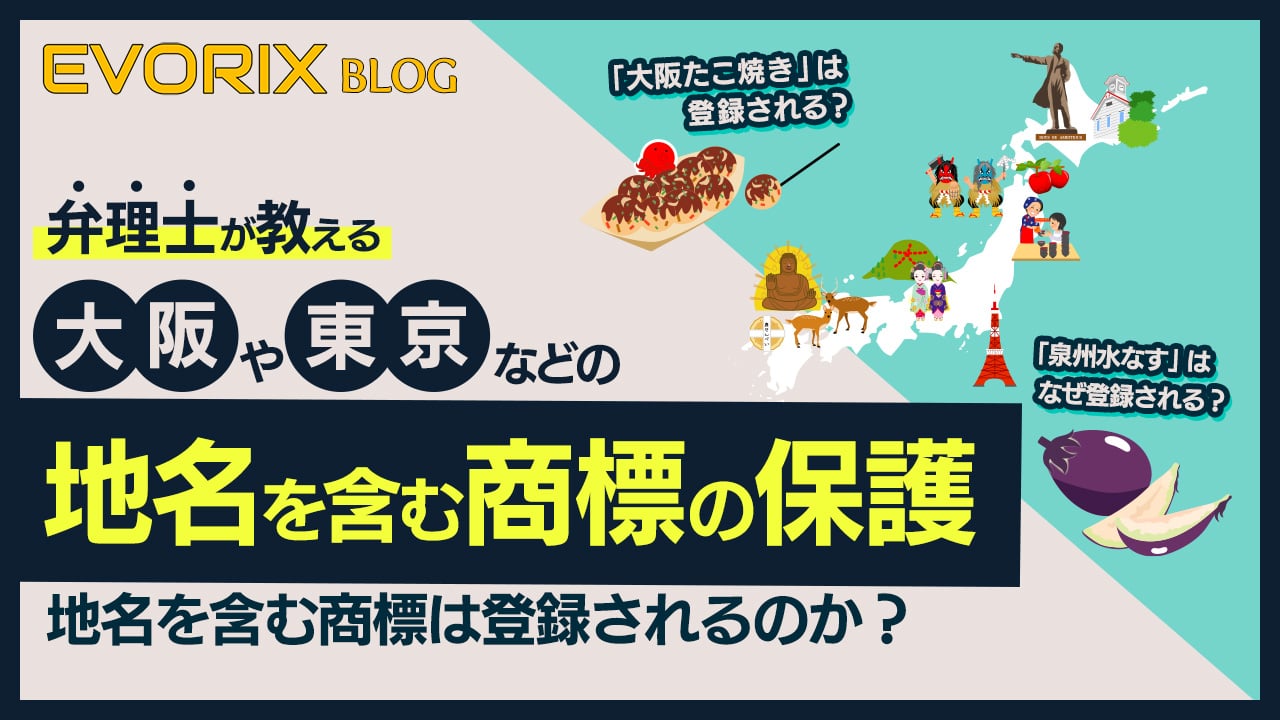
Table of Contents
- Problems with trademarks that include place names such as Osaka and Tokyo
- How to make your trademark famous and registered
- How to turn a trademark into a logo and register it
- Misperception of the quality of place name + coined word trademarks
- Comparison of three approaches
- Regional brand protection (regional collective trademark)
- Geographical Indication (GI) Protection System
- Summary
- Contact us about this article
Registrability of trademarks including place names such as Osaka and Tokyo
There may be times when you use a trademark that includes a "place name" when developing your brand. What kind of problems arise when acquiring rights to such trademarks?
Since a trademark is supposed to be a mark of the product or service, a "place name" itself cannot be registered as a trademark.
Examples of place name trademarks that cannot be registered
- Osaka, Osaka, OSAKA
- Tokyo, Tokyo, TOKYO
- Kyoto, Kyoto, KYOTO
- Nagoya, Nagoya, NAGOYA
Similarly, a trademark consisting of a "place name" and "general name of a product or service" (this is called a "common name") cannot be registered in principle.
Example where "place name + common name" cannot be registered
- Osaka Ramen, Osaka Karamen, OSAKA Ramen
- Tokyo Cleaning, Tokyo Cleaning, TOKYO Cleaning
- Kyoto pickles, Nagoya Cochin (if it is a common name)
These are trademarks that simply do not serve as landmarks and are extremely difficult to become landmarks, and it is thought that it would be unfair to allow individuals to monopolize trademarks consisting of a "place name" or "place name + common name" that anyone would want to use descriptively, so they are not legally allowed to be registered.
How to make your trademark famous and register
However, there are exceptional cases in which rights can be obtained for such trademarks by continuing to use them for a certain amount of time. Even if a trademark has low distinctiveness and is difficult to use as a landmark in the first place, it can be registered if it has been used for a long time and is recognized by consumers (demanders) as an indication of its origin.
Point
If you want to obtain rights for a trademark consisting of a "place name + common name", you need to continue using it for a certain amount of time and become famous before filing an application. However, it is a very difficult method as it requires public awareness on a national level. Until the trademark is registered, third parties cannot be prevented from using the trademark.
Specifically, pursuant to the provisions of Article 3, Paragraph 2 of the Trademark Law, it is necessary to prove that the trademark is widely recognized among consumers by submitting evidence such as long-term usage history, advertising, and sales results.
How to turn a trademark into a logo and register it
It is not easy to gain national recognition, but it will be easier to register if you create a logo to a considerable extent. By using a designed logo instead of a trademark consisting of only text, you can compensate for the low distinguishability of the text part.
Note
Logo is only for branding and only when the logo is important. Please keep in mind that creating a logo just for registration is putting the cart before the horse. It is also important to note that when a logo is registered as a trademark, the scope of protection is limited to the logo design, so the use of only text is not protected.
Problem of misperception of quality in trademark of place name + coined word
On the other hand, if it is a trademark consisting of a "place name" + "coined word" (or a similar word), it is possible to obtain rights without any problems. However, in this case, it may be necessary to devise a design for the designated product to avoid ``misperception of the quality of the product or the quality of the service''.
For example, if a trademark includes the word "Osaka", consumers will typically assume that the product is produced or served in Osaka. Even if a product contains the word "Osaka," if it is produced in Tokyo, consumers may misunderstand the quality or place of origin.
Countermeasure: Limited production area of specified products
Based on Article 4, Paragraph 1, Item 16 of the Trademark Law, in order to avoid misperceptions of quality, it is necessary to limit the production area by stating "Made in Osaka" in the description of designated products.
If you search for trademarks containing "Osaka" on the patent information platform (J-PlatPat), you will find too many to list. Among them, there are also trademarks that are not specific to the specified product, such as "made in Osaka." Although this trademark has the word "Osaka" attached to it, it is a trademark that would be recognized as a coined word as a whole, and in other words, it was determined that consumers would not mistake the trademark for being made in Osaka.
Registration example: Trademark registration No. 4436555
| Trademark | Osaka King |
| Designated goods and services | Class 30 Gyoza |
| Trademark owner | Hanei Co., Ltd. |
| J-PlatPat | View details |
Comparison of three approaches
Compare the three main approaches to registering trademarks that include place names. Each has advantages and disadvantages, so it is important to choose a strategy according to the situation.
| Comparison item | Notification through use | Logo conversion | Place name + coined word |
|---|---|---|---|
| Registration difficulty level | High (needs to be known nationwide) | medium | Low (distinguishable in the coined word part) |
| Required time | Long term (accumulation of usage experience required) | Relatively short period of time | Normal review period |
| Protection range | Wide (can be registered as a word trademark) | Narrow (limited to logo design) | Wide (similar range of coined word part) |
| Cost | Expensive (advertisement/evidence collection costs) | Medium (design cost) | Low (regular filing fee) |
| Need to restrict production area | Often unnecessary | Often unnecessary | Necessary in some cases (preventing quality misperceptions) |
| Recommended cases | Brands you have already used for many years | Brands where design is important | Launching a new brand |
Regional brand protection (regional collective trademark)
I think that many trademarks that include place names are related to regional brands. The Trademark Law has a system aimed at protecting regional brands, and this is called a "regional collective trademark."
Characteristics of regional collective trademarks
- Even “place name + common name” can be registered even if it is not well known nationwide
- Individual applications are not allowed (only specific organizations can apply)
- Must be fairly well known in multiple prefectures
- It is necessary to limit the origin of designated products
By applying as a regional collective trademark, you can receive registration even if it is not well known nationwide. If the product or service is well known, taking into account the type of product or service and the distribution route, it can be registered.
If you are aiming to brand a specialty product not by an individual but by a region as a whole, please use a regional collective trademark.
Registration example: Trademark registration No. 5063730 "Senshu water eggplant"
| Trademark | Senshu water eggplant |
| Specified goods and services | Mizunasu from Senshu area, Osaka prefecture |
| Trademark owner | Osaka Senshu Agricultural Cooperative (Izumisano City, Osaka Prefecture) Izumi Agricultural Cooperative Association (Kishiwada City, Osaka Prefecture) |
| J-PlatPat | View details |
By the way, I, the author, was also in charge of applications for regional collective trademarks as a patent attorney representing regional collective trademarks in the past. At that time, we recommend "Tokyo Nihachi Soba" and "Tokyo Nihachi Soba" was the trademark. This was also successfully registered and is still protected.
Geographical Indication (GI) Protection System
In addition to regional collective trademarks, there is a system called the "Geographical Indication (GI) Protection System" to protect regional intellectual property. It may be a system similar to a regional collective trademark, but this is under the jurisdiction of the Ministry of Agriculture, Forestry and Fisheries, and its protection only applies to agricultural, forestry and fishery products, food and beverages. The hurdle is high because it requires approximately 25 years of usage (production) experience.
Advantages of the GI protection system
- Once registered as a GI, the government will crack down on unauthorized use, so there will be no burden of litigation on the rights holder.
- If registered as a GI in Japan, it is possible to protect geographical indications overseas based on international agreements between countries (trademark rights must be obtained for each country)
Summary
The situation is a little complicated when it comes to acquiring rights to trademarks that include place names. It is important to choose the approach that best suits your situation.
Key points of this article
- In principle, place names themselves, place names + common names cannot be registered as trademarks
- It is possible to register if it becomes famous nationwide, but the hurdle is high
- Creating a logo makes it easier to register, but the scope of protection is limited
- Easy to register if it is a place name + a coined word (limitation on the place of origin may be required.)
- For regional brands, it is recommended to utilize the "regional collective trademark" system
- “GI protection system” is also an option for agricultural, forestry and fishery products
Please contact us if you would like to obtain rights to a trademark that includes a "place name," register a regional collective trademark, or register a geographical indication protection system (GI).
Inquiry about this article
Consultation on application and acquisition of rights for place name trademarks
A patent attorney will carefully assist you

AUTHOR
Takefumi SUGIURA (杉浦 健文)
EVORIX Intellectual Property Law Firm Managing Patent Attorney
Supports clients across IT, manufacturing, startups, fashion, and medical industries, covering patent, trademark, design, and copyright filings through trials and infringement litigation. Specialized in IP strategy for AI, IoT, Web3, and FinTech. Member of the Japan Patent Attorneys Association (JPAA), Asian Patent Attorneys Association (APAA), and Japan Trademark Association (JTA).