.png?width=500&height=250&name=%E7%9F%A5%E7%9A%84%E8%B2%A1%E7%94%A3%E4%BA%8B%E5%8B%99%E6%89%80%E3%82%A8%E3%83%9C%E3%83%AA%E3%82%AF%E3%82%B9%20(500%20%C3%97%20250%20px).png)

![[2023 Law Revision] What will change with the introduction of the consent system? Thorough explanation of the key points for utilizing trademark registration and assign back](https://www.evorix.jp/hs-fs/hubfs/blog-thumbnails/face-post-166132660044.png?height=200&name=face-post-166132660044.png)
With the legal revision in April 2023, the introduction of the "consent system" is attracting...

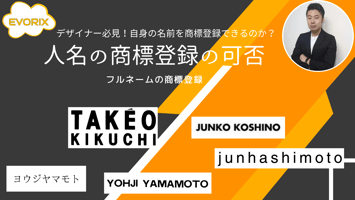
In a previous blog, I talked about how difficult it is to register a person's full name as a trademark. (Reference link)
However, due to recent legal amendments, the requirements for registering a person's name as a trademark have been relaxed and streamlined, making registration smoother. Let's take a closer look at what has changed compared to the previous situation.
Handling of people's names so far (review)
This does not mean that trademarks consisting of names could not be registered at all. In the past, several registrations have been approved. However, in recent years, standards have become stricter, and if the examiner determines that there are multiple people with the same last name, consent from all of them is required. You may be able to get consent from one or two people (although it still takes a lot of effort), but if there are dozens of people, it may be realistically impossible to get everyone's consent. As a result, a person's name could not be registered as a trademark.
About the revision contents
The key point of this revision is that it is now possible to register a trademark consisting of a name without obtaining the consent of another person. However, trademark registration of a name is not permitted in all cases. Certain requirements apply. Specifically, if (1) the name is not the name of another person well known in the field of the product or service being registered, and (2) the name does not violate the requirements specified by government ordinance, registration can be obtained without the consent of the other person.
With this revision, it has become easier for people who use their name as a brand to obtain trademark rights. If you started a business using your name as a brand during a time when screening standards were strict, be sure to apply proactively to obtain rights. Please note that this applies to applications filed after April 1st.
.svg)
Q&A
Q.1
What kind of name is "a name widely recognized among consumers" in Article 4, Paragraph 1, Item 8 after the revised law?
A .1
In the field of goods or services that use a trademark, the name of another person who is fairly well known cannot be registered without the other person's consent. Considerable extent is determined by whether it is known after considering the geographical scope and business scope. For example, even if the name is not known nationally, it may be well-known in one region, or within a certain product or service field, it may be well-known to people in that industry.
In such cases, the consent of the other person will be required.
Q.2
What are the requirements stipulated by the ordinance in the article?
A. 2
Specifically, there are two points below.
"There is a considerable relationship between the name of another person included in the trademark and the trademark registration applicant"
It is determined that there is a considerable relationship if the applicant and the applied trademark are the same (your own name), the trademark is designated by the founder or representative, or the trademark has been used continuously for a long time.
(2) "The applicant for trademark registration must not seek to obtain trademark registration for fraudulent purposes."
If the purpose is discernible to harass others or to preemptively buy the trademark, it will be determined that the purpose is fraudulent. (Example: In the case where it is recognized that trademark applications are made only for other people's names on the database, or where a third party provides information that there is a fraudulent purpose, etc.)
Q.3
What happens to foreigners' names?
A.3
No. 8 "Names of other people" includes names of foreigners. However, if your name does not include your middle name, it will be treated as an "abbreviation" rather than your full name. In the case of an ``abbreviation,'' it is not enough to have a fairly well-known name; it must be well-known. In other words, it must be an abbreviation that everyone knows.
Q.4
What is the name of the deceased (historical person)?
A.4
The name of the other person in No. 8 does not include the name of the deceased. Must be the name of a living person. However, issues of No. 7 (public order and morals, etc.) may arise regarding historical figures. Please be careful. (Reference link)
Reference:
Revised article 4, paragraph 1, item 8
A trademark that includes another person's portrait or another person's name (limited to a name that is widely recognized among consumers in the field of goods or services in which the trademark is used), or a name, or a famous pseudonym, stage name, pen name, or a famous abbreviation of these (excluding those with the consent of another person), or a trademark that includes another person's name, and is a trademark that includes another person's name, and is a trademark that includes another person's name (limited to names that are widely recognized among consumers in the field of goods or services in which the trademark is used), or a name, or a famous pseudonym, stage name, pen name, or a famous abbreviation of these (excluding those with the consent of another person). Items that do not meet the requirements
Examination criteria for "widely recognized names"
When determining "names that are widely recognized among consumers," from the perspective of protecting moral rights, it is necessary to fully consider the geographical and business scope in which the name of another person is recognized, and pay attention to whether or not the other person can be recalled or associated when the name is used for the product or service.

AUTHOR
Takefumi SUGIURA (杉浦 健文)
EVORIX Intellectual Property Law Firm Managing Patent Attorney
Supports clients across IT, manufacturing, startups, fashion, and medical industries, covering patent, trademark, design, and copyright filings through trials and infringement litigation. Specialized in IP strategy for AI, IoT, Web3, and FinTech. Member of the Japan Patent Attorneys Association (JPAA), Asian Patent Attorneys Association (APAA), and Japan Trademark Association (JTA).