.png?width=500&height=250&name=%E7%9F%A5%E7%9A%84%E8%B2%A1%E7%94%A3%E4%BA%8B%E5%8B%99%E6%89%80%E3%82%A8%E3%83%9C%E3%83%AA%E3%82%AF%E3%82%B9%20(500%20%C3%97%20250%20px).png)


📌 For those reading this article: If you are drafting your statement using generated AI such as...
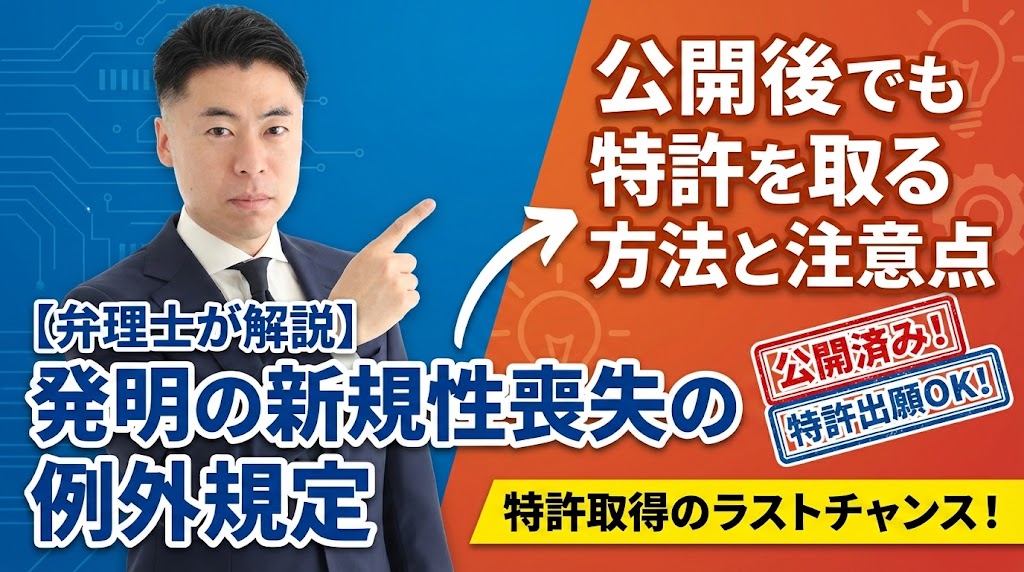
When a company develops an innovative new product or technology, it is not uncommon for the company to distribute a press release, publish it on a website, or announce it at an academic conference or exhibition before filing a patent application because they want the world to know about it as soon as possible or to appeal to investors to raise funds.
However, in the patent system, the fact that the invention has been made public in advance may cause fatal problems in obtaining a patent. This is because the most important requirement for a patent, ``novelty'' (something new that is not yet known to the world), will be lost.
"Even though I made a great invention, I accidentally made it public so I can't get a patent anymore..."
For managers, developers, and researchers who are about to give up, please wait a moment. Japan's Patent Law provides a system called ``Exceptions to Loss of Novelty of Inventions (Article 30 of the Patent Law)'' to provide relief to such inventors and companies.
In this article, a patent attorney who is a patent expert provides a thorough explanation in an easy-to-understand manner, from the basic mechanism of the "exceptions to loss of novelty of an invention," to the specific procedural steps to apply, how to write a certificate, and important practical risks (such as pitfalls when filing overseas applications).
📑 Table of contents of this article
- What is the exception to the lack of novelty of an invention (Article 30 of the Patent Law)?
- Procedure steps for application [Practical flow]
- Be careful! “Pitfalls” and serious risks of exception provisions
- Advantages of requesting a patent attorney for procedures
- Summary: After disclosing your invention, immediately contact a patent attorney
1. What is the exception to the lack of novelty of an invention (Article 30 of the Patent Law)?
1-1. What is "novelty", the absolute condition for patents
Article 29, Paragraph 1 of the Patent Law stipulates that a requirement for an invention to be patentable is that the invention must not be publicly known in Japan or abroad before the patent application (publicly known invention). This is called“novelty”.
Specifically, an invention is considered to have lost its novelty if the following acts are performed.
| Publication mode | Specific example |
|---|---|
| Post on website | Company homepage, SNS (X, Instagram, etc.), video sharing site |
| Press release distribution | News distribution through PR media |
| Presentation at academic conferences and seminars | Paper presentation, slide presentation, poster session |
| Exhibiting at an exhibition | New product introduction and demonstration at the trade show |
| Sale or distribution | Test sales, sample distribution, crowdfunding (Makuake, CAMPFIRE, etc.) |
| Mass media coverage | Interview articles on TV, newspapers, and magazines |
⚠️ Principle:If you do any of these things even once, any subsequent patent applications will be rejected by the Patent Office as the technology is already known in the world.
1-2. Remedy called exception to loss of novelty (grace period)
If we adhere to strict principles such as those mentioned above, there is a risk that the speed of business activities and publication of academic research will be unduly hindered. This is why Article 30 of the Patent Law provides for the ``exception to the loss of novelty of an invention.'' Internationally, it is also called the "grace period."
Effect of Article 30 of the Patent Act
"It is treated as if the novelty was not lost due to the act of publication."
= If you follow certain conditions and strict procedures, it can be treated as if it had not been published.
1-3. Absolute requirements for application
In order to apply the exception to loss of novelty, a patent application must be filed within 'one year' from the date of publication. Due to the revision of the law in 2018 (Heisei 30), the grace period was extended from the previous six months to one year.
The following two publishing patterns are mainly targeted.
① Publication caused by the rights holder's own actions
(Article 30, Paragraph 2)
When the inventor or applicant voluntarily discloses the invention. Almost all public acts such as conference presentations, exhibitions, web postings, sales, etc. are eligible for relief.
② Disclosure against will
(Article 30, Paragraph 1)
Publication contrary to the intention of the applicant, such as when a partner with whom an NDA has been concluded publishes a paper without permission, or when information is leaked due to industrial espionage.
2. Procedure steps for application [Practical flow]
This does not mean that you will automatically receive relief if you file an application within one year of publication. Strictly prescribed procedures must be followed with the Patent Office. If there is even the slightest flaw in the procedure, there will be no remedy and you will lose your patent rights forever.
STEP 1
"Declaration of intention" at the same time as patent application
At the moment you file a patent application, you must clearly state in the application (application documents) that you would like to have the exceptions to the loss of novelty applied.
[Example of application form]
[Special Notes] Patent application seeking application of the provisions of Article 30, Paragraph 2 of the Patent Act
⚠️ Note:If you forget to write this sentence when you apply, you will generally not be able to add it later and will lose the right to apply the exceptions.
STEP 2
Submit "certificate" within 30 days of application
A document (certificate) objectively proving the fact of publication must be submitted to the Commissioner of the Patent Office within ``within 30 days'' from the date of the patent application.
📋 Required information to be included in the certificate
| Description items | Content |
|---|---|
| Public facts | When, where, and how it was published Example: On October 0, 2020, at the 〇〇 academic conference |
| Publisher | Who published it? Proof that you are a “person with the right to obtain a patent” |
| Contents of the published invention | Explanation that the identity with the claimed invention (claims) is recognized |
📎 Evidence for each disclosure mode
| Publication mode | Required evidence |
|---|---|
| Web publication/press release | Screenshot of the web page (URL/published date and time printed), distribution management screen, etc. |
| Conference/seminar presentation | Cover of the proceedings, table of contents, relevant paper page, presentation certificate, etc. |
| Exhibition exhibition | Official brochure, exhibitor list, booth distribution catalog, exhibit photos (with date and time) |
| Sales/Crowdfunding | Delivery note/receipt with sales start date, project screen capture of CF site |
💡 Regarding proof when published multiple times (latest operation)
In actual business, there are many cases where one invention is published multiple times in a row, such as "press release → exhibition → test sales." If the disclosed inventions arethe same, it is widely accepted that a ``comprehensive certification'' can be used to omit the certification of subsequent disclosures by submitting a certification for the earliest publication. However, since the determination of "identical" is very specialized, careful determination and document preparation by a patent attorney are essential.
3. Be careful! “Pitfalls” and serious risks of exception provisions
It is very dangerous to easily think that ``you can get a patent within one year of publishing your work''. Exceptions are only a ``safety net of last resort,'' and their use involves the following serious risks.
⚠️ Risk 1: Cannot compete with third party's "independent development" or "rush application"
Japan's patent system adopts a "first come, first served" system. The exception to lack of novelty is nothing more than a personal remedy that ``makes your own public disclosure non-countable only in your patent examination.''
What exactly does it mean?
If between the time you publish your invention and the time you file your application, an unrelated third party independently develops the same invention and files it before you → your patent will be rejected on the grounds that it was later than someone else's application. There is also the ``risk of imitation,'' in which a third party reads a press release, applies for an improved invention, and obtains a patent.
⚠️ Risk 2: Possibility of obtaining a patent in a foreign country (overseas) becoming hopeless
This is themost fatal risk for companies looking to expand globally. The "grace period" system is not universal.
| Country/Region | Handling grace periods | Salvation degree |
|---|---|---|
| Japan | One year from publication. Applies to almost all public acts | ◎ Wide |
| USA | One year from publication. Relatively flexible relief | ◎ Wide |
| Europe (EPO) | The principle of "absolute novelty". Only BIE certified exhibitions and acts of betrayal. Duration 6 months | ✕ Extremely narrow |
| China | Only for government-sponsored international exhibitions and designated academic conferences. Duration 6 months | △ Limited |
Presentations at academic conferences in Japan, publication on your company's website or exhibitions will not be compensated in any way in Europe. Obtaining a patent in Europe will be virtually impossible.
If you are even thinking about entering the overseas market
"Before any public disclosure, first complete the patent application (basic application) in Japan"
This is the golden rule of golden rules
⚠️ Risk 3: Risk of denial of application due to procedural deficiencies
The schedule of ``declaration of intention at the same time as application'', ``application within one year'', and ``submission of certificate within 30 days'' is an absolute must. If there is a logical leap in the content of the certificate, or if it is not possible to prove the identity of the disclosed invention and the invention to be applied for, the application of the exceptions will be denied and the patent will be refused. Completing legally impeccable procedures in a short period of time is extremely difficult for those without specialized knowledge of intellectual property.
4. Benefits of requesting a patent attorney to handle the procedure
Procedures for obtaining exceptions to the lack of novelty of an invention are more complex than a general patent application, requiring careful legal judgment, accuracy, and above all, speed.
✅ Benefit 1: Create accurate certificates and prevent fatal procedural mistakes
Patent attorneys are familiar with the latest examination standards and guidelines of the Patent Office. Compare ``when, where, and by whom the disclosure was made'' to the legal requirements and accurately determine what kind of evidence needs to be gathered to be accepted by the examiner. Promptly create and submit logical and persuasive certificates within the deadline to prevent fatal failures due to procedural deficiencies.
✅ Advantage ②: Speedy response to minimize the risk of third party applications
The more time passes from the publication date, the greater the risk that the rights will be stolen by a third party. By hiring a patent attorney, you can complete everything from the preparation of advanced technical documents (patent specifications) that define the scope of patent rights to application procedures at the speed of a professional, allowing you to complete your application with the Patent Office as quickly as possible.
✅ Benefit 3: Proposal of global intellectual property strategy tailored to business strategy
``How to cover overseas expansion of technology that has already been released'' is a major management issue.
By consulting with a patent attorney, you can receive advice on comprehensive intellectual property strategies that can eliminate competition while minimizing damage, such as ``In addition to the basic technology that has already been released, extract new improved technology (peripheral know-how) that has not yet been released and use it to build an overseas patent network.''
5. Summary: Once you have disclosed your invention, contact a patent attorney immediately
The major principle of the patent system is ``Disclosure before filing is strictly prohibited''. However, even if you unavoidably or unintentionally disclose your invention to the public, if you correctly understand the "exceptions to the loss of novelty of an invention" and act quickly, it is quite possible to obtain a patent and protect your business.
📌 Summary of main points of procedure
Within 1 year
Application deadline from publication date
Same time as application
Declaration of intention on application form
Within 30 days
Certificate submission deadline
Do you have any of these problems?
- "I issued a press release for a new product a few months ago, but will I be able to get a patent now?"
- “We are planning to present it at an exhibition next week, but we are not ready to apply for a patent in time.”
- “I want to expand the technology posted on my website overseas, but how should I develop a strategy?”
Before you decide on your own that ``it is no longer possible to obtain a patent'' and give up, please consult a patent attorney as soon as possible.
Start with a free consultation
A patent attorney who is a professional in intellectual property strategy will carefully listen to the customer's situation and not only take appropriate procedures on behalf of the client using exceptions, but also propose the optimal route to acquire rights with an eye to future business development.
To avoid wasting valuable ideas, which are the source of business.

AUTHOR
Takefumi SUGIURA (杉浦 健文)
EVORIX Intellectual Property Law Firm Managing Patent Attorney
Supports clients across IT, manufacturing, startups, fashion, and medical industries, covering patent, trademark, design, and copyright filings through trials and infringement litigation. Specialized in IP strategy for AI, IoT, Web3, and FinTech. Member of the Japan Patent Attorneys Association (JPAA), Asian Patent Attorneys Association (APAA), and Japan Trademark Association (JTA).