.png?width=500&height=250&name=%E7%9F%A5%E7%9A%84%E8%B2%A1%E7%94%A3%E4%BA%8B%E5%8B%99%E6%89%80%E3%82%A8%E3%83%9C%E3%83%AA%E3%82%AF%E3%82%B9%20(500%20%C3%97%20250%20px).png)


In recent years, with the evolution of large language models (LLMs) such as ChatGPT, the...
📌 For those reading this article: If you are drafting your statement using generated AI such as ChatGPT, please also use the AI draft x patent attorney check page.
Introduction
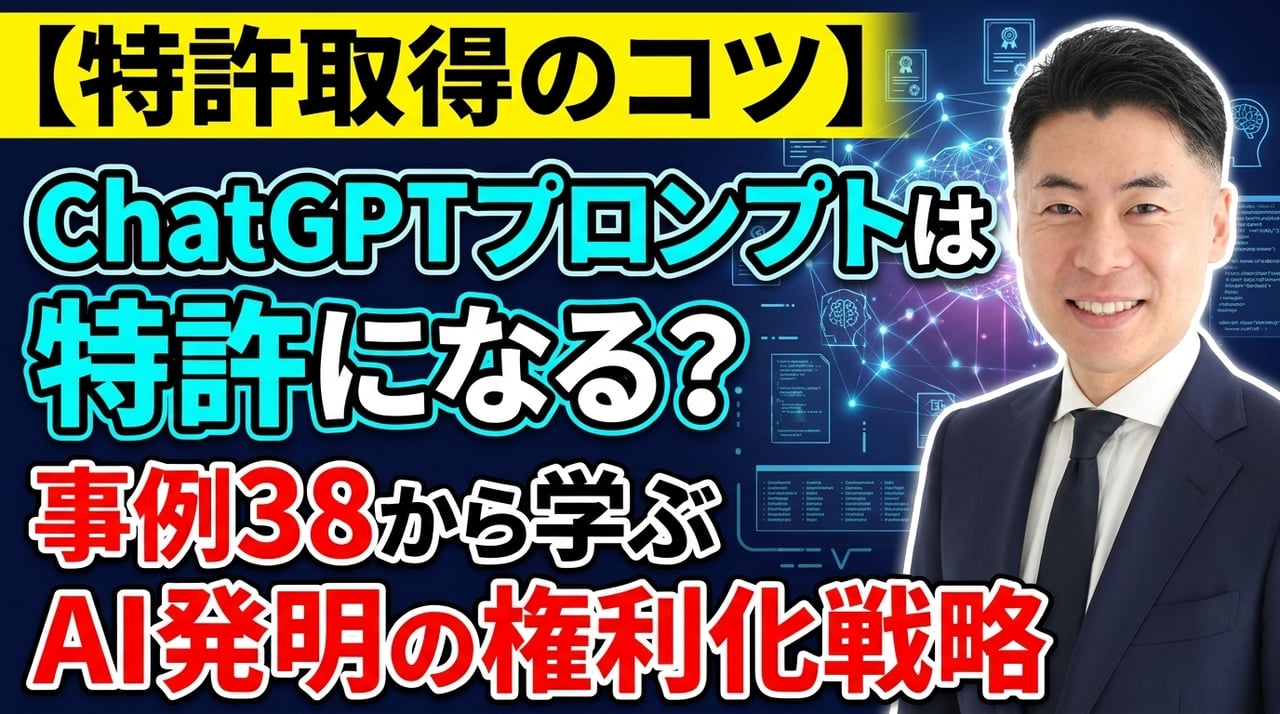
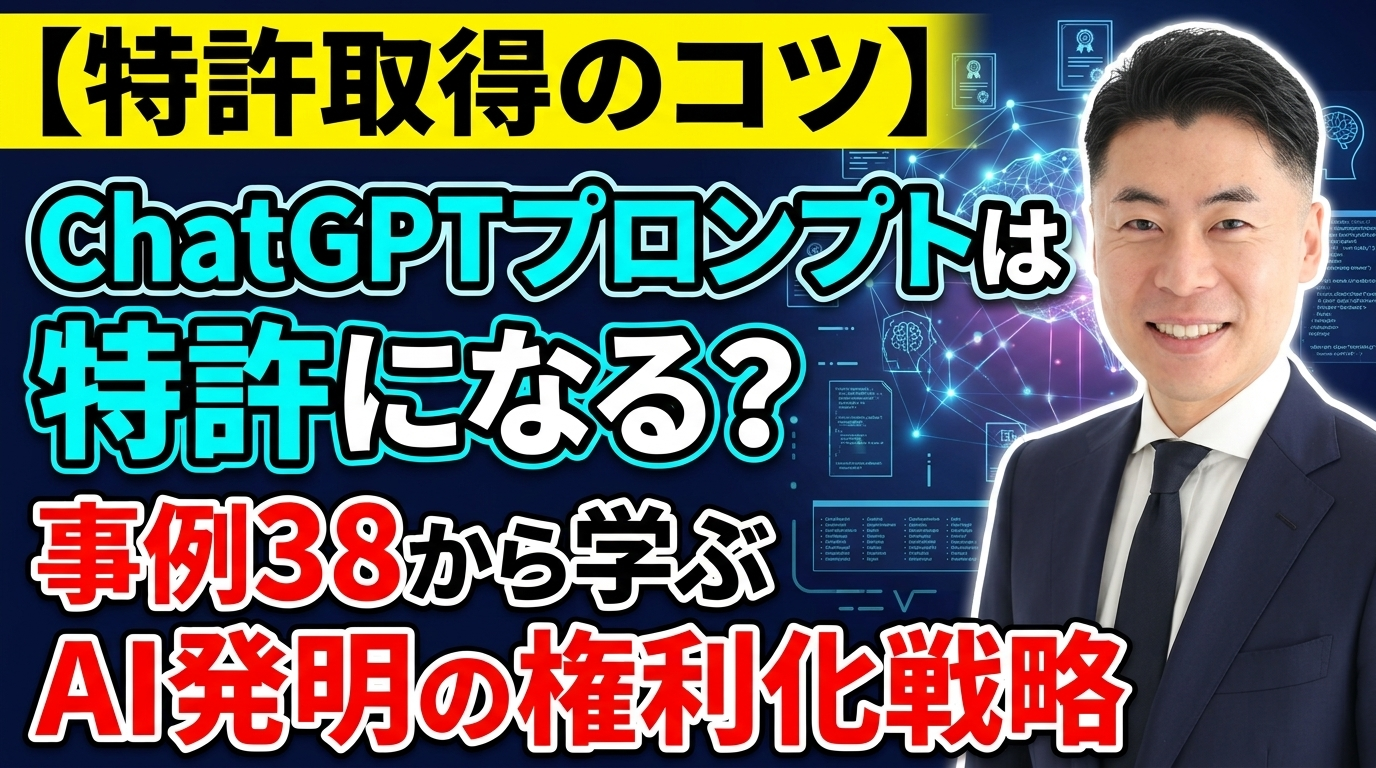
“When I ask a question on ChatGPT, how can I get the best answer?”—this is a question many users have. This technical field, called prompt engineering, has become important in business and is also attracting attention as the subject of patent applications. However, can innovations in how to use AI tools be recognized as patents? In this article, we will explain in detail from a patent attorney's perspective the conditions under which a large-scale language model (LLM) prompt generation technology such as ChatGPT can be patented, using case 38 published by the Japan Patent Office.
In March 2024, the Japan Patent Office expanded the examination cases of AI-related technologies and published 38 cases related to "prompt text generation method." This case shows that the method of using AI tools such as ChatGPT can be patentable, and has important implications not only for AI development companies but also for general companies that utilize AI tools.
In this article, we will explain this case 38 in detail and clarify the difference between "mere use of AI" and "patentable AI utilization technology." By reading this, you will understand the possibility that your company's AI utilization method can be patented, as well as the patent risks of your competitors. Additionally, you can get hints on how to structure your IP strategy for future business development.
1. Overview and technical background of case 38
1.1 Position and background of case 38
Case 38 "Prompt sentence generation method for input to a large-scale language model" has been published as a case study regarding determination of inventive step. This case study is an introduction to techniques for optimizing input to LLM, particularly how to generate effective prompts within the technical constraints of a limited number of characters.
Currently, many LLMs, including OpenAI's GPT series, have an upper limit on the number of tokens (number of characters) that can be entered at one time. For example, GPT-4 has an input limit of 8,192 or 32,768 tokens depending on the model. How to create high-quality prompts within these constraints is an important technical issue in effectively utilizing LLM.
In particular, RAG (Retrieval-Augmented Generation) technology, which improves the accuracy of LLM answers by adding context and reference information, is attracting attention, and technology that efficiently and effectively adds information with a limited number of input tokens can be said to have high practical value.
1.2 Claim of Case 38
Case 38 presents the following two claims.
Claim 1 (no inventive step)
A prompt sentence generation method in which a computer generates a prompt to be input into a large-scale language model by adding reference information to an input question sentence,
The large-scale language model has a character limit that is the upper limit of the number of prompt characters that can be input, and when a prompt including a question sentence is input, an answer sentence regarding the question sentence is output. Based on the input question sentence, an additional sentence generation step that generates an additional sentence related to the question sentence so that the total number of characters including the number of characters of the question sentence is equal to or less than the limited number of characters; a prompt generation step of generating the prompt by adding the additional sentence generated in the additional sentence generation step as the reference information to the input question sentence;
Claim 2 (inventive step)
The prompt text generation method according to claim 1, wherein the additional text generation step is a step of obtaining a plurality of related texts related to the input question text based on the input question text, extracting a plurality of keywords suitable as the reference information from the obtained plurality of related texts, and using the plurality of keywords to generate the additional text in which the total number of characters does not exceed the limited number of characters.
2. Detailed analysis of technical content of case 38
2.1 Key points of detailed description of the invention
From the detailed explanation of the invention in Case 38, the following technical problems and solutions can be understood.
Technical issues
When using large-scale language models, there may be a limit on the number of characters that can be input, and there was a problem in that it was not possible to add an unlimited number of reference information to the input question text. The present invention aims to provide a method for adding valid reference information to question sentences and generating prompt sentences within a predetermined character limit.
Solution
The solution of claim 1 is to generate additional text based on the input question text so that the total number of characters including the number of characters in the question text is less than the limit number of characters, and add it to the question text to generate a prompt.
Claim 2 adopts, as a more specific solution, a method of acquiring multiple related sentences related to the question text, extracting keywords suitable for reference information from them, and generating additional sentences using those keywords. Regarding the acquisition of related texts, for example, a method is shown to extract information that is highly relevant to the question text from a database of the questioner's question history, behavior history, purchase history, etc.
Effect
The effect of claim 1 is that it is possible to generate a prompt with valid additional sentences added as reference information to the question text input within the character limit.
An additional effect of claim 2 is that it is possible to generate a prompt with additional text that is highly relevant to the question text and suitable as reference information within a predetermined character limit, and that it is possible to obtain more reliable and appropriate answer texts.
2.2 Drawing explanation
Case 38 does not include detailed drawings, but based on the description in the book, the following system configuration is conceptually assumed.
- Question input section: Accepts questions from users
- Related text acquisition section: Obtains multiple texts related to the question text
- Keyword extraction part: Extracts keywords suitable for reference information from the obtained related texts
- Additional text generation unit: Generates additional text using the extracted keywords, taking into account the character limit
- Prompt generator: Generates a prompt by combining question text and additional text
- Large-scale language model: Generate answers using generated prompts as input
3. Detailed analysis of inventive step determination in case 38
3.1 Cited inventions and common technical knowledge
In Case 38, the following cited invention 1 and common general technical knowledge are shown.
Cited invention 1
A prompt text generation method in which a computer generates a prompt to be input to a large-scale language model by adding reference information to an input question text,
The large-scale language model is a large-scale language model that outputs an answer regarding the question text when a prompt including a question text is input,
The computer: r>An additional sentence generation step of generating an additional sentence related to the question sentence based on the input question sentence;
A prompt generation step of generating the prompt by adding the additional sentence generated by the additional sentence generation step to the input question sentence as the reference information;
Technical knowledge
In the technical field of language processing, preventing the amount of information processing from becoming excessive is an obvious problem that those skilled in the art usually consider.In addition, as a solution to this problem, it is well known at the time of filing to set a character limit that is the upper limit of the text that can be input, and when the text exceeds the limit, discard the part that exceeds the limit so that the actual input text is created to have the number of characters less than the limit.
3.2 Determination of inventive step of claim 1
Comparing Claim 1 and Cited Invention 1, the following differences are recognized.
Differences
In the large-scale language model of the invention according to claim 1, a limit number of characters is set as the upper limit of the number of prompt characters that can be input, and the additional sentence generation step is performed to generate the question text so that the total number of characters including the number of characters of the question text is equal to or less than the limit number of characters. While the large-scale language model of Cited Invention 1 generates additional sentences related to sentences, it is unclear whether or not there is a character limit set that is the upper limit of the number of prompt characters that can be input, and it is unclear whether the additional sentence generation step generates additional sentences as described above.
With regard to this difference, the examiner has determined that, considering the above-mentioned common general knowledge, a person skilled in the art could have easily conceived of generating the additional text so that the number of characters is below the limit.
Specifically, considering the amount of information to be processed is a self-evident issue in the field of language processing, and applying the well-known technique of setting a character limit and discarding the portion exceeding the limit is nothing more than the exercise of the ordinary creative ability of those skilled in the art.
3.3 Determination of inventive step of claim 2
Regarding claim 2, in addition to the above differences, the following differences are recognized.
Additional differences
The additional text generation step of the invention according to claim 2 obtains a plurality of related texts related to the question text based on the input question text, extracts a plurality of keywords suitable as reference information from the obtained plurality of related texts, and uses the plurality of keywords to generate an additional text whose total number of characters does not exceed the limit number of characters, whereas the additional text generation step of the cited invention 1 does not include such specification.
Regarding this difference, the examiner has determined as follows.
-
No prior art has been discovered that discloses a configuration in which a plurality of related sentences are acquired, keywords suitable for reference information are extracted from them, and additional sentences are generated within the limited number of characters using the keywords, nor is it common general knowledge at the time of filing.
-
The invention according to claim 2 has an advantageous effect compared to the cited invention 1 in that, due to the configuration, "a prompt with additional text that is highly relevant to the question text and suitable as reference information can be generated within a predetermined limited number of characters, and a more reliable and appropriate answer text can be obtained."
-
This is not just a design change, but an invention with an inventive step.
4. Points to learn from Case 38 in determining the patentability of LLM-related inventions
4.1 Specificity of the means to solve the technical problem
Claim 1 of Case 38 is denied inventive step because it merely presents an abstract solution of "generating additional sentences so that the number of characters is below the limit." This is because it is common technical knowledge to consider the character limit, and those skilled in the art can easily come up with the idea of simply keeping it within the character limit.
On the other hand, claim 2 specifically identifies the following three steps.
- Get multiple related texts related to the question text
- Extract multiple keywords suitable for reference information from multiple retrieved related sentences
- Use the extracted keywords to generate additional text within the character limit
The description of this specific solution leads to a positive judgment of inventive step.
For LLM-related inventions, it is not enough to simply "use LLM"; it is important to present specific technical means. In particular, it is effective to assert inventive step by adding unique innovations to the preprocessing of input data and postprocessing of output data, and specifying the specific processing flow.
4.2 Effect salience and non-obviousness
One of the reasons why claim 2 was determined to have inventive step is that the effect of "obtaining a more reliable and appropriate response text" was evaluated as an effect that is difficult to predict based on cited invention 1.
This effect is not just a quantitative effect of cramming information into a limited number of characters, but focuses on the fact that by using keywords extracted from related sentences, it is possible to generate qualitatively superior additional sentences. In other words, we are claiming the effect of qualitative improvement within quantitative constraints (limited number of characters).
For LLM-related inventions, it is also effective to claim effects that go beyond simple automation and efficiency, especially the following effects.
- Improvement of processing accuracy and quality
- Reducing computational resources
- Improving learning efficiency
- Improved user experience
- Improved data security
4.3 Differentiation from well-known technology
In Case 38, the novel method of ``extracting keywords from related sentences and generating additional sentences'' was judged to be an inventive step, as opposed to the well-known technique of ``setting a limit on the number of characters and discarding the part that exceeds it''.
From this judgment, it is clear that it is important to clarify the points of differentiation from well-known technologies, such as the following, even in LLM-related inventions.
- Unique method for preprocessing input data
- Unique method for post-processing output data
- Unique method for LLM operation control
- Unique approach to user interface
- A unique approach to data management
5. Patent application strategy for LLM-related inventions
5.1 Points of writing claims
The following points can be learned from Case 38 when writing claims for LLM-related inventions.
5.1.1 Clarify technical issues
Rather than simply improving efficiency and automation, we will set specific technical issues in the use of LLM. For example:
- The challenge of generating high-quality prompts within the character limit
- Improving accuracy and reproducibility of LLM output
- Issues to improve LLM response speed
- The challenge of efficiently imparting specialized knowledge in a specific field to LLMs
5.1.2 Describe specific solutions
Describe the steps of a concrete solution, not an abstract one. As in Claim 2 of Case 38, it is effective to describe a solution that combines multiple steps (obtaining related sentences → extracting keywords → generating additional sentences).
5.1.3 Include components that support effectiveness
It is important to include technical features that support the effect in the claim, such as "extracting keywords suitable for reference information." This allows us to claim that it is not just a design change, but a technical ingenuity aimed at a specific outcome.
5.1.4 Prepare multiple independent claims
Although Case 38 shows only a method invention, in an actual application, you should consider preparing multiple independent claims as shown below.
- Invention of method
- Invention of device
- Invention of programs
- System invention
- Inventions involving communication between a server and a client
5.2 Points to write in the specification
The following points are particularly important when preparing specifications for LLM-related inventions.
5.2.1 Detailed description of the technical issue
Specifically point out the problems of the prior art and clearly explain the technical issues that the present invention attempts to solve. In Case 38, the issue of "existence of character limit" is clearly stated. For LLM-related inventions, it is important to specifically describe the following issues.
- LLM input limits (number of tokens, number of characters, etc.)
- Instability or inaccuracy of LLM output
- Computational resource savings
- Lack of knowledge in specialized field
- Privacy and security concerns
5.2.2 Specific description of embodiment
We will describe concrete implementations rather than abstract explanations. It is important to explain in detail the method for acquiring related sentences, the keyword extraction algorithm, the sentence generation process, etc.
Specifically, it is effective to include the following contents.
- System configuration diagram and data flow
- Detailed algorithms for each processing step
- Specific input/output examples
- Parameter setting method and optimization method
- Error handling and exception handling
5.2.3 Evidence of effectiveness
It is effective to support the effect of ``obtaining more reliable and appropriate response sentences'' with specific experimental results or comparative data. For example, you should consider including supporting information such as:
- Comparison experiment with conventional method
- User evaluation results
- Quantitative evaluation of processing speed and accuracy
- Comparing resource usage
- Effects in actual usage scenarios
5.2.4 Identification of technical field
By clarifying the specific technical field to which the LLM-related invention is applied (e.g. customer support, medical diagnosis, legal consultation, etc.) and describing the challenges and effects specific to that field, patentability can be expected to improve.
6. Summary: Strategy for obtaining rights for LLM-related inventions
From the analysis of Case 38, the following are important points in obtaining rights for LLM-related inventions.
6.1 Rather than simply using LLM, clarify unique technical innovations
- Pre-processing of input data (e.g. keyword extraction from related sentences)
- Post-processing of output data
- LLM operation control (e.g. optimization within character limit)
- User interface improvements
- Customization for specific fields
6.2 Clearly explain technical challenges and effects
- Technical challenges beyond simple automation and efficiency
- Significant effects that are difficult to predict
- Qualitative improvement within quantitative constraints
6.3 Clarify the points of differentiation from well-known technologies
- Instead of simply limiting information processing, ideas to improve quality
- A unique approach different from existing AI technologies
- Use of specialized knowledge in specific technical fields
6.4 Consider multiple rights acquisition strategies
- Invention of method, invention of device, invention of program...
- Combination of superordinate and subordinate concepts
- Individual feature rights and combination feature rights
In patent applications for LLM-related inventions, it is difficult to recognize inventive step simply by using LLM. However, as Case 38 shows, by adding specific technical innovations such as preprocessing input data and optimizing output data, it is possible to obtain a patent with an inventive step.
In recent years, various services utilizing LLM such as ChatGPT and Gemini have appeared, but in order to differentiate them and secure competitive advantage, it is essential to strategically obtain rights for LLM-related inventions. In particular, technologies that achieve higher quality LLM usage by adding ingenuity to preprocessing input data, as in Case 38, will become increasingly important in the future.
Our firm has a wealth of experience in filing patent applications for AI/LLM-related inventions, and supports the planning of patent acquisition strategies based on the latest examination trends. If you are concerned about patent protection for a new business that utilizes large-scale language models, please feel free to contact us.
References
- Japan Patent Office “Patent and Utility Model Examination Handbook Annex A and Annex B” revised in March 2020
- Japan Patent Office “Addition of examination cases for AI-related inventions” (March 2020)
- Japan Patent Office "Examination Guidelines Part III Chapter 2 Section 2 Inventive Step"
- Japan Patent Office “Case studies related to AI-related technologies”
- Japan Patent Attorneys Association “Research report on patent practices for AI-related inventions”
🤖 For those who created a draft of a patent specification with ChatGPT
You are welcome to bring in your AI drafts. A patent attorney who specializes in IT and AI patents will rewrite the generated AI draft into a "strong title deed that protects your business."
Leave the final check of the statement quality to a professional with over 15 years of experience in intellectual property practice.
AUTHOR
Takefumi SUGIURA (杉浦 健文)
EVORIX Intellectual Property Law Firm Managing Patent Attorney
Supports clients across IT, manufacturing, startups, fashion, and medical industries, covering patent, trademark, design, and copyright filings through trials and infringement litigation. Specialized in IP strategy for AI, IoT, Web3, and FinTech. Member of the Japan Patent Attorneys Association (JPAA), Asian Patent Attorneys Association (APAA), and Japan Trademark Association (JTA).

![[Forefront of patent practice] Can business planning support technology using AI be patented? Strategies for obtaining rights for business-related AI inventions learned from Case 47](https://www.evorix.jp/hs-fs/hubfs/blog-thumbnails/face-post-189997481655.png?height=200&name=face-post-189997481655.png)