.png?width=500&height=250&name=%E7%9F%A5%E7%9A%84%E8%B2%A1%E7%94%A3%E4%BA%8B%E5%8B%99%E6%89%80%E3%82%A8%E3%83%9C%E3%83%AA%E3%82%AF%E3%82%B9%20(500%20%C3%97%20250%20px).png)


When you file a patent application and request examination, you may receive a “Notice of Reasons...
Hello, my name is Takefumi Sugiura and I am a patent attorney. This time, we will explain in detail the important knowledge regarding trademark registration, especially "trademarks that cannot be registered." There are many cases where an application is rejected at the examination stage. Therefore, we will explain what types of trademarks cannot be registered, along with the reasons and specific examples.
*The description is intended for the general public, not experts.
Three major categories of trademarks that cannot be registered
.svg)
Under the Trademark Law, there are cases in which a trademark cannot be registered for the following three reasons:
- Items that do not have the ability to distinguish one's own goods and services from others (Trademark Law Article 3)
- Things that are against the public interest (Article 4 of the Trademark Law)
- Anything that is confusingly similar to another person's trademark (Article 4 of the Trademark Law)
Let's take a closer look at each.
1. Items that do not have the ability to distinguish between own and other goods and services
The essential function of a trademark is to distinguish your goods and services from those of others. In the following cases, this function cannot be performed and registration cannot be performed.
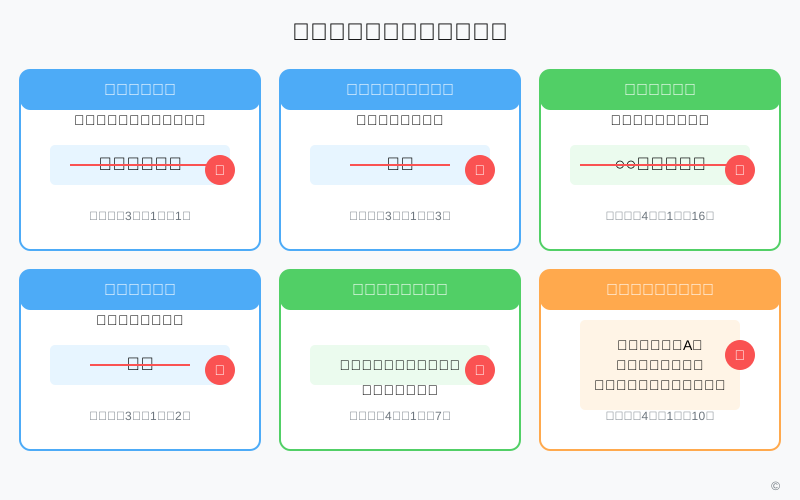
① Trademark with common name only (Article 3, Paragraph 1, Item 1)
The generic name of a product or service should be one that anyone can use.
Example: Even if you apply for a trademark for "aluminum" or "aluminum" for a product called "aluminum", it will not be registered.
② Trademarks commonly used in the industry (Article 3, Paragraph 1, Item 2)
Even if a name is commonly used among people in the same industry, it should not be used exclusively by certain people.
Example: "Masamune" cannot be registered as a trademark for sake because it is used idiomatically.
③ Mere indication of origin, quality, etc. (Article 3, Paragraph 1, Item 3)
A mark that only indicates the origin and quality of a product, or the location and quality of a service, also lacks distinctiveness.
Example:
- “Tokyo” for “sweets” (production area)
- “Special tailoring” (quality) for “shirts”
- "Tokyo Ginza" for "food and drink provision" (provided location)
④ Common names and appellations (Article 3, Paragraph 1, Item 4)
General names that appear in many telephone directories or names such as "○○ Co., Ltd." lack distinctiveness.
Example: Yamada, Suzuki, Tanakaya, Sato Shoten
⑤ Extremely simple and common mark (Article 3, Paragraph 1, Item 5)
Symbols and characters that are too simple are judged to have low discrimination power.
Example:
- One kana character
- Numbers
- Common shapes (○, △, □)
- 1-2 letters of the alphabet
⑥ Other items without discernment (Article 3, Paragraph 1, Item 6)
Example:
- Just a background pattern
- Common slogans and catchphrases
- Current era name
Exception: Distinctiveness by use (Article 3, Paragraph 2)
However, in exceptional cases, registration may be possible if, through long-term use, consumers have come to associate the product with a specific company or product. For example, ``Yubari Melon'' was originally a combination of a place name and a product name, but through years of use it has acquired distinctiveness and has been registered.
The following materials are required for the proof:
- Evidence of trademarks and products/services actually used
- Data such as period of use, region, production volume, number of advertisements, etc.
2. Items that violate the public interest, such as being confusing with marks of public institutions
Marks with public meaning or marks that are against the public interest cannot be registered.
① National flag, chrysanthemum emblem, medals, etc. (Article 4, Paragraph 1, Item 1)
Symbols related to national dignity should not be used as trademarks.
② Marks of international organizations, Red Cross, etc. (Nos. 2-5)
International credentials and humanitarian symbols are also protected.
Example: International Atomic Energy Agency mark, Red Cross, Geneva Cross
③ Famous emblem representing the national or local government (No. 6)
Example: Marks of prefectures/municipalities, Tokyo Metropolitan Bureau of Transportation marks
④ Trademark that violates public order and morals (No. 7)
Any content that is obscene, discriminatory, offensive, or whose use is prohibited by law.
⑤ Misperception of product/service quality (No. 16)
Trademarks that give an impression different from the content cannot be registered from the perspective of consumer protection.
Example:
- “Beer” and “○○ Whiskey”
- “Panda almond chocolate” for “sweets” (if it does not contain almonds)
3. Anything that is confusingly similar to someone else's trademark
To protect the rights of others, the following trademarks cannot be registered.
① Other person's name, name, stage name, etc. (No. 8)
The name of an existing natural or legal person cannot be registered as a trademark without that person's consent.
Example: Names, photos, and illustrations of famous people
② Identical or similar to another person's well-known trademark (No. 10)
A trademark that is the same or similar to a trademark that is widely known in a specific industry or region cannot be registered for the same or similar products or services.
③ Identical or similar to another person's registered trademark (No. 11)
A trademark that is the same or similar to a previously registered trademark cannot be registered for the same or similar goods or services (first-to-file principle).
④ Risk of confusion with other people's business (No. 15)
Even if the product or service is different, it cannot be registered if there is a risk of misunderstanding that it is related to a well-known trademark.
⑤ Application for fraudulent purposes (No. 19)
Applications for the purpose of purchasing well-known foreign trademarks or applications for the purpose of diluting the value of well-known trademarks will not be accepted.
Summary: Checkpoints before trademark application
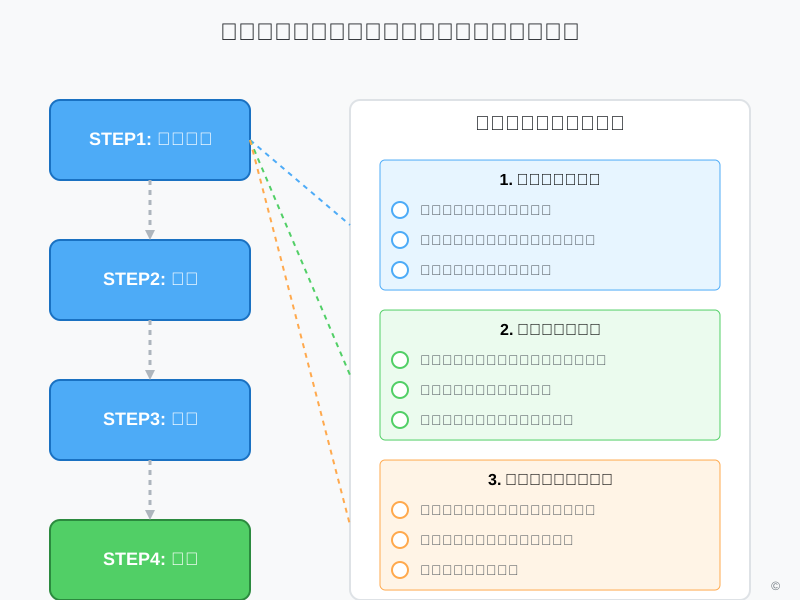
When considering trademark registration, please check the following points in advance:
- Are you discerning?: Check through dictionaries and web searches
- Is it against the public interest: Investigate through J-PlatPat, dictionary or web search
- Does it infringe on the rights of others: Search for prior trademarks using J-PlatPat etc.
Trademark filing may seem simple at first glance, but there are actually many pitfalls. Rather than responding after receiving the reasons for refusal, you can obtain rights more smoothly by consulting with an expert in advance.
If you have any questions regarding trademarks, please leave them in the comments section. Next time, I plan to explain in detail how to acquire distinctiveness through use.
*This article is intended to provide general information; please consult a patent attorney or other specialist regarding your individual case.

AUTHOR
Takefumi SUGIURA (杉浦 健文)
EVORIX Intellectual Property Law Firm Managing Patent Attorney
Supports clients across IT, manufacturing, startups, fashion, and medical industries, covering patent, trademark, design, and copyright filings through trials and infringement litigation. Specialized in IP strategy for AI, IoT, Web3, and FinTech. Member of the Japan Patent Attorneys Association (JPAA), Asian Patent Attorneys Association (APAA), and Japan Trademark Association (JTA).