.png?width=500&height=250&name=%E7%9F%A5%E7%9A%84%E8%B2%A1%E7%94%A3%E4%BA%8B%E5%8B%99%E6%89%80%E3%82%A8%E3%83%9C%E3%83%AA%E3%82%AF%E3%82%B9%20(500%20%C3%97%20250%20px).png)


Introduction: ``Waiting for patents'' is the biggest risk for startups where speed is vital "I've...
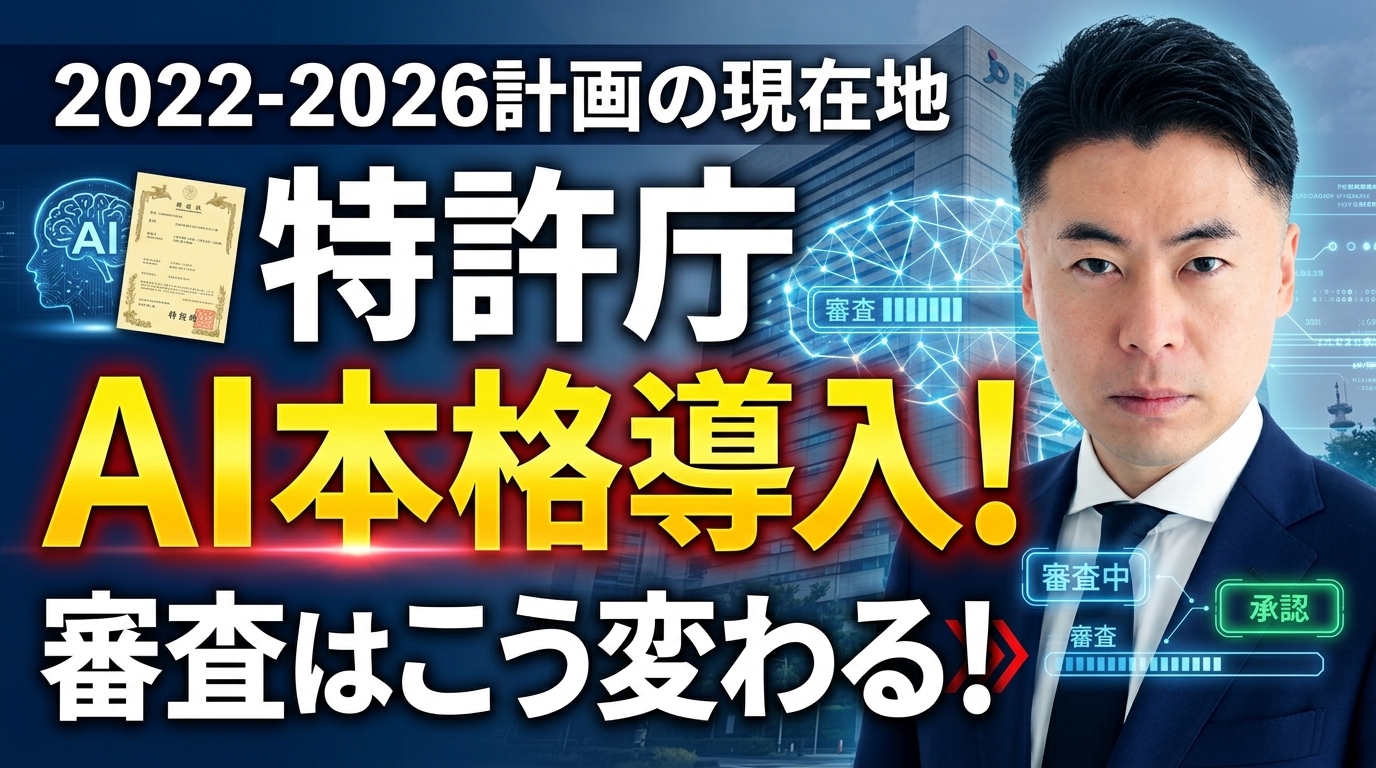
The Japan Patent Office (JPO) has decided to fully introduce AI (artificial intelligence) technology in order to address the dual challenges of rapidly increasing patent applications and improving the quality of examinations. The AI Action Plan, formulated in 2022, is an ambitious roadmap to incorporate AI into the core of the patent examination process over a four-year period until 2026.
This plan has the potential to greatly change the future of Japan's intellectual property system, including automating prior art searches, machine translation of foreign language documents, increasing the sophistication of design and trademark examinations using image recognition AI, and even examining the applicability of generative AI.
However, the introduction of AI is not just for examiners. For applicants, inventors, and patent attorneys, the intervention of AI in the examination process creates a completely different "new threat." In this article, we will provide an overview of the JPO's AI action plan, as well as delve deeper into the challenges faced by applicants in the age of AI examination and the value of patent attorneys' intervention in response.
Table of Contents
- What is the AI action plan?—Overall picture of examination DX drawn by the Japan Patent Office
- How is AI implemented in examinations—four technical areas
- Three threats in the era of AI examination—risks that applicants should be aware of
- The value of a patent attorney's intervention—specialized knowledge required in the AI era
1. What is the AI action plan?—Overall picture of examination DX drawn by the Japan Patent Office
1-1. Background of plan formulation
The number of patent applications filed in Japan reaches approximately 300,000 annually, and the processing burden on each examiner is increasing year by year. In addition, as technology becomes more sophisticated and complex, the scope of prior art searches has expanded dramatically. With traditional keyword searches and classification code-based research methods, it is becoming difficult to efficiently discover truly relevant prior art from a vast collection of documents.
In response to this situation, the Japan Patent Office has formulated an "AI Action Plan" in 2022 to systematically incorporate AI technology into the examination process. This plan is not just an extension of digitalization, but a major turning point in intellectual property administration, as it uses the power of AI to improve the quality of examinations themselves.
There is also a global trend toward the use of AI. Major patent offices such as the United States Patent and Trademark Office (USPTO), European Patent Office (EPO), and China National Intellectual Property Administration (CNIPA) are also pursuing their own AI strategies. In order for the JPO to maintain its international competitiveness and continue to provide speedy and high-quality examination services to applicants, the introduction of AI was an unavoidable issue.
1-2. Overview of action plan
The AI Action Plan is a comprehensive roadmap covering the five years from FY2022 to FY2026. The core of this is to gradually introduce AI technology into multiple phases of patent examination and use it as a tool to support examiners' decisions.
AI action plan—four pillars
- AI support for prior art searches—Using natural language processing (NLP) and machine learning to dramatically improve search accuracy for patent and non-patent documents
- Translation AI for foreign language documents—Achieves highly accurate machine translation of patent documents from non-English speaking countries, mainly Chinese and Korean
- Utilization of image recognition AI——Using AI to help determine the similarity of shapes in design and trademark examinations
- Investigating the applicability of generative AI——Promoting research and development of examination support tools that utilize large-scale language models (LLM)
What is particularly noteworthy is that this plan does not aim for "automatic examination using AI," but rather that its basic philosophy is "utilization of AI as a tool for examiners." The final decision on whether or not to grant a patent will continue to be made by a human examiner.
New concept of "hybrid examination"
JPO aims for a "hybrid examination" model in which AI and examiners collaborate. AI extracts candidate prior art from a huge amount of data, and the examiner examines it and makes a decision.This division of labor is expected to speed up examinations and improve quality at the same time. However, this "hybrid" nature also creates new challenges for applicants. This is because the scope and accuracy of prior art that AI “finds” is fundamentally different from traditional examinations.
2. How is AI implemented in examinations—four technical areas
Based on the AI Action Plan, multiple AI technologies have already entered the demonstration and operation phase at JPO. Here we take a closer look at the implementation status of each of the four main technology areas and their impact on audits.
2-1. AI support for prior art search
Prior art search is a core process of patent examination. In order to determine the novelty and inventive step of a filed invention, it is necessary to comprehensively search related prior art documents. Traditionally, this work was done manually by examiners using the International Patent Classification (IPC) and keywords.
The AI Action Plan is progressing with the development and introduction of search support tools that utilize natural language processing (NLP) technology. This tool takes the text of the application specification as direct input and automatically ranks semantically similar prior art documents. Since searches are performed based on similarities in context and meaning, rather than relying on exact matches of keywords, it is possible to capture ``paraphrased expressions'' and ``similar technologies described in different technical terms,'' which are difficult to find with conventional searches.
Main features of AI prior art search
- Semantic search—Analyzes sentences in claims and specifications at a semantic level to detect conceptually similar documents
- Cross-lingual search——Search documents in English, Chinese, and Korean directly from Japanese application documents
- Inclusion of non-patent literature—Also includes academic papers, technical reports, standards documents, etc.
- Similarity scoring——Assigns a relevance score to each search result to help examiners prioritize
2-2. Foreign language literature translation AI
With globalization, the importance of foreign language documents in patent examination is increasing dramatically. In particular, China has the highest number of patent applications in the world, and Japanese examiners need to accurately understand the vast amount of prior art documents written in Chinese.
JPO is promoting the development of neural machine translation (NMT) systems specialized in the patent field. Unlike general-purpose translation engines, we aim to significantly improve translation accuracy by building a model that is optimized for the technical terminology, legal terminology, and writing style specific to patent documents.
Technical features of translation AI
- Domain-specific model——Additional learning with patent document corpus to optimize translation accuracy of technical terms
- Expansion of target languages——In addition to Chinese and Korean, support has been expanded to include European languages such as German and French
- Ensuring terminology consistency—Equipped with a mechanism that controls the translation of the same technical terms in the same document to be consistent
- Reflecting examiner feedback——Reflecting translation corrections made by examiners in the model to continuously improve accuracy
The advancement of translation AI will dramatically expand the scope of prior art that examiners have access to. This means that foreign language literature, which until now was virtually inaccessible due to language barriers, will now be actively cited in examinations. For applicants, this increases the possibility that technical information published in all languages around the world will stand in the way as "prior art."
2-3. Utilizing image recognition AI
Image recognition AI technology is mainly being used in the fields of design examination and trademark examination. In design examination, AI is used to determine the similarity between applied designs and existing registered and publicly known designs. In trademark examination, AI technology is being introduced for similar searches for graphic trademarks.
Application area of image recognition AI
- Design similarity search——Automatic search for similar designs in shape, pattern, and color using deep learning-based image feature extraction
- Trademark graphic search——Similarity determination of graphic trademarks based on visual characteristics without relying on the Vienna classification
- Drawing analysis——Automatically recognizes the components of patent drawings and supports extraction of technical features
- Response to partial designs——Support for determining the similarity between the applied partial design and the entire design
Drawing analysis capabilities are particularly noteworthy in the context of patent prosecution. If AI can automatically extract and analyze constituent elements from patent drawings, there will be a greater possibility that prior art that could not be found through text-based searches will be discovered based on similarities in the drawings.
2-4. Applicability of generative AI (LLM)
In response to the rapid development of large-scale language models (LLM) such as ChatGPT, JPO is actively considering the possibility of applying generative AI technology to examination operations. Although this is an advanced initiative that goes beyond the original scope of the action plan, it is an extremely important area when considering the future of AI examinations.
Potential application areas for generative AI are being considered, such as assisting in drafting examination reports, assisting in claim interpretation, generating summaries of technical fields, and automating format checks of application documents. However, since patent examination is an administrative act with legal effect, dealing with the risk of "hallucination" (generation of information that is not based on facts) of generative AI has become a major issue.
Area of consideration for generation AI
- Examination report draft support——Automatically generates a draft of the notice of reasons for refusal, reducing the burden of writing on the examiner
- Claim interpretation assistance—-Disassembles and organizes the components of complex claims and clarifies the technical features of the invention
- Technology trend analysis—Automatic analysis of application trends and direction of technology development in specific technology fields
- Format check automation——Initial screening of application document format requirements (description requirements, clarity requirements)
The introduction of generative AI to examination operations is still in the research and demonstration stage, but its impact is expected to be extremely large in the future. This is because when AI generates a draft of the review report, the quality of that draft may directly affect the final review result.
Overall picture of AI introduction technology—Summary of impact by tool
| AI technology area | Main tools/methods | Impact on review | Impact on applicant |
|---|---|---|---|
| Prior art search AI | Semantic search, NLP-based ranking | Drastically improve search coverage | Difficult to avoid using paraphrase |
| Translation AI | Domain-specific NMT | Expanding the scope of use of foreign language literature | Risk of documents from all over the world becoming prior art |
| Image recognition AI | Deep learning-based image feature extraction | Improving the accuracy of design/trademark similarity determination | Increased rejection risk due to graphical similarity only |
| Generation AI (LLM) | Large language model | Report creation/complaint analysis support | Response to reasons for rejection based on AI draft |
3. Three threats in the age of AI examination—risks that applicants should be aware of
While the introduction of AI in examination brings the benefits of streamlining examinations and improving quality, it also creates new threats for applicants that they have never experienced before. Here, we will explain the specific mechanisms and impacts of the three major threats that applicants will face in the era of AI examination.
3-1. Threat ① Identification of paraphrased expressions - Threat of semantic search
Traditional patent search systems search for documents based on exact or partial keyword matches. For this reason, it was possible for the applicant to differentiate the application from the prior art by "rephrasing" technical terminology, whether intentionally or not. For example, if the prior art uses the term "container" and the applicant uses a different expression, "accommodating member," the prior art may not be found in a keyword search.
Threat level: High
Semantic search AI searches based on "semantic similarity" rather than superficial word matches. As a result, even if different expressions such as "container," "accommodating member," "housing," "casing," and "retention structure" are used, the system recognizes them as referring to the same technical concept and detects all related prior art. The "terminology barrier" protection that applicants have unwittingly enjoyed in the past will be significantly weakened. There is a need to fundamentally rethink term selection strategies when writing claims.
This threat is particularly noticeable in software-related inventions and business model patents. In these fields, it is common to express the same technical idea using a variety of terms, and in the past, differences in terminology have functioned as de facto "barriers to entry." The introduction of AI semantic search will remove this barrier.
3-2. Threat ② Combining literature from different fields—“Unexpected combinations” created by AI
When determining inventive step in patent examination, the question is whether "it would have been easy for a person skilled in the art to arrive at the structure of the applied invention" by combining multiple prior art documents. Traditionally, examiners have primarily focused on combining documents in the same technical field or in closely related fields. Combining literature from different technical fields requires knowledge of both fields, which is a practical limitation.
Threat level: High
AI-based prior art searches have the ability to cross-search documents beyond the boundaries of technical fields. Because machine learning models are not constrained by ``specialty'' like human examiners, they can present ``unexpected combinations'' such as combining medical technology with agricultural literature or automotive technology with aerospace technology. For applicants, the risk of having inventive step denied not only based on prior art in their own technical field but also in a completely different field increases significantly.
This problem has become more serious in conjunction with the recent technology fusion trend. In fields such as IoT, AI, and biotechnology, inventions that combine technologies from different fields are increasing, and the scope of "related documents" discovered by AI may far exceed conventional expectations. For applicants, a prior art search limited to their own technical field will no longer be sufficient, and they will be required to conduct a search from a broader perspective.
3-3. Threat ③ Overflow of prior art—explosive increase in number of cited documents
With the introduction of AI prior art search tools, the number of prior art documents that examiners can refer to for a single application is expected to increase dramatically. Traditionally, due to examiners' time and physical constraints, there was a practical upper limit to the number of cited documents per application. However, if AI automatically extracts and ranks related documents, this restriction will be greatly alleviated.
Threat level: Medium to high
If the number of prior art documents cited in a notice of reasons for refusal increases, the scope of prior art that applicants should address in written opinions and written amendments will also expand. Even in cases where it would have been sufficient to construct a counterargument for two or three cited documents in the past, AI may discover 10 or more related documents and need to construct a logic of differentiation for each. This means a significant increase in the applicant's response costs (time and expenses).
Furthermore, the increase in the number of cited documents also raises the issue of "quality of the literature." The documents automatically extracted by AI based on relevance scores may include “subtly related” documents that would not have been cited if the examiner had manually screened them. Applicants will be required to respond formally to such "noise" cited documents, and there is a concern that the procedure will become complicated.
In addition, if a large amount of non-patent documents (academic papers, technical blogs, standardization documents, etc.) are discovered by AI, applicants will be required to accurately understand the content of these non-patent documents and be able to demonstrate the difference from their own invention. Non-patent documents differ from patent documents in that they do not have structured descriptions like claims, making it more difficult to identify and compare technical features.
4. The value of a patent attorney's intervention—specialized knowledge required in the AI era
The advent of the era of AI examination will not diminish the role of patent attorneys, but rather will further enhance the value of their expertise. As AI strengthens examination "weapons," applicants will also be required to have the same or better "defense power." Here, we will explain the four core values of a patent attorney's intervention in the age of AI examination.
① Prior art investigation in the AI era——aggressive investigation strategy
Patent attorneys can use AI tools themselves to conduct prior art searches before filing, allowing them to predict and understand in advance the prior art that examiners will discover using AI. This makes it possible to clearly highlight points of differentiation from prior art at the stage of preparing application documents. Furthermore, by accurately verbalizing technical differences based on ``tacit knowledge'' and ``industry practices,'' which AI searches are weak at, and stating them in the specification, we ensure differentiating factors that AI may miss. The unique value of a patent attorney is to be able to plan and execute an "offensive investigation strategy" that takes advantage of AI's capabilities, rather than just a defensive response.
② Multi-layered claim design——building rights with an eye on AI search
With the introduction of semantic search AI, it will be difficult to differentiate by rephrasing terms. Patent attorneys will carry out "multi-layered claim design" in response to this new environment. In addition to broad independent claims, we strategically configure multiple levels of dependent claims to create a fallback structure that allows AI to assert patentability at any claim layer, no matter what prior art it discovers. In addition, we ensure the robustness of claims by effectively incorporating "quantitative differentiating factors" that are difficult to capture with AI semantic searches, such as numerical limitations, process conditions, and specific combinations.
③ Building an invention story——The power of "context" that AI cannot understand
Although AI is good at detecting similarities in individual technical features, it has limitations in understanding the "context" in which inventions were born and the "logical chain of problem-solving." By constructing a consistent "story" of the background, problems, solutions, and effects of the invention in the specification, a patent attorney creates a basis for effectively asserting the inventive step of the invention as a whole, which goes beyond the similarities of individual components. In particular, in rebutting a combination of multiple prior art, the ability to logically explain from the technical context why the combination was not easy for a person skilled in the art is an area where a patent attorney's expertise is most demonstrated.
④ Rights scope consulting—portfolio strategy in the AI era
With the introduction of AI examination, it is expected that the difficulty of obtaining patents will increase overall. Patent attorneys support strategic planning for the entire intellectual property portfolio in light of these changes in the environment. When it becomes difficult to secure a wide range of rights with a single patent, we propose maximizing coverage by strategically combining multiple patents into a "patent group." Furthermore, since the introduction status of AI examination varies by country and region, it is an important role for patent attorneys to formulate international application strategies that take into account the differences in examination practices in each country. Only a patent attorney can provide a consistent strategic perspective from filing to enforcement of rights.
Summary
JPO's AI Action Plan (2022-2026) will fundamentally change the way patent examinations are conducted in Japan. AI support for prior art searches, AI translation of foreign language documents, utilization of image recognition AI, and consideration of the applicability of generation AI—these four pillars have the potential to speed up examinations and improve quality at the same time.
However, it is also true that the introduction of AI creates new threats for applicants. In order to appropriately deal with these threats, such as detecting paraphrased expressions through semantic search, unexpected denial of inventive step due to the combination of documents from different fields, and an explosive increase in the number of cited documents, a new application strategy adapted to the AI era is essential.
And in formulating and implementing this new strategy, the expertise of patent attorneys will play a more important role than ever before. Understanding the capabilities of AI and designing an optimal filing strategy based on its strengths and limitations—this is the true value of a patent attorney's intervention in the age of AI examination.
Please contact us for patent strategy in the era of AI examination
In light of changes in the examination environment due to the introduction of JPO's AI, we will consult with you to optimize your company's intellectual property strategy.
We provide comprehensive support for the AI era, from strengthening prior art searches to reviewing claim designs.
Japan Patent Office JPO AI review AI action plan Prior art search Semantic search Patent Strategy Patent Attorney Generation AI

AUTHOR
Takefumi SUGIURA (杉浦 健文)
EVORIX Intellectual Property Law Firm Managing Patent Attorney
Supports clients across IT, manufacturing, startups, fashion, and medical industries, covering patent, trademark, design, and copyright filings through trials and infringement litigation. Specialized in IP strategy for AI, IoT, Web3, and FinTech. Member of the Japan Patent Attorneys Association (JPAA), Asian Patent Attorneys Association (APAA), and Japan Trademark Association (JTA).