.png?width=500&height=250&name=%E7%9F%A5%E7%9A%84%E8%B2%A1%E7%94%A3%E4%BA%8B%E5%8B%99%E6%89%80%E3%82%A8%E3%83%9C%E3%83%AA%E3%82%AF%E3%82%B9%20(500%20%C3%97%20250%20px).png)


"The OEM products we worked so hard to develop are now being sold to unknown sellers" "The product...
Introduction: Design is a "corporate asset." Are you ready to protect?
"I'm confident in the design of the new product, but I'm worried that other companies will copy it..."
"I want to register a design, but how is it different from a patent? Is the procedure difficult?"
For manufacturing companies and designers, "design" created with all their heart is an irreplaceable corporate asset. However, the better the design, the more there is a risk that cheap imitation products (copy products) will be available soon after the product is released, and the market will be taken over.
The strongest shield to protect yourself from such malicious imitation is "design rights".
If you obtain a design right, you can monopolize the design for up to 25 years and can demand that counterfeiters stop sales and pay damages. However, the procedure is a profound world that requires more specialized know-how than patents, such as ``creating drawings'' and ``judging similarities.''
In this article, an active patent attorney provides a thorough explanation of the seemingly complicated ``all steps from design application to patent acquisition'' with a single illustration. In addition to textbook-like explanations, it also covers``Tips for passing the examination on the first try'' and``Secret systems that will give your business an advantage''**, so please read until the end.
The big picture: A roadmap from ideas to "powerful rights"
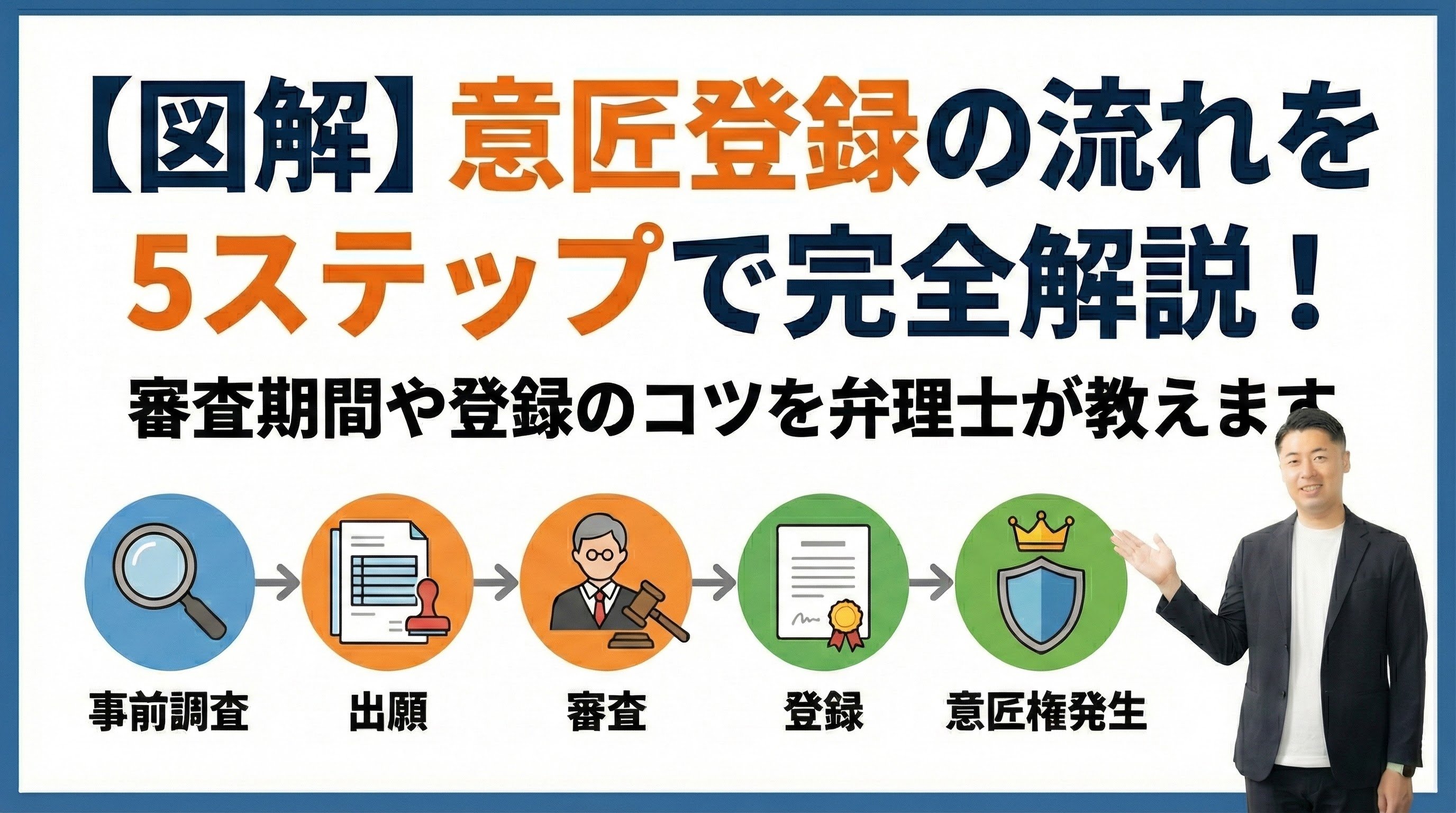
First, let's understand the overall flow of design registration. The flowchart below shows the standard process for your idea to be examined at the patent office and registered as a right.
.jpg?width=2752&height=1536&name=Gemini_Generated_Image_7irbdz7irbdz7irb%20(1).jpg)
This process proceeds in five main steps. Let's take a closer look at ``what to do'' and ``where mistakes are likely to occur'' in each process from a professional perspective.
Step 1: Preliminary investigation (search for prior designs)
The first step in registering a design is not drawing a design or creating documents, but starting with "research".
Why is research absolutely necessary?
The Design Act has a registration requirement of "Novelty (a design that no one in the world has known yet)".
If a design that is ``same'' or ``similar'' to the design you came up with has already been applied for in the past or published on the Internet, you will not be able to receive registration. Applying without doing your research is like paying to take a test that you're guaranteed to fail, wasting your money and time.
Investigation methods and "professional walls"
Generally, searches are performed using the free database "J-PlatPat (Patent Information Platform)" provided by the Industrial Property Information and Training Center, an independent administrative agency. However, unlike patents and trademarks, which can be searched by keyword, researching designs is extremely difficult.
-
Article classification (Japanese design classification): You must narrow down your search using the correct classification code.
-
D-term: You need to master search keys that encode shape characteristics (e.g. "round handle", "transparent body", etc.).
[Patent attorney's perspective] Even professionals have trouble determining "similarity"
The most difficult thing is "judgment of similarity (determination of similarity)".
Even if they appear to be completely different to the untrained eye, they may be judged to be similar under legal standards (common aesthetic sense through consumers' visual senses). On the other hand, even if they look exactly alike, there are cases where they can be determined to be "dissimilar" if you exclude "common shapes (common forms)".
This "judging the possibility of registration" is the first benefit of hiring a patent attorney.
Step 2: Preparation of application documents (strategy for creating drawings)
This is the biggest challenge in design applications.
While patents use "words (text)" to explain the technology and determine the scope of rights, designs use "drawings (appearance)" to determine the entire scope of rights.
"Six-sided diagram" that will decide your fate
As a general rule, it is necessary to create a drawing (orthographic projection) of the object viewed from the following six directions.
-
Front view
-
Back view
-
Plan view (view from above)
-
Bottom view (view from below)
-
Right side view
-
Left side view
These must be drawn according to strict drafting rules called "trigonometry." If there is even the slightest mistake in the thickness of a single line or the proper use of dotted lines, you will be asked to make corrections.
Can I apply with photos or CG?
Recently, applications using photos and 3D CAD data (CG) are also accepted.
You may think that it's easy if it's just a photo, but in reality, the more professional you are, the more careful you are. This is because photos can have light reflections (halation) or shadows, which can cause the image to be judged as having an unclear shape, or the shadows to be mistaken for a pattern.
``By daring to file an application with a line drawing (illustration), unnecessary information is removed and the scope of rights is made clear.'' is a commonly used technique.
Step 3: Application to the Patent Office
Once the set of documents is complete, submit it (application) to the Japan Patent Office. Currently, online applications using electronic certificates are the mainstream.
"First to apply" = Speed game
Japan's intellectual property system adopts a "first-to-file" system (first come, first served).
Even if you created and sold the design first, if another company files the application first due to a difference in touch, the rights will belong to that company.
While you are leisurely thinking, ``I'll apply after the exhibition ends next month,'' another company gets wind of your application and ends up applying for it. This is a real tragedy. The golden rule is to "apply as soon as the design is completed"**.
Step 4: Examination (strict check by patent office examiner)
The submitted documents will be rigorously examined by the patent office examiner. Unlike patents, designs are, in principle, fully examined (there is no need to request an examination).
How long is the review period?
Normally, it takes about 6 to 8 months on average from application to receiving the first result (decision of registration or notice of reasons for refusal).
(*If you are in a hurry, the time can be shortened to about 2 months by using the "Early Examination System" described below)
Main screening criteria (hurdles to clear)
The examiner mainly checks the following points.
-
Novelty: Is it not known to the public before the application is filed?
-
[Very important] Be careful not to "accidentally publish" on SNS!
-
If you announce a product on your company's Instagram, blog, exhibition, etc. before filing, the "novelty" will be lost at that point, and as a general rule, you will not be able to register it.
-
*Even in the unlikely event that your work is made public, you may be able to receive a remedy called ``Exception to Loss of Novelty''** within one year. Please don't give up and contact us immediately.
-
-
Creative difficulty: From the perspective of a professional designer, isn't it easy to come up with an existing design?
-
Items such as ``simply enlarging an existing shape'' or ``just pasting a famous character'' will be rejected.
-
-
Industrial applicability: Can it be mass-produced in a factory?
-
Ornaments made from natural stone or one-of-a-kind artworks are not eligible for design registration.
-
Step 5: Result (Decision of Registration or Decision of Refusal)
After a long examination period, the patent office will notify you of the results.
Pattern A: Registration assessment (passed)
If you pass the screening without any problems, you will receive a "Registration Assessment".
After that, by paying the "registration fee (for the first year)" within 30 days, it will be registered in the design registry and a "design right" will be generated**.
Once you receive your registration certificate, you can exercise your exclusive rights for up to 25 minutes.
Pattern B: Notification of reasons for refusal (failure pinch)
You may receive a notice from the examiner saying, "You cannot register as is." But there's no need to give up here. This is not a "complete failure", but a situation in which a ball of dialogue is thrown at you, "I have some questions, so please explain."
[Where a patent attorney shows off his skills]
If you receive a notification of reasons for refusal, we will take the following actions.
-
Opinion statement: ``Dear Examiner, the shape of this precedent case and our design is decisively different.'' This is a logical counterargument.
-
Procedural amendments: Correct minor defects in drawings or add explanations.
There are many cases where, by making an appropriate counterargument, a case that was once said to be no good can be turned around and successfully registered.
Accelerate your business! Four strategic systems
Four icons lined up at the bottom of the image. These are important systems that should not only be registered, but should be used appropriately according to your business strategy.
1. Accelerated examination system (clock icon)
If there are circumstances such as ``counterfeit products are already on the market'' or ``we are in a hurry to expand overseas'', this is a system that can significantly shorten the review period to 2 months on average by applying. This is an essential option for businesses that prioritize speed.
2. Secret design system (key icon)
Normally, once a design is registered, the design (drawing) is published in the official gazette and can be seen by anyone. However, if the release date is still six months away, you don't want your competitors to know your design.
With this system, you can keep your design secret (unpublished) for up to 3 years after registration. This allows for advanced strategies to secure rights while keeping secrets hidden.
3. Related design system (link icon)
It is common for a single design concept to produce multiple variations (different colors, different details, etc.). This is a system that comprehensively protects these as a ``group'' of designs by registering them as ``related designs'' that are linked to the main design (main design), rather than treating them as separate designs.
Due to the 2020 legal amendment, additional applications can now be filed within 10 years of the original application, making it extremely easy to use for brand development.
4. Partial design system (puzzle icon)
This is a system in which rights are granted only to ``characteristic parts'' (e.g., the shape of a camera grip, the spout of a bottle, etc.) rather than the entire design of the product.
It is extremely effective in eliminating ``skillful imitations'' that are not similar as a whole but only copy distinctive parts. "Multi-faceted protection," in which applications are filed for a combination of whole designs and partial designs, is said to be the most powerful intellectual property strategy.
Frequently Asked Questions (FAQ)
Q1. How much does it cost?
A. Including the patent office fee and the stamp fee (actual cost) to the Japan Patent Office, the cost from application to registration generally ranges from 100,000 yen to 200,000 yen (*depending on the number of drawings and whether or not rejection is handled).
It may seem expensive at first glance, but once you register, you can maintain the rights for 25 years, so if you convert it into a monthly cost, you can protect your brand for only a few hundred yen.
Q2. Can I apply by myself?
A. Legally it is possible. However, when it comes to registering a design, ``drawings are the lifeblood'', and it is extremely difficult to draw ``strong drawings with a wide scope of rights'' by self-study.
A common mistake is to describe the rights in too much detail, resulting in an extremely narrow scope of rights, resulting in "rights that cannot exclude imitations even if the form is slightly changed (colander rights)." We strongly recommend that you make an investment to protect your business and hire a professional.
Q3. Are the rights valid overseas?
A. No, Japanese design rights are valid only within Japan (territorial principle).
In order to crackdown on counterfeit products manufactured and sold overseas, it is necessary to obtain rights for each country in which the product enters the market, or to apply for international registration based on the Hague Agreement. Our office also provides support for overseas applications.
Summary: Protecting design is protecting future profits
Thank you for reading to the end.
We hope you understand the process of design registration and its depth.
-
Avoid risks with preliminary research,
-
Fill with strategic drawings,
-
Clear review
-
Get 25 years of exclusivity.
By making full use of systems such as accelerated examination and secret designs, it is possible to conduct not only "defensive" but also "offensive" management that keeps competitors in check.
At our firm, we deeply understand the features of our customers' products and support them in acquiring "strong design rights", taking into account the risk of future counterfeiting.
It doesn't matter if you don't have a drawing yet or only have a rough sketch. First, please consult with an expert patent attorney.
We will do our best to support you so that the design filled with your passion becomes a product that will be justly appreciated and loved for a long time.
[Free consultation in progress]
Please feel free to contact us if you would like to know if your product can be registered as a design, or if you would like a cost estimate.
The first consultation is free.
Intellectual property office Evolix
[Click here for inquiry/free diagnosis form]
-
Telephone number: 06-7777-1844 (Weekdays 9:00-18:00)
-
Supported area: Nationwide (supports online interviews via Zoom/Teams, etc.)
-
Access: 7 minutes walk from Yodoyabashi Station
*The content of this article is based on the laws and regulations at the time of writing. Please consult a patent attorney regarding specific individual cases.

AUTHOR
Takefumi SUGIURA (杉浦 健文)
EVORIX Intellectual Property Law Firm Managing Patent Attorney
Supports clients across IT, manufacturing, startups, fashion, and medical industries, covering patent, trademark, design, and copyright filings through trials and infringement litigation. Specialized in IP strategy for AI, IoT, Web3, and FinTech. Member of the Japan Patent Attorneys Association (JPAA), Asian Patent Attorneys Association (APAA), and Japan Trademark Association (JTA).