.png?width=500&height=250&name=%E7%9F%A5%E7%9A%84%E8%B2%A1%E7%94%A3%E4%BA%8B%E5%8B%99%E6%89%80%E3%82%A8%E3%83%9C%E3%83%AA%E3%82%AF%E3%82%B9%20(500%20%C3%97%20250%20px).png)

.jpg?height=200&name=unnamed%20(4).jpg)
📌 For those reading this article: If you are drafting your statement using generated AI such as...
📌 For those reading this article: If you are drafting your statement using generated AI such as ChatGPT, please also use the AI draft x patent attorney check page.
"I'm not a programmer, so patents have nothing to do with me."
"I've created an innovative business system using a no-code tool, but what if a competitor copies it?"
"I want to get a patent, but hiring a patent attorney is too expensive and I can't afford it..."
Are you having problems like this and leaving your great business idea unprotected?
In recent years, we have entered an era where even "non-engineers" without programming skills can develop their own web services, apps, and in-house DX systems by using no-code and low-code tools. Systems created by non-engineers who know the real issues in the field actually have a great potential to turn into powerful business assets in the form of patents.
However, in order to apply for a patent, it is necessary to create a specialized "patent specification", and it is extremely difficult for someone without specialized knowledge to start from scratch. However, if you leave everything to a patent office, it will cost hundreds of thousands of yen.
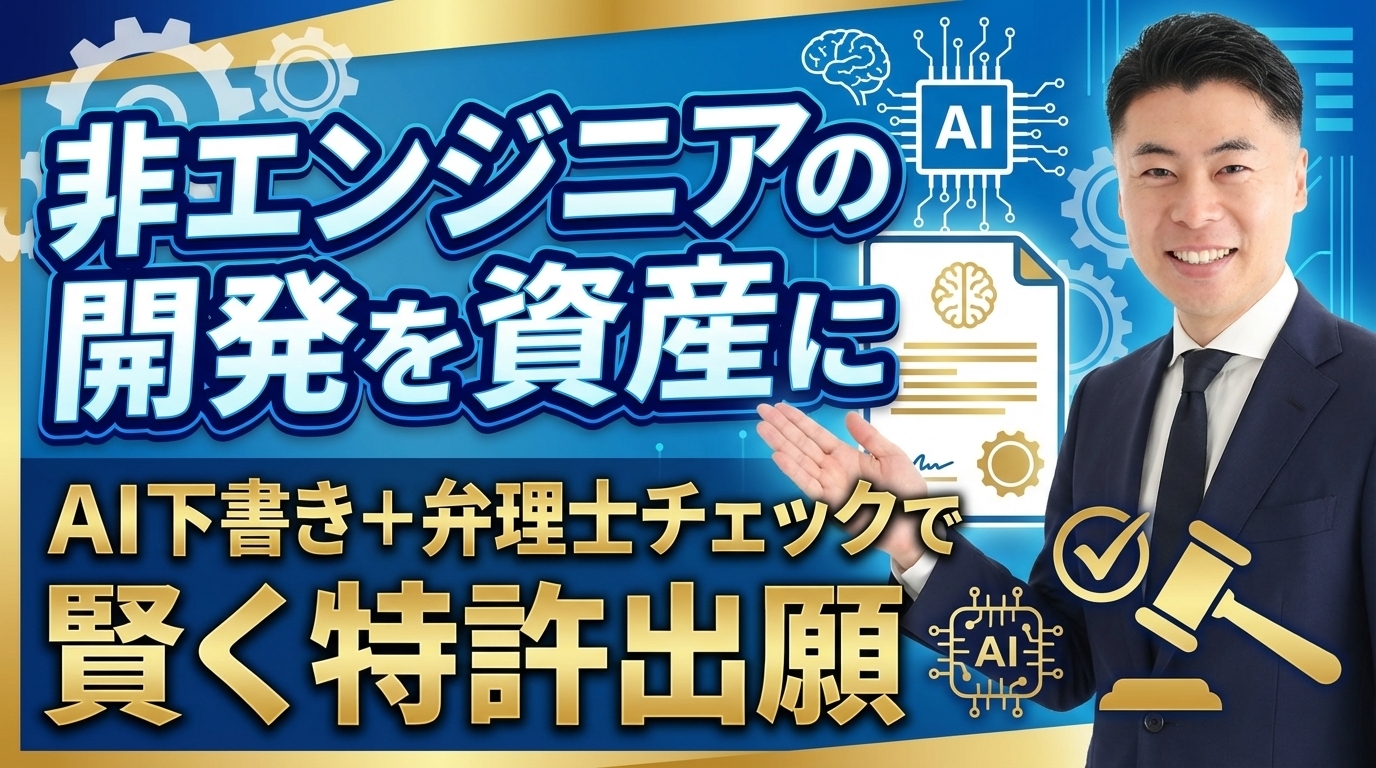
Therefore, what is currently attracting attention among smart entrepreneurs and business people is the latest hybrid method that uses generative AI such as ChatGPT to create a draft of the patent specification, which is then checked and rewritten by a patent attorney who is a patent professional before filing the application.
In this article, a patent attorney who is familiar with IT patents and business model patents will thoroughly explain the mechanism and benefits of "AI draft + patent attorney check" for turning non-engineers' ideas into valuable intellectual property, as well as the pitfalls to be aware of.
Table of Contents
- Business ideas developed by non-engineers can be "patented"
- Patent application barrier: Why do non-engineers give up on patenting?
- Overwhelming benefits of drafting patent specifications with AI (ChatGPT, etc.)
- Attention! Three reasons why “filing a patent application based solely on AI” is extremely dangerous
- Specific steps for the most powerful IP strategy "AI draft + patent attorney check"
Business ideas developed by non-engineers become "patents"
The image that "patents = blueprints for cutting-edge AI or complex machines" is actually a big misunderstanding. Even if the development is done by a non-engineer with no programming knowledge, it is quite possible to obtain a patent.
The "mechanism" of the program is protected, not the "code"
What is protected under Japanese patent law is not the string of source code itself, but the "creation of technical ideas that utilize the laws of nature." In other words, even if it is not a complex code written by a programmer, if the ``mechanism (information processing flow)'' that solves the business problem of ``what data is input, how the system judges (processes) the conditions, and what is output'' is new, it can be recognized as a ``software patent.''
No-code/low-code development can also be a great intellectual property
Even if the system is built using no-code tools such as Bubble or Kintone, if it combines existing technologies (smartphones, cloud servers, GPS functions, etc.) to create a convenient system that has never existed before, it is eligible for patent protection.
Point of note: Non-engineers have a deep understanding of "workplace pains (issues)" such as sales, marketing, and worksite operations. In many cases, unique flows that solve these problems result in groundbreaking inventions (business model patents) that engineers alone would not have thought of.
The tremendous benefits that patents (intangible assets) bring to your business
Building barriers to entry
Strong defensive wall that legally eliminates imitation by competitors and allows you to monopolize the market
Improving brand power
"Patented" reliability increases reputation from customers and business partners
Improving corporate value
Highly valued as an intangible asset when raising funds from investors and banks
A patent application is the first step in turning an idea into a legally protected "asset" rather than just a "thought".
The patent application barrier: Why do non-engineers give up on patenting?
Patents are very attractive, but until now there have been two major barriers that have prevented many non-engineers from applying.
High application fees and patent attorney fees
If you ask a patent attorney at a patent office to discuss your idea from scratch and create a patent specification that spans dozens of pages, it typically costs about 300,000 to 500,000 yen just to apply, and a total of 600,000 to 1,000,000 yen to go through the examination and registration at the Patent Office. For start-ups and sole proprietorships without financial resources, this initial cost is a big pain.
Communication barrier that "technical explanation is difficult"
It is very difficult for non-engineers to tell experts exactly what is "patentable" about their idea. Patent attorneys had to conduct multiple interviews to translate explanations in business terms such as ``Press the button on this screen and the data will be matched'' into ``technical terminology'' under patent law, resulting in huge communication costs.
| Cost wall | Communication barrier |
|---|---|
| Application fee: 300,000 to 500,000 yen | Difficult to translate into technical terms |
| Total registration fee: 600,000 to 1 million yen | Time cost of multiple interviews |
| Big pain for startups | Difficult to convey the essence of the idea |
Overwhelming benefits of drafting patent specifications with AI (ChatGPT etc.)
The advent of generative AI (such as ChatGPT and Claude) broke down these thick walls. Even non-engineers can now create patent drafts (invention proposals) with surprising ease by using AI as a challenger.
Organize your ideas instantly into patent format
You simply prompt the AI, saying, ``I am a non-engineer, but please organize the following business idea into a patent specification format (background technology, problem to be solved, means for solving the problem, effects of the invention)'' and enter your ideas in bullet points. AI instantly constructs logical sentences and creates the skeleton of a document that is close to the format required by the patent office.
Translation of non-engineer words into "technical expressions"
Example of "technical translation" by AI:
Your explanation:"A coupon is delivered when the user approaches the store"
↓
AI conversion result:``A system that sends benefit information from the server to the user device when it is determined that the user has entered a predetermined area based on the location information obtained from the device's GPS.''
Dramatically reduce meeting time and costs with patent attorneys
By bringing the completed "AI draft" to your patent attorney, it will be much easier to convey the overall picture and core of your idea than if you explain it orally from scratch. This saves time for hearings and the trouble of considering the composition of patent attorneys, and as a result, there are an increasing number of cases in which the costs paid to patent offices can be reduced.
Attention! Three reasons why “patent applications based solely on AI” are extremely dangerous
``If AI can create such a nice document, why not just apply to the patent office yourself without going through a patent attorney?'' However, this is an extremely dangerous choice that should be avoided at all costs.
Risk 1: Failure to design the scope of rights (claims) resulting in an "unusable patent"
Since AI creates text faithfully to the input specifications, it tends to create a very narrow range of rights that specifies details down to "specific screen transitions and specific conditions." In this case, competitors can easily circumvent (detour) patents by simply changing the functionality slightly, and patents that have been acquired become ``useless assets that no one can infringe.''
Risk 2: Unable to develop strategic logic to pass the patent office examination
In order to obtain a patent, you need to convince the examiner that your work is new (novelty) and cannot be easily thought of (inventive step) compared to past technologies (prior art) around the world. AI cannot precisely analyze the patent office's database and embed sophisticated legal logic (foreshadowing) into the specification, such as, ``If the examiner makes this objection, we can retaliate with this constituent element.''
Risk 3: Risk of information leakage and loss of novelty (not patentable)
If you enter an unpublished business idea into a general free version of ChatGPT, etc., there is a risk that the data will be used for AI learning and displayed in other people's answers (= disclosed to the public). The absolute condition for a patent is that it must be kept secret before filing, so the moment someone learns about it, it will no longer be possible to obtain a patent. When using AI, you must always use a non-learning setting (opt-out) and a secure corporate environment.
Specific steps for the most powerful intellectual property strategy "AI draft + patent attorney check"
The optimal solution for non-engineers to obtain "strong patents (assets)" that can never be circumvented while keeping costs down. This is a hybrid strategy in which a draft is created using AI, and a patent attorney rewrites it using professional technology and then files the application.
STEP 1
Organize the outline of your ideas with secure AI
You will use AI with settings that are not used for learning data to convert ideas, solutions, flowcharts, etc. into text. You don't have to aim for perfection. It is enough to feel like you are creating a "high-quality memo" to convey your intentions to a patent attorney.
STEP 2
Free consultation with patent office (patent attorney) and prior art search
Bring the created "AI draft" to the patent office. A patent attorney reads the draft and instantly understands the key points of the invention. After that, a patent attorney will use a dedicated database to conduct a full-scale prior art search to see if there are any similar patents in the past (could it be a patent)?
STEP 3
Patent attorney uses professional techniques to rewrite the "scope of rights (claims) that can be won"
Based on the AI draft, patent attorneys predict how competitors will bypass the technology in the future, abstract and conceptualize it at a higher level, and rebuild it into a ``broad and strong rights network that is difficult to avoid'' (claim drafting). This is the moment when AI's verbalization ability and the legal and strategic thinking of patent attorneys merge.
STEP 4
Formal application and examination response to the Patent Office
We will file a completed and robust patent specification with the patent office. Even if you receive a "notice of reasons for refusal (notification that the patent cannot be granted because there is similar technology)" from the examiner after filing your application, our patent attorneys will use their specialized knowledge to prepare a rebuttal (written opinion/procedural amendment) and provide strong support until the patent is granted (granted).
Summary: Turn your development into a "powerful business asset". Please consult our office first!
Gone are the days of giving up and thinking, "I can't get a patent because I'm a non-engineer." Now that you have a powerful assistant called AI, you can verbalize your great business ideas yourself and get to the starting line of filing a patent application.
However, the craftsmanship of a skilled patent attorney is essential to beautifully cutting the rough idea into a strong "diamond (asset)" that will stand out from competitors. By using the "AI draft + patent attorney check" scheme, it is possible to obtain high-quality patents that can be used as a weapon for business while significantly reducing communication stress and time costs.
At our patent office, we actively accept inquiries from non-engineering entrepreneurs and business owners. You are also welcome to bring in "drafts (invention proposals) created using AI such as ChatGPT." A patent attorney who is familiar with IT/software patents and business model patents will advise you on the possibility of obtaining a patent and strategies to strengthen your rights based on the draft you bring.
Now accepting free initial consultation
"Can this no-code system be patented?"
You are also welcome to bring your own AI drafts. Please leave the intellectual property protection of non-engineers to us
Tags: #Patent application #Patent attorney #Non-engineer #AI utilization #ChatGPT #Business model patent #Software patent #No-code #Low-code #Intellectual property #Startup #Cost reduction #Intellectual property strategy #Entrepreneurship #DX promotion
🤖 For those who created a draft of a patent specification with ChatGPT
You are welcome to bring in your AI drafts. A patent attorney who specializes in IT and AI patents will rewrite the generated AI draft into a "strong title deed that protects your business."
Leave the final check of the statement quality to a professional with over 15 years of experience in intellectual property practice.

AUTHOR
Takefumi SUGIURA (杉浦 健文)
EVORIX Intellectual Property Law Firm Managing Patent Attorney
Supports clients across IT, manufacturing, startups, fashion, and medical industries, covering patent, trademark, design, and copyright filings through trials and infringement litigation. Specialized in IP strategy for AI, IoT, Web3, and FinTech. Member of the Japan Patent Attorneys Association (JPAA), Asian Patent Attorneys Association (APAA), and Japan Trademark Association (JTA).

![[Tips for obtaining a patent] Can ChatGPT's prompt generation technology be patented? Strategies for obtaining rights for AI inventions learned from Case 38](https://www.evorix.jp/hs-fs/hubfs/blog-thumbnails/face-post-189997412523.png?height=200&name=face-post-189997412523.png)