.png?width=500&height=250&name=%E7%9F%A5%E7%9A%84%E8%B2%A1%E7%94%A3%E4%BA%8B%E5%8B%99%E6%89%80%E3%82%A8%E3%83%9C%E3%83%AA%E3%82%AF%E3%82%B9%20(500%20%C3%97%20250%20px).png)



Effective April 1, 2024, the Japan Trademark Act introduced a Letter of Consent (LoC) system under...
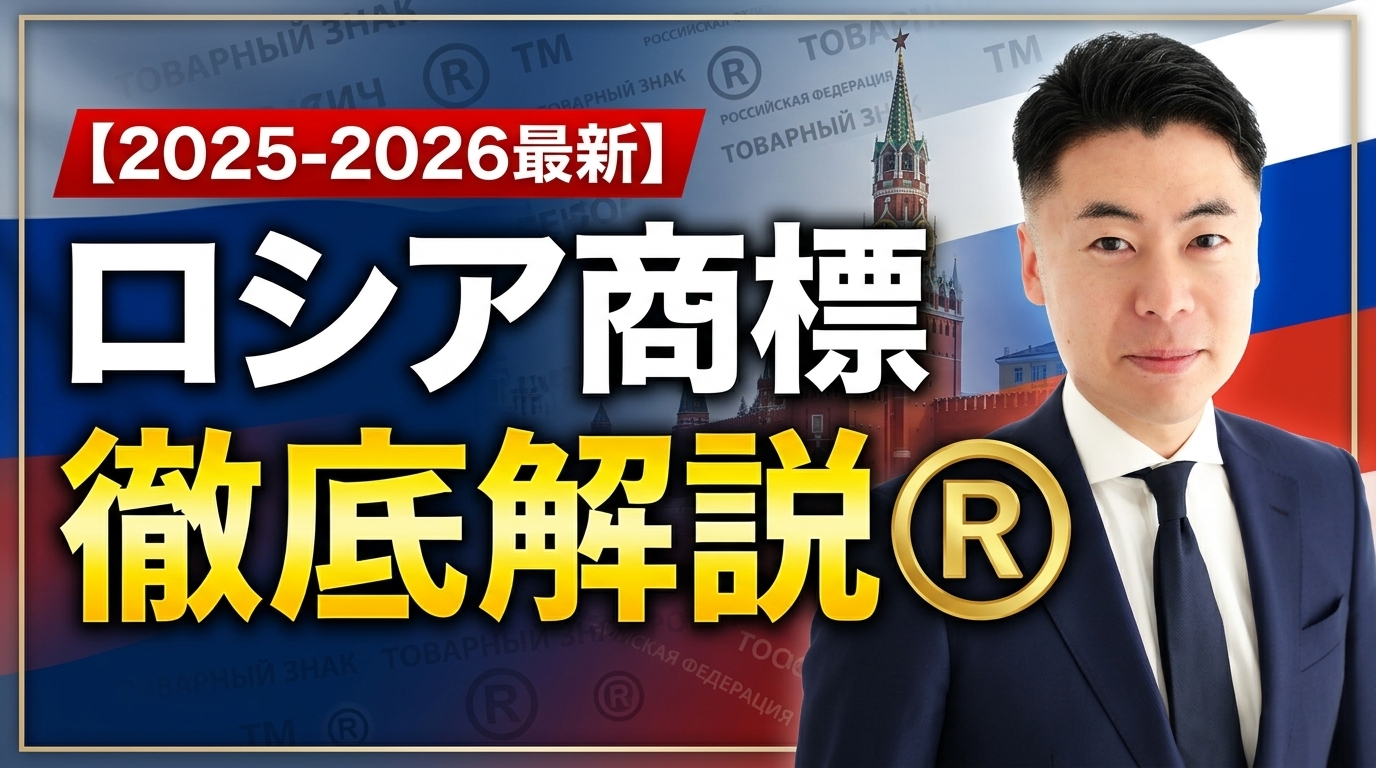
Hello. I am Kenbun Sugiura, a patent attorney. In this article, I will explain the latest trends in the Russian trademark system (2025–2026), covering everything from Rospatent (Federal Service for Intellectual Property) procedures to the large number of cancellations for non-use that emerged in 2025, Federal Law No. 214-FZ (effective January 2026), and the current status of the EAEU regional system—all the key points that foreign rights holders need to know.
🚨 Urgent Alert (2025)
The three-year grace period for non-use granted to foreign companies that withdrew from the Russian market in 2022 has expired, putting the trademarks of over 300 foreign companies—including Nokia, Amazon, Sega, and Starbucks—at risk of cancellation. Russian courts do not recognize “sanctions or geopolitical circumstances” as valid grounds for non-use. Immediate action is required.
Table of Contents
1. Fundamentals of the Russian Trademark System
The Russian trademark system is based on Part IV of the Civil Code of the Russian Federation, and Rospatent (the Federal Service for Intellectual Property) oversees applications, examinations, and registrations.
| Topic | Russian System |
|---|---|
| Competent Authority | Rospatent (Federal Service for Intellectual Property, ФИПС) |
| Legal Basis | Civil Code of the Russian Federation, Part IV |
| Classification of Goods and Services | Nice Classification (multi-class applications permitted) |
| Registration System | First-to-file system |
| Madrid Protocol | Member (December 1991, successor to the Soviet Union) |
| Standard examination period | Approximately 12–18 months |
| Opposition period | 3 months from publication |
| Period for cancellation due to non-use | 3 years (subject to cancellation if not used for 3 or more years after registration) |
| Term of Protection and Renewal | 10 years (renewable indefinitely) |
| Agent Requirements | Foreign applicants must appoint a registered Russian trademark attorney as their representative |
2. Major Changes in 2025–2026
2.1 Massive Wave of Cancellation Claims for Non-Use Becomes a Reality
For foreign companies that withdrew from the Russian market in 2022, the three-year grace period for non-use will expire in 2025. More than 300 foreign companies face the risk of having their trademarks subject to cancellation requests, either in whole or in part.
Major Cancellation Rulings in 2025
- Nokia Trademarks (June 2025): Protection for multiple Nokia trademarks was revoked due to a lack of evidence of use and an inability to prove insurmountable obstacles
- Amazon/Амазон Trademark (June 2025): A Russian entrepreneur’s request for cancellation due to non-use was granted for marketplace and logistics services
- Other well-known brands such as Sega and Starbucks are also undergoing cancellation proceedings
Key Court Rulings: The Russian Intellectual Property Court does not recognize “sanctions or geopolitical circumstances” as valid grounds for non-use. The current judicial position is that “Russian domestic law does not prohibit foreign trademark owners from using their brands, and voluntary withdrawal or foreign sanctions do not constitute an excuse for non-use.”
2.2 Federal Law No. 214-FZ: Amendments to Intellectual Property Infringement Compensation (Effective January 2026)
Federal Law No. 214-FZ, promulgated on July 8, 2025, significantly amends the provisions of the Civil Code of the Russian Federation regarding compensation for intellectual property infringement. As it will take effect in January 2026, foreign rights holders must closely monitor its implementation following the effective date.
2.3 September 2024: New Trademark Registration Rules
The new registration rules, which took effect in September 2024, introduce verification procedures for applicants from countries subject to “special economic measures or other restrictive measures,” in addition to changes to the application process and examination requirements. Applicants from sanctioned countries (such as the U.S., EU, and Japan) tend to experience longer examination periods.
2.4 Surge in Domestic Applications and the Squatter Problem
Between 2021 and 2024, Russian trademark applications increased by approximately 30%. Seven of the top 10 applicants are domestic Russian companies, and at least three of these have been identified as squatters filing for trademarks identical or similar to those of foreign brands. As cases of domestic companies acquiring trademarks previously held by foreign firms that have withdrawn from the market are surging, continuous monitoring of the Rospatent Gazette is of critical importance.
3. Application, Examination, and Registration Process
1
Preliminary Research
Search the gazette on the FIPS website to identify prior similar trademarks. Also investigate whether a Cyrillic version of the trademark exists.
2
Filing
Madrid Protocol application via the Japan Patent Office, or direct application to Rospatent through a local agent
3
Formality and Substantive Examination
Approximately 12–18 months. Strict examination of both absolute and relative grounds for refusal. Applicants from sanctioned countries may experience longer examination periods
4
Publication and Opposition
Third parties may file an opposition within 3 months of publication
5
Registration
Trademark rights arise upon payment of the registration fee (Term of protection: 10 years from the date of registration; renewable)
4. Restrictions on Payments to “Unfriendly Countries” (Type O Ruble Accounts)
Under Presidential Decree No. 322 issued on May 27, 2022, domestic licensees in Russia are prohibited from paying royalties to overseas accounts held by rights holders residing in “unfriendly countries.” Japan is included on the list of unfriendly countries, making it effectively difficult for Japanese companies to collect royalties.
Alternative: O-type ruble account
- Limit payment recipients to ruble O-type accounts opened at authorized Russian banks
- Unless the foreign rights holder formally consents to the opening of an O-type account, the Russian entity can suspend payments while continuing to use the trademark or other rights
- Outbound remittances are strictly restricted and are effectively limited to reinvestment within Russia
- WIPO international application fees via the Madrid, Hague, and Lisbon systems can be paid through WIPO (operational as of March 2025)
5. Current Status of the EAEU Regional System
The Eurasian Economic Union (EAEU) “Agreement on Trademarks, Service Marks, and Appellations of Origin” was signed on February 3, 2020, and entered into force on April 26, 2021, but implementation has not yet begun (procedural coordination and deposit of instruments of ratification by member states are ongoing).
| Item | Details |
|---|---|
| Member States | Russia, Armenia, Belarus, Kazakhstan, Kyrgyzstan (5 countries) |
| Agreement Entry into Force | April 26, 2021 |
| Operational Status | Not yet in effect (as of 2025) |
| System | File one application with the national office of any member country → Protection throughout all five countries |
| Term of Protection | 10 years from the filing date |
→ Since the anticipated unified application system is not yet operational, entering the Russian market still requires country-by-country applications (via the Madrid System or directly).
6. Five Defense Strategies for Foreign Brands
To ensure future re-entry into the Russian market and prevent the cancellation of existing brands, foreign rights holders should consider the following five strategies:
① Register a separate Cyrillic-script trademark
Registering Cyrillic transliterations or translations separately from Latin-script trademarks strengthens protection against squatters. Since Russian consumers strongly recognize brands in their native language, this also significantly enhances brand protection.
② Register the license with Rospatent
By officially registering licenses granted to local partners with Rospatent, you secure the ability to enforce your rights against third parties (requirements for opposition). This can also serve as evidence of use.
③ Transfer of Rights to Affiliates and Local Partners
By transferring trademark rights to affiliates in jurisdictions not classified as unfriendly nations (e.g., Central Asia, Turkey, UAE), the scope of sanctions can be limited. Registration of the transfer with Rospatent is required.
④ Re-file minor variations
By filing new applications for minor variations—such as changes in font, added characters, or color modifications—you can disperse the targets of cancellation for non-use. This allows the three-year period to start anew.
⑤ Continuous Monitoring and Documentation of Unauthorized Use
By continuously monitoring the Rospatent Gazette and consistently filing oppositions and invalidation proceedings against similar third-party applications, the company demonstrates its commitment to enforcing its rights. This has a de facto deterrent effect on squatters.
7. Summary
Although the Russian trademark system remains operational, the practical environment for foreign rights holders is extremely challenging. With a surge in cancellation proceedings for non-use expected to begin in earnest in 2025 and the enforcement of Federal Law 214-FZ in January 2026, the industry faces major turning points for two consecutive years.
Foreign companies seeking to maintain or restore their brand presence in the Russian market must urgently assess the risk of cancellation for non-use, register additional trademarks in the Cyrillic script, explore alternative payment schemes—including Type O accounts—and consider maintenance strategies via affiliated companies.
At EVORIX, we continuously monitor the latest trends in trademark systems worldwide, including Russia, and provide one-stop support for strategies to protect intellectual property rights amid geopolitical risks.
For those concerned about Russian trademarks
The regulatory changes scheduled for 2025–2026 represent the most significant turning point in the past 20 years. Please entrust the
assessment of non-use cancellation risks and the development of defense strategies to our patent attorneys. Initial consultations and quotes are free of charge.

AUTHOR / Writer
Kenbun Sugiura
Representative Patent Attorney, EVORIX Intellectual Property Firm
Well-versed in intellectual property practice across various countries, from patent, trademark, design, and copyright applications to trials and infringement litigation. Member of the Japan Patent Attorneys Association, the Asian Patent Attorneys Association (APAA), the Japan Trademark Association (JTA), and others.