.png?width=500&height=250&name=%E7%9F%A5%E7%9A%84%E8%B2%A1%E7%94%A3%E4%BA%8B%E5%8B%99%E6%89%80%E3%82%A8%E3%83%9C%E3%83%AA%E3%82%AF%E3%82%B9%20(500%20%C3%97%20250%20px).png)


📌 For those reading this article: If you are considering IT patents for software, SaaS, IoT, etc.,...

Last time, I talked about how relying on copyright to protect product design is an emergency evacuation approach and is not desirable. So what exactly is the problem?
Please note that the content is a little complicated to clarify the situation. If you only want to know the conclusion, please see the summary at the end of the article.
In order to be protected by copyright law, a work must be a copyrighted work. The conditions for a work to be a copyrighted work are stipulated by law as follows.
Anything that creatively expresses thoughts or feelings and falls within the scope of literature, science, art, or music (Article 2, Paragraph 1, Item 1 of the Copyright Act)
As examples of how such things fall under the category of copyrighted works, there is an article that states, ``Paintings, prints, sculptures, and other works of art (Article 10, Paragraph 1, Item 4 of the same Act),'' and an article that says, ``Works of art include works of art (Article 2, Paragraph 2 of the same Act).''
I previously talked about how mass-produced product design is treated as applied art under copyright law. Therefore, it is normal to think that there are provisions regarding applied art in addition to the above provisions, but no matter where I look in the article, I cannot find the wording regarding applied art.
In this regard, although the Berne Convention, which is the basic copyright-related treaty, clearly states that the scope of protection for copyrighted works includes works of applied art, the scope of application is left to each member country. Despite this, the Copyright Act does not provide a definition of applied art. Because of this situation, the copyrighted property of applied art becomes a source of controversy.
Since it is called applied "art", it is easy to assume that it falls under the category of works of art. If the work is only one piece and was clearly made for viewing purposes, there would be little room for discussion. In the first place, with regard to arts and crafts in Article 2, Paragraph 2, it appears that the legislator wanted to limit them to one-off works.
However, in reality, even mass-produced items tend to be recognized as works of art, and in fact, since the Hakata Doll Red Dragonfly Incident in 1971, there have been many examples in which even mass-produced items have been recognized as copyrighted works. In other words, although there is no clear provision in the law, in principle product design = applied art can be protected under copyright law.
Note:Not everything can be recognized as a copyrighted work; only works that have been certified as copyrighted works under certain requirements can be protected by copyright as works of applied art. Because the criteria for determining this one requirement are so strict, in most cases copyrightability is not recognized in court.
I will explain how it is determined in practice, based on changes.
Table of Contents
Relationship with pure art
For a long time, the judgment of whether or not applied art is a work has focused on whether it has the characteristics of fine art and whether it can be equated with pure art.
Please think of pure art as something that can be recognized as a painting, sculpture, etc. at first glance. In other words, judgments have been made from the perspectives of whether product design has the same level of "high artistry" as sculpture, and whether the product was created for the purpose of aesthetic appreciation. Do the product designs that are all over the world have the artistry of sculpture? If you ask me that question, I can't help but think that it's not that far.
What the TRIP TRAP case decision brought about
A groundbreaking precedent has emerged in this context. That is theTRIP TRAP casejudgment. This judgment stated that regardless of the relationship between pure art and applied art, judgments should be made based on whether or not the creator's individuality is expressed individually, just as with general works (of course, whether or not a work falls under the category of art work is also judged).
This is a method of uniformly determining whether a work is a copyrighted work based on the presence or absence of creativity, without distinguishing whether it is pure art or applied art, that is, whether it has a high level of artistry (creativity).
Trends after the TRIP TRAP judgment
After the TRIP TRAP case, it is not the case that other cases related to applied art were decided based on the non-distinction theory.
For example, the Children's Chopsticks Case decision required that the minimum requirement for recognition of creativity as a work of art is that it must have characteristics that could be considered aesthetically pleasing in some way, and the policy was to question the creativity of devices that could be viewed as objects of appreciation.
However, after the TRIP TRAP case, there have been no more decisions that explicitly require the possibility of equating it with pure art.
At the district court level, there have been many rulings that clearly state that a work is eligible for protection as a work of art if it has aesthetic characteristics that make it an object of aesthetic appreciation apart from its practical function. This judgment standard was influenced by the fashion show case decision that came just before the TRIP TRAP case decision.
Latest IP High Court decisions
December 8, 2021Octopus slide case judgment,
Among applied art, even if it is something other than a work of art, if a part of it can be separated from its practical purpose and has creative expression as an aesthetic characteristic that can be the object of aesthetic appreciation, it is understood that the entire creation, including that part, can be protected as a work of art.
was determined.
Continuing after the TRIP TRAP case judgment, high artistry and creativity on the same level as pure art are not questioned. It is organized that among applied arts, works that belong to arts and crafts can be protected without any problems, and even works other than arts and crafts can be protected as artistic works if various requirements are met.
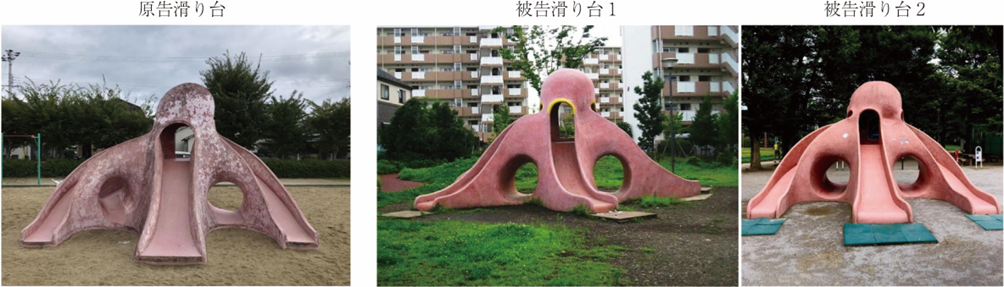
The court determined that the part imitating an octopus's head was a necessary structure to achieve the practical purpose of a slide, and denied copyright property, stating that the shape of the canopy part was simple and a common shape for an octopus's head.
(In addition to determining whether or not it was an art work, it was also determined whether or not it was an architectural work, and the plaintiff's case was lost as the copyright was denied as it did not fall under an architectural work.)
Summary
In conclusion, although there is room for copyright property to be recognized for product design, which is applied art, it can be said to be limited.
Specifically, referring to the recent Intellectual Property High Court decision, whether or not applied art is recognized as a copyrighted work will be judged based on whether the work has (1) creative expression, which is an aesthetic characteristic that can be the object of aesthetic appreciation, separate from (1) a functional structure necessary to achieve a practical purpose.
Since composition related to the functions necessary to achieve the practical purpose is ignored, expressions necessary for the efficacy and function of the product/material, in other words, technical and mechanical creative expressions, are almost never protected by copyright. In general, the beauty of product design often comes from its functional beauty.
Functional beauty, which is the beauty that arises from the appearance to perform a function, is not within the scope of copyright protection because it is a configuration related to the functions necessary to achieve the actual purpose. This kind of appearance is an expression of technical ideas, and since there is no aesthetic element, it can be interpreted that it cannot be appreciated aesthetically.
In other words, if something that expresses a technical idea is both functional and happens to be aesthetic, it is not a copyrighted work.
Also, technical/mechanical expressions have certain limitations, and it is expected that if you materialize that expression, it will have a roughly similar appearance. In that case, the individuality exhibited would be limited, and it would be doubtful whether it could be called a creative expression with aesthetic characteristics that could be an object of aesthetic appreciation (just because the regular arrangement of the base is a beautiful geometric pattern does not mean that it has aesthetic characteristics that could be an object of appreciation)
In addition, creative expressions that are often seen in the world are not protected (the octopus slide incident also takes into account the fact that there are quite a few slides with octopus motifs).
So, how is a creative expression with aesthetic characteristics judged? As a case that can be used as a reference for this decision, let's check theBAOBAO case, which is a district court judgment.
The shape of ISSEI MIYAKE's BAOBAO is quite distinctive (https://www.baobaoisseymiyake.com *The bag listed on the site is the current model).
However, even with such distinctive decoration (styling), the judgment has determined that the fact that the appearance of a bag made of triangular pieces transforms three-dimensionally depending on the baggage is a configuration that corresponds to its practical purpose as a bag for carrying things, so it can be said that the criteria for determining the objectivity of aesthetic appreciation are quite strict. The fact that ``beauty'' is a standard that is difficult to view objectively makes the situation difficult.
I hope you understand that relying on copyright law to protect product design is a very dangerous bridge to cross.
Important:This case is all about the fact that product design is difficult to protect as a copyrighted work. Product design falls within the scope of the Design Act, so it can be protected by filing a design application. Please utilize design rights for the external design of important products.
Introduced incident:
- Hakata doll red dragonfly incident
- TRIP TRAP case 2014 (Ne) No. 10063 Appeal case for requesting injunction against copyright infringement activity
- Children's Chopsticks Case No. 27220 of 2015 (Wa) 2015 Case of Request for Injunction, etc. of Copyright Infringement Act
- Octopus slide incident Reiwa 3 (Ne) No. 10044 Copyright infringement appeal case (Intellectual Property High Court)
- BAOBAO Case 2017 (Wa) No. 31572 Case of request for injunction against unfair competition practices
Inquiry about this article
Contact form
If you have any questions or concerns regarding product design and copyright, please feel free to contact us here.

AUTHOR
Takefumi SUGIURA (杉浦 健文)
EVORIX Intellectual Property Law Firm Managing Patent Attorney
Supports clients across IT, manufacturing, startups, fashion, and medical industries, covering patent, trademark, design, and copyright filings through trials and infringement litigation. Specialized in IP strategy for AI, IoT, Web3, and FinTech. Member of the Japan Patent Attorneys Association (JPAA), Asian Patent Attorneys Association (APAA), and Japan Trademark Association (JTA).
.jpg?height=200&name=unnamed%20(39).jpg)
