.png?width=500&height=250&name=%E7%9F%A5%E7%9A%84%E8%B2%A1%E7%94%A3%E4%BA%8B%E5%8B%99%E6%89%80%E3%82%A8%E3%83%9C%E3%83%AA%E3%82%AF%E3%82%B9%20(500%20%C3%97%20250%20px).png)


Introduction: That "Chinese patent" may be a piece of paper in Hong Kong Hong Kong, the gateway to...
"I've come up with a great idea. I want to patent it, but I don't know where to start." "I've developed a new product, but I'm worried that I might unknowingly infringe on another company's patent."
In the field of new business and product development, such concerns are endless. The first thing you should consider is "patent search (prior art search)".
However, for those who are hiring a patent attorney for the first time, the patent industry can seem daunting. You may be worried about things like, ``How much will it cost?'' ``Is it okay to consult with someone who is still in the idea stage?'' ``I'm afraid the conversation won't progress because of all the difficult technical terms.''
In this article, an active patent attorney who has handled numerous patent searches will thoroughly explain the basic knowledge, cost considerations, process of requesting, and key points to avoid failure that customers requesting patent searches for the first time should know, using as little technical jargon as possible.
By the time you finish reading this article, you should feel less anxious about patent research and feel confident in taking the next step.
1. Why is a patent search (prior art search) necessary?
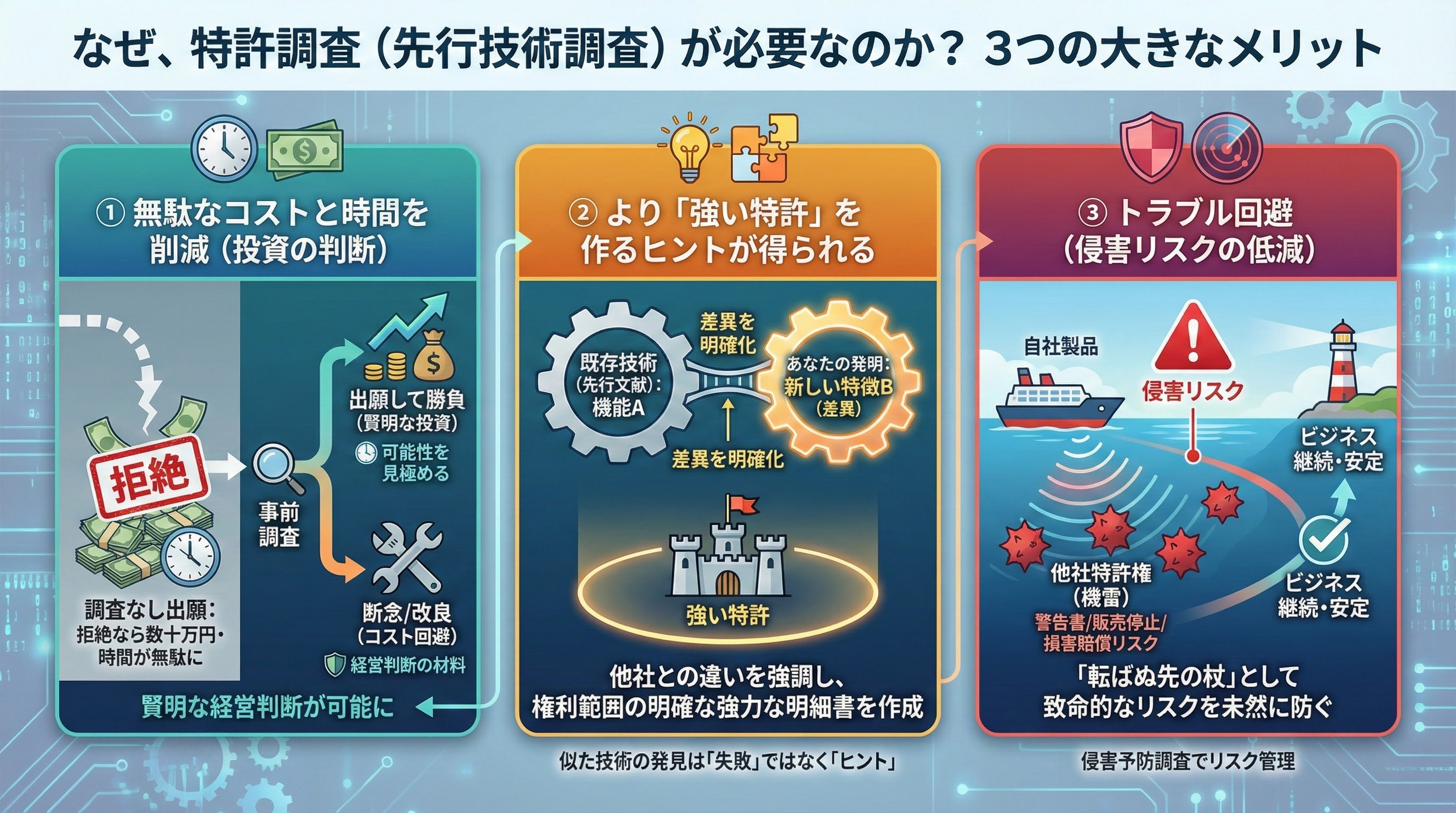
In the first place, why do we need to spend money and time on "investigation"? It's not just because I want to know if I can get a patent. This is because there are "three major benefits" that are essential for business success.
① You can reduce unnecessary costs and time (investment decisions)
A patent application costs at least 300,000 to 500,000 yen, including stamp fees paid to the Japan Patent Office and document preparation fees for a patent attorney. If you suddenly apply without doing any research and the application is rejected as a result of the examination saying, ``It cannot be registered because a similar patent already exists,'' all the money and time spent up to that point will be wasted. By conducting research in advance and determining the ``possibility of obtaining a patent,'' you will be able to make a wise business decision whether to ``file an application and compete'' or ``give up (or improve) this time.''
② Get hints on how to create stronger patents
It is not uncommon to find similar technologies (prior documents) as a result of research. However, it is not a "failure". This is because you can clarify the difference: ``The existing technology has feature A, but your invention has new feature B.'' By knowing your competitors, you can create a stronger patent specification that emphasizes your differences from other companies and has a clearer scope of rights.
③ Trouble avoidance (reducing risk of infringement)
This is also called "infringement prevention investigation," and confirming whether a company's products infringe on the patent rights of other companies is extremely important for corporate risk management. If, after selling a product, you receive a warning letter stating that it has infringed a patent, and you are required to stop sales or pay damages, your business will come to a standstill. Research is essential to keep you from falling.
2. "Two types of research" you should know before making a request
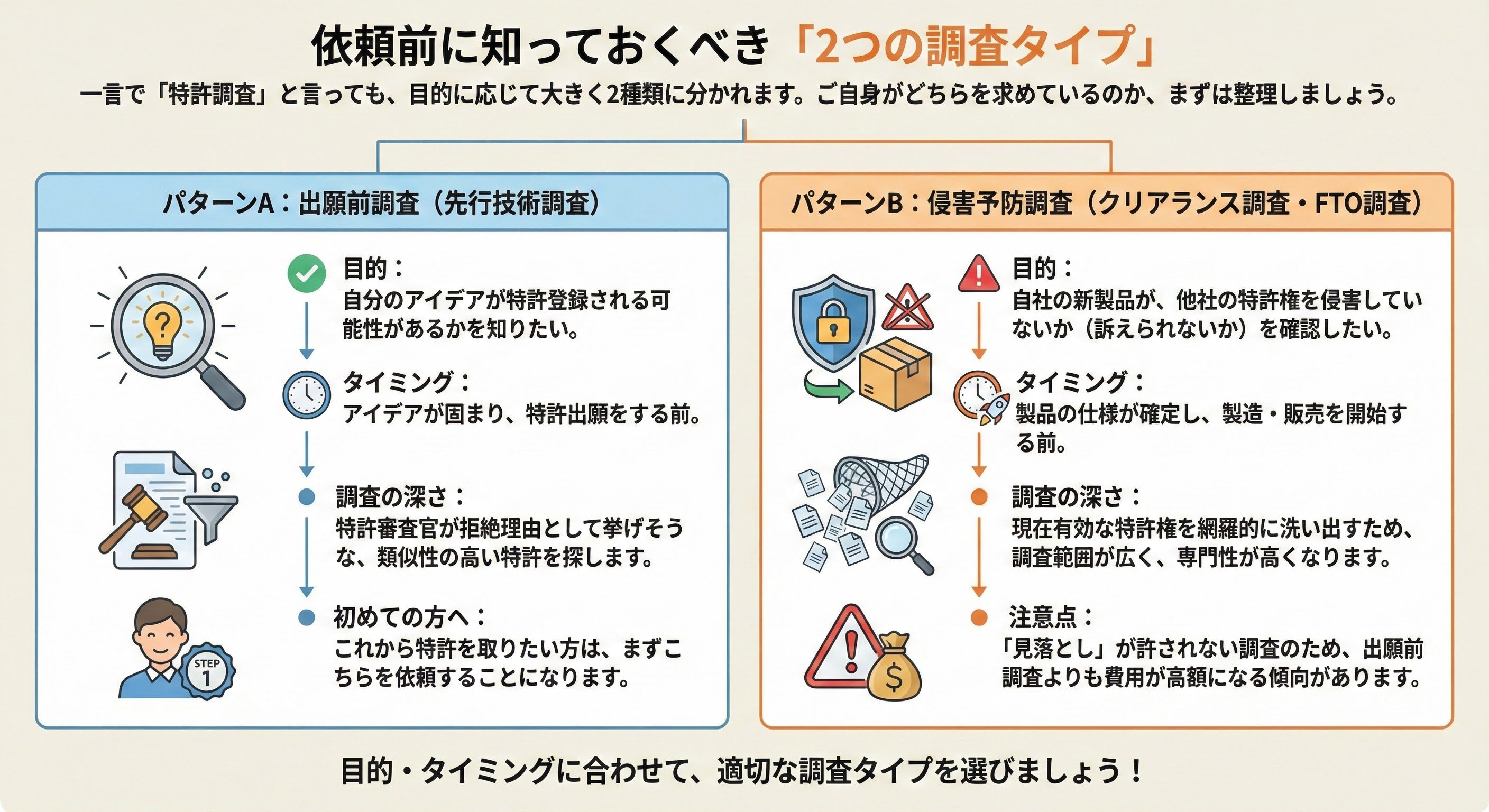
The term "patent search" can be broadly divided into two types depending on the purpose. First, figure out which one you are looking for.
Pattern A: Pre-filing search (prior art search)
-
Purpose: I want to know if my idea has a chance of being patented.
-
Timing: Before the idea is solidified and a patent application is filed.
-
Search Depth: Look for highly similar patents that patent examiners are likely to cite as reasons for rejection.
-
For first-time users: If you want to obtain a patent, you should request this first.
Pattern B: Infringement prevention investigation (clearance investigation/FTO investigation)
-
Purpose: I want to check whether my company's new product does not infringe on the patent rights of other companies (or not be sued).
-
Timing: Before product specifications are finalized and manufacturing and sales begin.
-
Depth of search: As we comprehensively identify currently valid patent rights, the scope of the search is wide and the level of expertise is high.
-
Points to note: Since this is a search that cannot be overlooked, it tends to be more expensive than a pre-filing search.
3. Difference between "investigating it yourself (J-PlatPat)" and "asking a professional"
Recently, anyone can search using the free database "J-PlatPat (Patent Information Platform)" provided by the Japan Patent Office. Some people think, "It's okay because I researched it myself," but there is a big pitfall here.
Limits of doing your own research (keyword search trap)
The text of patent publications is unique. For example, if you want to find out about a ``car steering wheel,'' and you type in ``steering wheel,'' in the patent world it might say ``steering member'' or ``steering device.'' This will cause your information to be overlooked in keyword searches.
Investigation methods for professional patent attorneys
Pros perform comprehensive searches not only using keywords, but also using codes called "Patent classification (IPC/FI/F terms)", which are assigned to each technology by the licensing office. In addition, rather than simply making a judgment based on ``there are similar pictures'', we legally interpret the scope of patent claims (scope of rights) and make sophisticated judgments such as ``Since the constituent elements are different, there is a chance of patenting it.''
"When I looked it up myself, I found 0 patents, but when a professional did it, I found a lot of similar patents."In fact, it happens every day.
4. Just be careful! "Three golden rules" before requesting
Before contacting a patent attorney, there are three things you should be aware of. If you do not know this, in the worst case scenario, you may not be able to obtain a patent.
Golden rule 1: Always consult before "publishing"
Patents have a requirement of "novelty." This rule states that it must be "new and not yet known to the world." If you make an announcement on your blog or SNS, exhibit at an exhibition, press release, sell, etc., at that point it becomes "publicly known" (everyone knows about it), and as a general rule, you will not be able to obtain a patent. If you have already made it public, please tell your patent attorney as soon as possible. You may be able to obtain a remedy called the “loss of novelty exception,” but there is a time limit.
Golden rule ②: "Black box period" of investigation
The content of a patent application will be kept secret and not disclosed to the public for 1 year and 6 months from the filing date. In other words, no matter how good a search company or patent attorney is, you will not be able to find patents filed by other companies within the past year and a half. Please be aware that there is always a small risk that ``even though the investigation results were negative (no problems)'', a rival had actually filed an application during that period.
Golden rule 3: Disclose information openly (there is a duty of confidentiality)
Some people may be afraid to tell others about important ideas that have not yet been legalized. However, patent attorneys are subject to extremely strict confidentiality obligations under the Patent Attorney Law. This is a heavy duty that can result in disqualification if you violate it. On the other hand, if you hide information such as ``Actually, we used a product called 〇〇 from another company as a reference,'' the premise of the survey will be incorrect and the survey results will become meaningless. Please share all information for accurate investigation.
5. Interesting "cost" and "period (schedule)"
What you are most concerned about is "How much will it cost?" and "When will it end?" I will give you a general view of the market. *It varies depending on the complexity of the technical field and the size of the office.
Estimated cost (excluding tax)
| Study type | Cost price | Summary |
| Simple survey | 30,000 to 70,000 yen | "I want to check if there is something roughly similar" level. In many cases, only a list is submitted without a written opinion (legal judgment by a patent attorney). |
| Pre-filing search | 100,000 to 200,000 yen | [Recommended] The most standard survey. It assumes a patent application and includes a ranking of the likelihood of registration and specific advice (written opinion). |
| Breach prevention investigation | 200,000 to 500,000 yen or more | Comprehensive inspection to avoid business risks. It takes a lot of man-hours and costs a lot of money to check every part and every process of the product. |
[Risk of choosing only based on low price] "Cheap surveys" also exist, but there are cases where there are not many search keywords, or there are cases where the search is performed only mechanically and is not checked by human eyes. If you overlook an important patent and apply for it, and it is later rejected, you are putting the cart before the horse. Choose a firm that can guarantee quality that meets your goals.
Schedule guideline
-
Standard delivery time: From formal request 2 to 3 weeks
-
Express delivery: 3 days to 1 week from official request (*Costs are generally 20-30% higher)
If you are in a hurry to apply, many offices will be flexible if you let them know at the time of consultation.
6. Smooth even for first-time users! 5 steps from request to delivery
Let's simulate what the process would be like if you actually made a request.
STEP 1: Contact us
We will contact you via the "inquiry form" on our homepage or by phone. All you have to do is tell them that you are considering a patent search.
STEP 2: Hearing (interview/web conference)
This is the most important part. A patent attorney will discuss the details of your invention in detail.
-
What kind of problem (problem) does this invention solve?
-
What is different from the conventional one?
-
What is the specific structure and mechanism?
★Points: It is difficult to explain things verbally, so it will go much more smoothly if you can provide simple hand-drawn diagrams, photos of prototypes, specifications, etc.
STEP 3: Proposal/Estimate
Based on the content of the interview, a patent attorney will design ``what keywords and scope to investigate'' and present the cost and delivery date.
STEP 4: Survey implementation
After a formal order is placed, a patent attorney or specialized searcher will conduct a search using the Patent Office database and paid commercial databases. It picks up relevant patent publications from a huge number of patent publications and reads the contents.
STEP 5: Report delivery and explanation
A "report" summarizing the survey results will be delivered to you. We don't just send you a list of similar patents.
-
"The possibility of registration is about 〇〇% (A judgment/B judgment, etc.)"
-
Professional advice (opinion) regarding future strategies such as "Let's emphasize the structure of 〇〇 in the application in order to differentiate it from this prior art" is described. It is also possible to receive an explanation of the contents of the report in an interview.
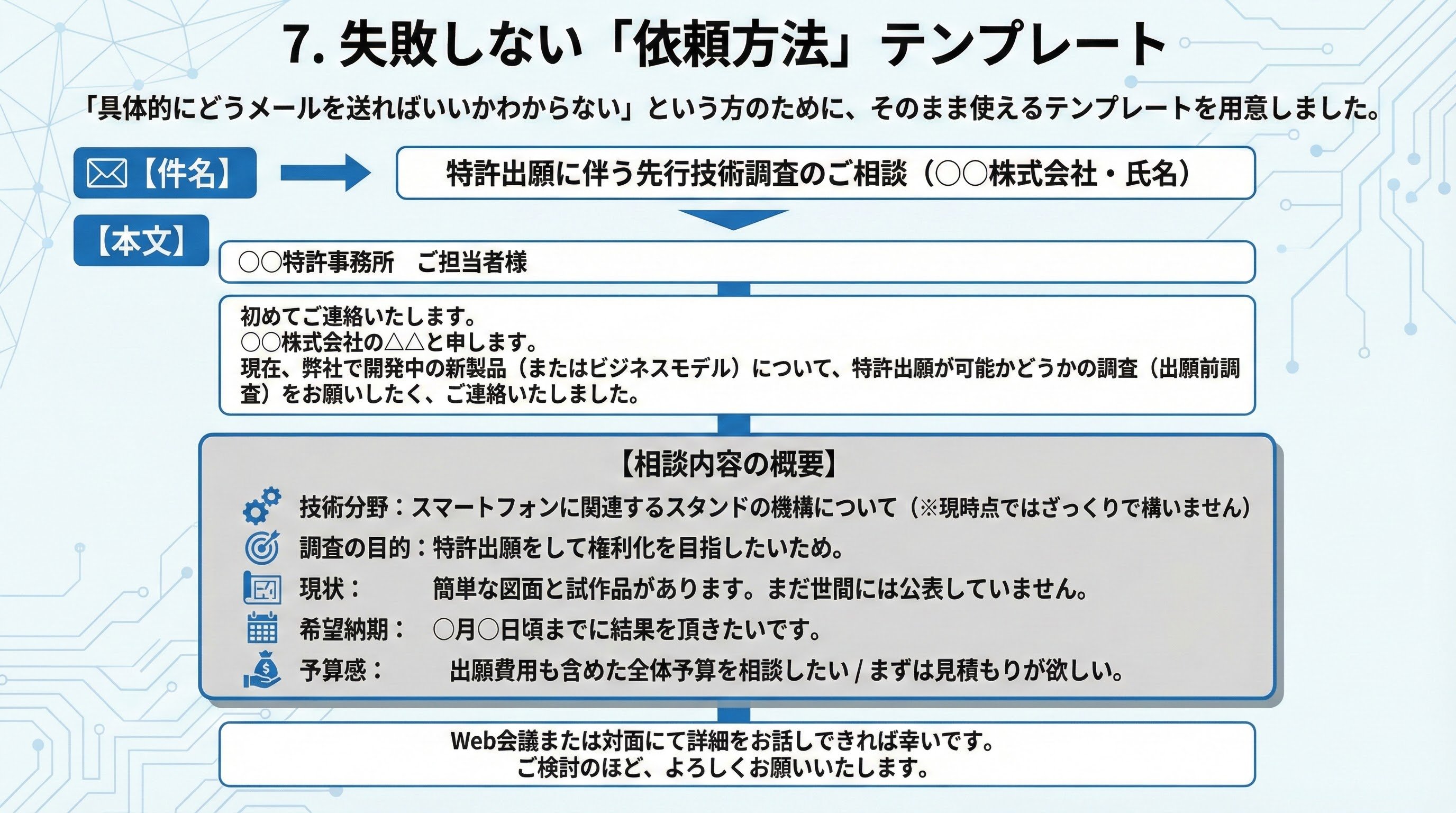
7. "Request method" template that will not fail
For those who don't know exactly how to send an email, we have prepared a template that you can use as is.
Subject: Consultation on prior art search associated with patent application (〇〇 Co., Ltd./Name)
Main text: 〇〇Patent Office Person in charge
This is the first time we will contact you. My name is △△ from 〇〇 Co., Ltd.
We are contacting you to request a survey (pre-filing survey) to determine whether it is possible to file a patent application for a new product (or business model) that we are currently developing.
[Summary of discussion]
-
Technical field: About the mechanism of stands related to smartphones (*Rough information is fine for now)
-
Purpose of research: To aim to apply for a patent and obtain rights.
-
Current status: There are simple drawings and prototypes. It has not been announced to the public yet.
-
Desired delivery date: I would like to receive the results by around 〇〇〇〇.
-
Budget: I would like to discuss the overall budget including application fees / I would like an estimate first.
We would be happy to discuss the details in a web conference or in person. Thank you for your consideration.
8. What to do if the survey results are "unsatisfactory"
As a result of our research, we may receive a report saying, ``Unfortunately, a very similar patent already exists (the possibility of registration is low)''.
This may come as a shock, but it is not a "failure". If you had applied without doing any research, you would have wasted hundreds of thousands of yen. Being able to prevent this from happening is a big plus for management.
Also, this is where a patent attorney's skills start. Even if prior art is found, we will thoroughly identify "devices unique to your invention that are not found in this prior art", and explore ways to obtain a patent by making slight changes to the design or narrowing down the target. The condition of a good patent attorney is to think together with the client about ``How can we obtain rights?'' without ending the case with ``It didn't work.''
Summary: First, relieve your anxiety with a "free consultation"
Patent research is the first step to protecting your intellectual property and accelerating your business. Although it costs money, you will get peace of mind and strategy that are worth it.
-
Can my idea be patented?
-
Are you infringing on the rights of other companies?
Before proceeding with development with this feeling of confusion, why not take in the perspective of an expert first?
At our office, we offer [Free initial consultation] for those requesting patent research for the first time. We will not suddenly sell you a paid survey. First, we will listen to your story and propose the optimal plan, including questions such as ``Is an investigation necessary?'' and ``Is there a way to protect your case other than patents (designs, trademarks, etc.)?''
Do not use difficult technical terms. As your business partner, we will respond in an easy-to-understand and courteous manner. Please feel free to contact us via the inquiry form or by phone.

AUTHOR
Takefumi SUGIURA (杉浦 健文)
EVORIX Intellectual Property Law Firm Managing Patent Attorney
Supports clients across IT, manufacturing, startups, fashion, and medical industries, covering patent, trademark, design, and copyright filings through trials and infringement litigation. Specialized in IP strategy for AI, IoT, Web3, and FinTech. Member of the Japan Patent Attorneys Association (JPAA), Asian Patent Attorneys Association (APAA), and Japan Trademark Association (JTA).