.png?width=500&height=250&name=%E7%9F%A5%E7%9A%84%E8%B2%A1%E7%94%A3%E4%BA%8B%E5%8B%99%E6%89%80%E3%82%A8%E3%83%9C%E3%83%AA%E3%82%AF%E3%82%B9%20(500%20%C3%97%20250%20px).png)


Things to know about trademark registration of stage name/artist name Stage names and artist names...
It's not uncommon for brands to be named after themselves. This is especially common in the world of fashion and jewelry. Since this is a brand used for business, you may be considering applying for a trademark, but when acquiring rights, you need to pay attention to the current examination circumstances at the Japan Patent Office.
In this article, "person's name" is used to mean the full name unless otherwise noted.
Table of Contents
- Cases in which a person's name cannot be trademarked and cases in which it is possible
- Registration and rejection cases of famous designers
- Trend to relax requirements and law amendments
- Practical points for successful registration of personal name trademark
- Estimated cost
- About trademark registration of last name only
- Reference
Cases in which a person's name cannot be trademarked and cases in which it is possible
As a general rule, trademarks that include a person's name cannot be registered (Article 4, Paragraph 1, Item 8 of the Trademark Law). This is because even if your name is your own, if there are other people with the same last name, they may be at a disadvantage. This provision is based on the purpose of ``protecting the personal interests of others.''
Summary of Article 4, Paragraph 1, Item 8 of the Trademark Act
Trademarks that include another person's name cannot be registered unless the other person's consent has been obtained.
However, as an exception, registration is possible with the consent of everyone with the same name. The Japan Patent Office seems to determine the existence of people with the same last name by referring to telephone directories such as Hello Page.
Registration examples approved in the past
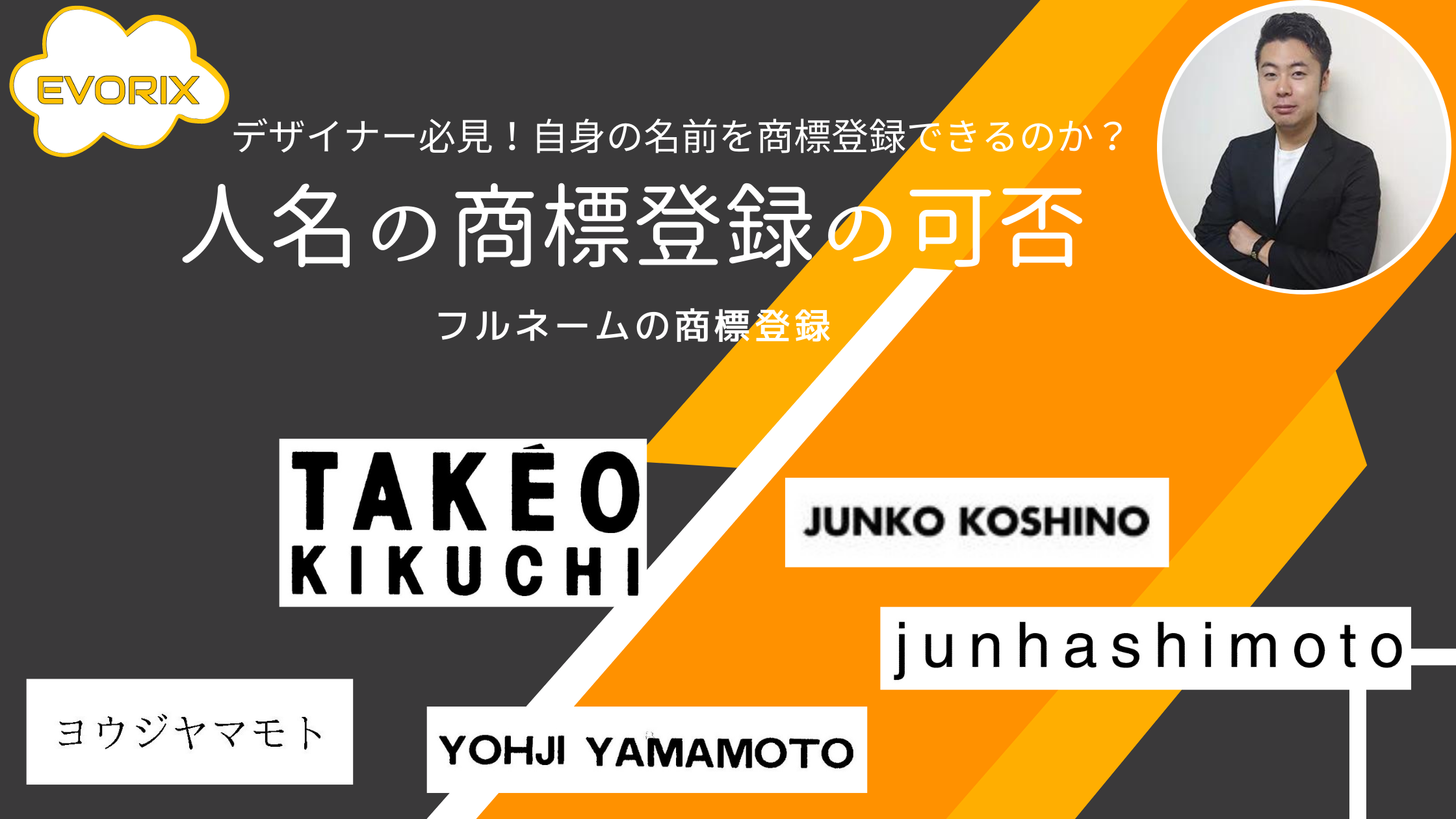
Despite the provisions of Article 4, Paragraph 1, Item 8, the reality has been that until now, personal names have been registered under relatively loose judgment. There are many cases where names have been registered by writing them in katakana or romaji, or by writing them in romaji with a space between the first and last name (for example, "TAKEFUMISUGIURA").
If you search for J-PlatPat, you will find many examples of registrations that are or include people's names.
| Registration number | Trademark | Field |
|---|---|---|
| No. 4373585 | TAKEO KIKUCHI | Fashion |
| No. 4897355 | JUNKO KOSHINO | Fashion |
| No. 5738507 | junhashimoto | Fashion |
No. 4373585 "TAKEO KIKUCHI"

No. 4897355 "JUNKO KOSHINO"

No. 5738507 "junhashimoto"

There are too many examples of overseas brands where the founder's name is used as the brand name, such as "LOUIS VUITTON," "COCO CHANEL," "GIORGIO ARMANI," and "RALPH LAUREN." Even in Japan, the names of internationally active designers such as ``ISSEY MIYAKE,'' ``HANAE MORI,'' and ``YOJI YAMAMOTO'' are registered as brands.
Registration and rejection cases of famous designers
However, the situation has changed in recent years, and it has become extremely difficult to register personal names or trademarks containing personal names. Increasingly, trademarks of famous designers are being rejected.
Takahiro Miyashita's case
Registration of "TAKAHIROMIYASHITATheSoloist." by designer Takahiro Miyashita, who presents his works at the Paris Collection, was not approved at the examination or trial, and although the registrability was contested in court, the registration was ultimately not approved (Reiwa 2 (Gyoke) No. 10006.Judgment).
Points to note
Even if you are a globally active designer, if there is someone with the same name and you do not have their consent, you will not be allowed to register your trademark. It is important to note that fame and brand performance alone cannot meet the requirements.
Yoshi Yamamoto's case
Regarding "Yohji Yamamoto", a trademark handled by Mr. Yohji Yamamoto, although there have been several registrations for this trademark in the past, a recent application has not been approved for registration.
| Division | Trademark | Result |
|---|---|---|
| Past applications | No. 1678376 "YOHJI YAMAMOTO" | Register |
| Recent applications | Business application 2019-23948 "Yohji Yamamoto" | Reject |
Past registration example: No. 1678376 "YOHJI YAMAMOTO"

Rejection example: Commercial application 2019-23948 "Yohji Yamamoto"
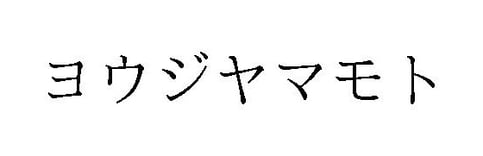
This situation is fraught with contradictions: even though the same person has previously obtained registration for the same brand name, new applications are not approved due to stricter examination standards.
Trends in relaxing requirements and legal reforms
Concerned that such a situation may be too harsh, experts discussed relaxing the requirements for registering trademarks that include the name of another person. Detailed information is published in the "Ideal Intellectual Property System to Promote Intellectual Property Utilization - Summary" by the Japan Patent Office Policy Promotion Council (Report PDF).
Direction of law reform
With the revision of the Trademark Law in 2023, some of the requirements for registering trademarks that include another person's name have been relaxed. Specifically, a trademark that is recognized as the applicant's name can be registered if the trademark is "widely recognized among consumers in the field of goods or services in which the trademark is used." Under the requirements stipulated by the Cabinet Order, there are cases in which registration is possible without the consent of all persons with the same last name.
It is expected that requirements will continue to be clarified and operations will be improved. If you are developing a brand using your name as a trademark, it is important to keep an eye on trends in legal revisions and consider filing an application.
Practical points for successful registration of personal name trademark
We will summarize the points to increase the success rate when registering a person's name as a trademark.
Things to consider before filing
- Investigation of people with the same last name: Understand the number of people with the same last name through hello pages and internet searches. The fewer people with the same name, the higher the possibility of registration.
- Improving the notation method:Consider using Romaji or Katakana instead of Kanji. It may also be effective to write the first and last names consecutively without spaces.
- Consideration of creating a logo:It may be possible to increase distinctiveness by applying for a logo trademark by adding not only the text but also a distinctive font and design.
- Preparation to prove name recognition:The revised law requires that the product be "widely recognized among consumers," so organize evidence such as media coverage, sales data, and awards.
- Obtaining consent from people with the same last name:If the number of people with the same last name is limited, try to obtain written consent.
Practical tips
Even if it is difficult to register a person's name itself, you can consider applying for a coined trademark that combines the person's name with a brand concept or product category. For example, it is also effective to apply for a logo with a good design, such as "TAKEO KIKUCHI."
Estimated cost
The cost of filing a personal name trademark is basically the same as a regular trademark application. However, additional costs may be incurred due to personal circumstances.
| Cost item | Summary |
|---|---|
| Stamp fee at the time of application | 3,400 yen + 8,600 yen x number of sections |
| Stamp fee for registration (10 years) | 32,900 yen x number of sections |
| Patent attorney fee (application fee) | Varies depending on the office (from tens of thousands of yen to tens of thousands of yen) |
| Cost for writing opinions and amendments | Occurs when a response to a notification of reasons for refusal is required |
| Consent fee for people with the same last name | Actual expenses for research, communication, and document preparation |
In the case of personal name trademarks, there is a high possibility that a notice of reasons for refusal will be issued, so it is advisable to allow for the cost of preparing a written opinion or amendment.
About trademark registration of last name only
In principle, a trademark with only a surname cannot be registered if the surname is not a special surname but a "common surname" (Article 3, Paragraph 1, Item 4 of the Trademark Law).
For example, common surnames such as "Sugiura," "Tanaka," "Sato," and "Suzuki" are judged to have no distinguishing power. However, if there are circumstances such as the trademark being well-known in a particular field, it may be recognized that it has distinctiveness through use (Article 3, Paragraph 2 of the Trademark Law) and may lead to registration.
Difference between full name and last name only
- Full name:Article 4, Paragraph 1, Item 8 (other person's name) issue → Consent from the person with the same name or fulfillment of law revision requirements
- Last name only:Article 3, Paragraph 1, Item 4 (Common Mr.) issue → Need to prove distinctiveness through use
It's a complicated situation, but since a person's name also functions as a brand, it should be copyrighted as a commercial product. If you are thinking of applying for a trademark for your name, please feel free to contact us.
Reference
- Article 4, Paragraph 1, Item 8 of the Trademark Act: Trademarks that include another person's portrait or another person's name, famous pseudonym, stage name or pen name, or a famous abbreviation thereof (excluding trademarks with the consent of other people)
- Research report on trademarks that include other people's names: https://www.jpo.go.jp/resources/report/takoku/document/zaisanken_kouhyou/2021_04.pdf
- The ideal state of the intellectual property system to promote the utilization of intellectual property ~Summary~: https://www.jpo.go.jp/resources/shingikai/kenkyukai/kondankai/document/index/hokoku.pdf
AUTHOR
Takefumi SUGIURA (杉浦 健文)
EVORIX Intellectual Property Law Firm Managing Patent Attorney
Supports clients across IT, manufacturing, startups, fashion, and medical industries, covering patent, trademark, design, and copyright filings through trials and infringement litigation. Specialized in IP strategy for AI, IoT, Web3, and FinTech. Member of the Japan Patent Attorneys Association (JPAA), Asian Patent Attorneys Association (APAA), and Japan Trademark Association (JTA).
.jpg?height=200&name=unnamed%20(94).jpg)