.png?width=500&height=250&name=%E7%9F%A5%E7%9A%84%E8%B2%A1%E7%94%A3%E4%BA%8B%E5%8B%99%E6%89%80%E3%82%A8%E3%83%9C%E3%83%AA%E3%82%AF%E3%82%B9%20(500%20%C3%97%20250%20px).png)

Foreign counsel typically need to provide their clients with a cost estimate before engaging...
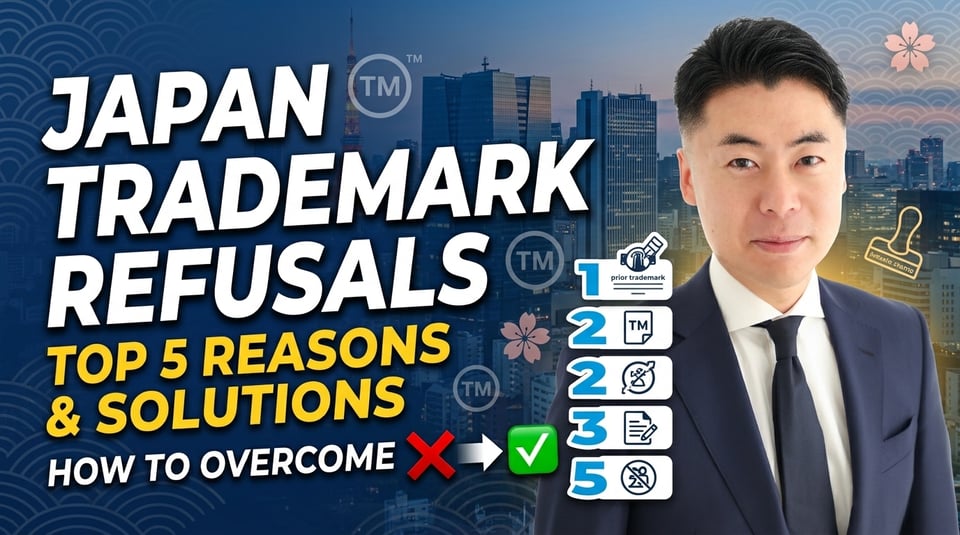
Most trademark refusals issued by the Japan Patent Office (JPO) — including Provisional Refusals against Madrid Protocol designations — fall into a small number of recurring grounds. This article ranks the five most common grounds based on our experience handling JPO Office Actions for foreign-counsel clients, and explains the response strategy that works for each.
Table of Contents
1. Article 3(1)(iii) — Descriptiveness
What it means: The mark is composed solely of indications of the quality, raw material, function, intended use, or place of origin of the designated goods/services. This is the most frequently cited ground for English-language and foreign-language marks designating Japan.
How we overcome it:
- Holistic non-descriptiveness argument: The JPO examines from the perspective of Japanese consumers. An English word that is plainly descriptive in the US/UK may not be perceived as such by Japanese consumers — particularly if not commonly used in industry. We submit dictionary surveys, industry usage data, and Japanese-language search results.
- Acquired distinctiveness (Article 3(2)): If the mark has been used in Japan and acquired source-identifying significance, we submit evidence of Japan-specific use: sales figures, advertising spend, JP-targeted website traffic, social media reach, awards.
- Specification restriction: Limit to goods/services where descriptiveness does not apply.
2. Article 4(1)(11) — Conflict with Prior Registered Mark
What it means: The mark is similar to a prior registered or applied-for trademark covering identical or similar goods/services. This is the most common relative ground in Japan.
How we overcome it:
- Dissimilarity argument: The JPO assesses similarity in appearance, sound, and concept from the perspective of Japanese consumers. Phonetic and visual analysis often reveals distinctions overlooked by foreign examiners.
- Letter of Consent (2024 amendment): Since April 2024, the JPO accepts Letters of Consent under Article 4(4). The consent must demonstrate no source confusion, supported by factual circumstances. See our Letter of Consent guide.
- Goods/services restriction: Restrict to goods that do not overlap with the cited mark's coverage.
- Non-use cancellation: If the cited mark has not been used in Japan for 3+ years, file a non-use cancellation action. Successful cancellation removes the citation entirely.
3. Article 3(1)(vi) — Lack of Distinctiveness (Catch-All)
What it means: A residual ground covering marks that, while not falling under specific subsections (i)–(v) of Article 3(1), still lack distinctiveness. Often invoked for short slogans, simple geometric devices, or commonly used industry terms.
How we overcome it:
- Demonstrate source-identifying function: Show that, in actual market use, consumers recognize the mark as identifying the applicant's goods/services.
- Combine with composite elements: Where the application includes additional elements (logo, stylization), emphasize that the composite as a whole is distinctive.
- Acquired distinctiveness evidence: Same as for Article 3(1)(iii) — Japan-specific use evidence.
4. Article 4(1)(15) — Likelihood of Confusion with Famous Mark
What it means: The mark is likely to cause confusion with another party's well-known or famous mark, even across non-similar goods/services. The JPO uses this ground to protect famous Japanese brands and globally famous foreign brands recognized in Japan.
How we overcome it:
- Challenge "fame in Japan": The cited mark must be famous among Japanese consumers. We collect evidence on whether the cited mark's fame is genuinely established in Japan.
- Distinct concept argument: Show that the marks evoke entirely different meanings or commercial impressions.
- Independent reputation: Demonstrate that the applicant's mark has its own reputation, established independently of the cited famous mark.
This ground is among the harder to overcome. We provide a candid feasibility assessment before quoting.
5. Article 4(1)(7) — Public Order and Morality
What it means: The mark is contrary to public order or morality. The JPO interprets this broadly to cover marks that may offend Japanese cultural or religious sensibilities, marks containing names of historical figures or places without proper authorization, and bad-faith filings against well-known foreign marks.
How we overcome it:
- Cultural context evidence: Explain the mark's actual meaning and intended use in the applicant's market.
- Good-faith adoption: Provide evidence of legitimate selection process — brand development records, consultancy reports, prior use in other jurisdictions.
- Non-bad-faith argument: For Article 4(1)(19) (closely related), demonstrate independent creation and absence of awareness of the third-party mark.
Frequently Asked Questions
Related Articles
RELATED ARTICLE
Article 4(1)(11): Strategies to Argue Non-Similarity in Japan
Effective non-similarity arguments under Article 4(1)(11).
RELATED ARTICLE
Letter of Consent in Japan: Practice After the 2024 Amendment
How LoC works in Japan after the 2024 Trademark Act amendment.
RELATED ARTICLE
Responding to a JPO Provisional Refusal: A Practical Guide for Foreign Counsel
Step-by-step guide for foreign attorneys handling a JPO refusal.
RELATED ARTICLE
Response to Madrid Refusal in Japan: Complete Guide (Deadlines & Options)
What happens after the JPO issues a provisional refusal under Madrid.
FOR FOREIGN COUNSEL
Need to respond to a JPO Provisional Refusal?
EVORIX provides specialized JPO Office Action response services for foreign counsel. Free assessment + fixed quote within 3-5 business days.
Related Articles
- Responding to a JPO Provisional Refusal: A Practical Guide for Foreign Counsel
- Top 5 Reasons for Trademark Refusals in Japan and How to Overcome Them
- Response to Madrid Refusal in Japan: Complete Guide (Deadlines & Options)
- Cost Estimate: Japan Trademark Office Action Response (2026 Update)
- Article 4(1)(11): Strategies to Argue Non-Similarity in Japan
- Japan Trademark Prosecution Timeline
- Letter of Consent in Japan: Practice After the 2024 Amendment
- Working with a Japanese Trademark Attorney: What Foreign Counsel Should Know

.jpg?height=200&name=Gemini_Generated_Image_3ggyph3ggyph3ggy%20(1).jpg)