.png?width=500&height=250&name=%E7%9F%A5%E7%9A%84%E8%B2%A1%E7%94%A3%E4%BA%8B%E5%8B%99%E6%89%80%E3%82%A8%E3%83%9C%E3%83%AA%E3%82%AF%E3%82%B9%20(500%20%C3%97%20250%20px).png)

.jpg?height=200&name=unnamed%20(5).jpg)
Nowadays, the main battlefield of business has shifted from packaged software to SaaS (Software as...
.jpg?width=1024&height=572&name=unnamed%20(3).jpg)
Introduction: ``Waiting for patents'' is the biggest risk for startups where speed is vital
"I've created an innovative idea, but I'm worried that other companies will imitate it"
"I want to have a track record of patents that prove my technological capabilities before the investor interview (VC round) next month."
"We are planning to expand overseas, so first we want to solidify our rights in Japan."
For managers of venture companies and startups whose situations are changing day by day and moment by moment, the "time" required for regular patent examinations is a big pain and can lead to the loss of business opportunities.
Normally, it is said that it takes about 10 to 14 months on average from filing a request for examination to obtaining rights. What will the market look like a year from now? Will the competition wait?
However, did you know that there is a system that can dramatically shorten this period if certain conditions are met?
That is "Super Accelerated Examination (Super Accelerated Examination System)" provided by the Japan Patent Office.
If you use this system, you can receive the examination result (first examination notification) within at least one month from the request for examination.
In this article, from the perspective of a patent attorney who has supported the intellectual property strategies of many venture companies, we will thoroughly explain the mechanism of super accelerated examination, the conditions for venture companies to utilize it (actually, there are cases where "foreign filing" is not required?), and the advantages and disadvantages from a practical perspective.
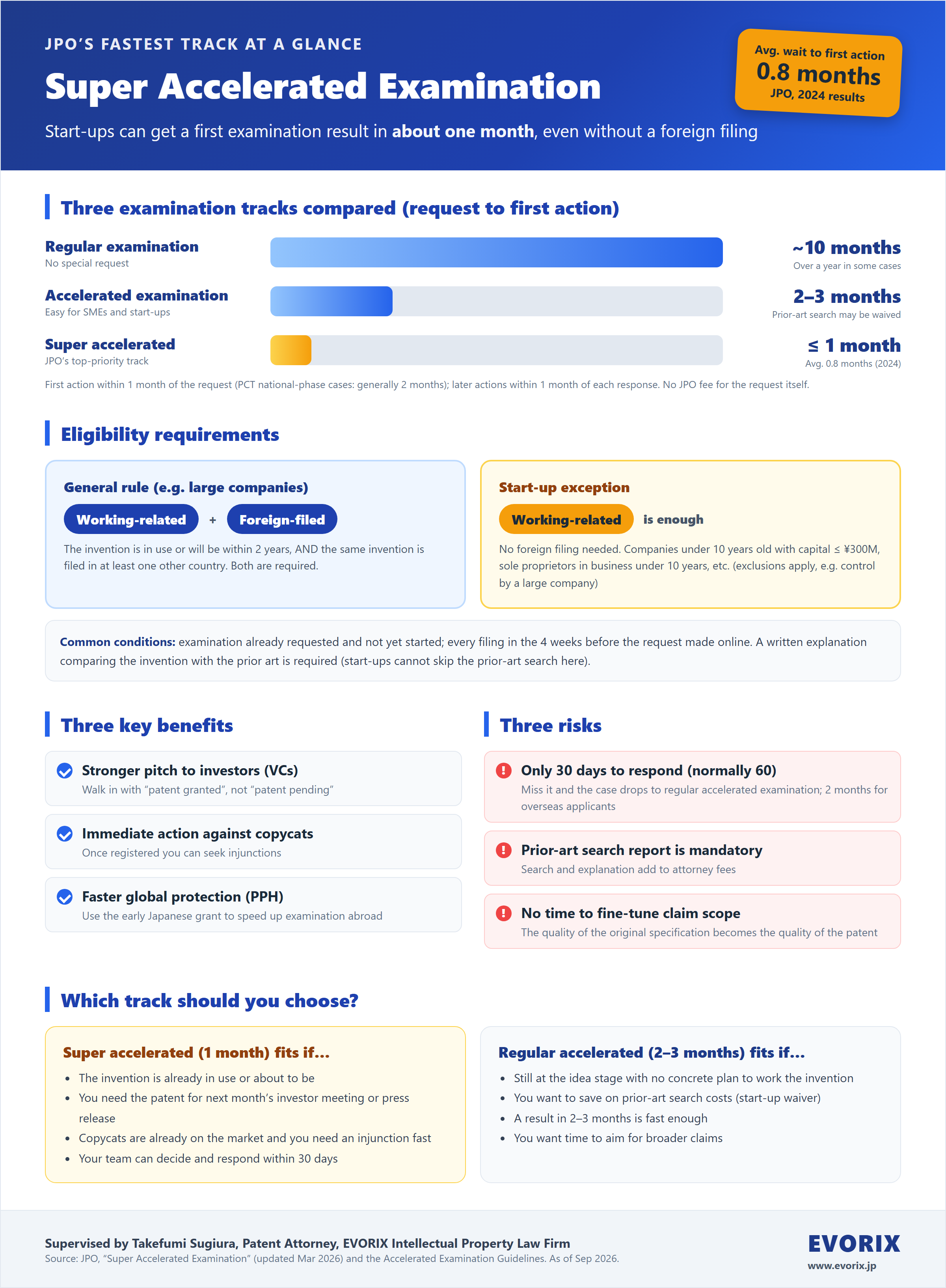
1. What is "Super Accelerated Examination"? Differences between regular examination and accelerated examination
First, let's organize the examination speed categories established by the Japan Patent Office. There are three main courses for patent examination in Japan, depending on the speed.
① Regular examination
-
Period: From request for review to initial review result, average approximately 10 months (more than 1 year depending on the case)
-
Characteristics: This is the normal route when no special application is made. It's stable, but it doesn't match the speed of startups.
② Accelerated examination
-
Period: From request for review to initial review result, average 2 to 3 months
-
Characteristics: This system is relatively easy to use for small and medium-sized enterprises and venture companies. This applies to projects that are "scheduled to be implemented" and those that have "foreign applications." This alone is fast enough.
③ Super accelerated examination
-
Period: From request for review to first review result, on average within 1 month (sometimes the shortest time is around 2 weeks)
-
Characteristics: This is the "highest priority route" at the patent office, with even higher priority than accelerated examination. However, the requirements become more stringent.
For venture companies, a difference of a few months can be a matter of life or death. Super early screening can truly be said to be the most powerful tool for "buying time."
2. Can venture companies use "no foreign application"? Unexpected special requirements
This is the most important point of this article. Many commentary sites say that ``a foreign application is required for super accelerated examination,'' but there are actually special exceptions for venture companies and startups.
Principle requirements (for large companies, etc.)
Normally, in order to receive super accelerated examination, both must be met.
-
Implementation-related applications: Already commercialized or planning to commercialize within 2 years.
-
Foreign-related applications: Applications are filed not only in Japan but also overseas (at least one country).
Special requirements for venture companies and startups
However, if the applicant is a "venture company (SME, etc.)", the requirements will be relaxed as follows.
-
If it is an "implementation-related application", no foreign application is required!
In other words, If you are a venture company that is already using (or ready to use) the technology in-house, you can take advantage of super early screening even if you have no plans to expand overseas.
This is a very powerful option for SaaS companies that want to rapidly expand their share in the domestic market and manufacturers that develop products for the domestic market. There's no need to give up and think, "We're mainly domestic, so super early screening is impossible."
*What is the definition of "venture company"?
According to the Japan Patent Office guidelines, the following companies mainly fall under this category:
-
Sole proprietor who has been in business for less than 10 years
-
Corporations established less than 10 years and with capital of 300 million yen or less
-
(Other requirements such as number of employees and control rate from large companies)
3. Three major benefits of super accelerated examination: Why is it necessary to take it in one month
What are the business benefits of utilizing super accelerated examination even after clearing strict requirements (such as the implementation requirements described below)?
① Strong appeal for funding (VC support)
In a meeting with an investor or venture capital (VC), it is much more persuasive to say, "We are applying for a patent (we don't know what will happen yet)" than to say, "We have already obtained a patent (the uniqueness of our technology has been officially recognized)."
By establishing rights before due diligence, you can prove the stability of your technical capabilities and rights, leading to improved corporate value (increased valuation) and smooth investment execution. Especially in procurement after Series A, the presence or absence of intellectual property is directly linked to the valuation.
② Immediate elimination of counterfeit products and competitors
If there is a risk that a counterfeit product will be distributed immediately after a product is released, it is necessary to register a "patent right" in order to issue a warning. At the "patent pending" stage, even if a warning can be issued, it is not legally enforceable (such as requesting an injunction).
If you can obtain a patent in about a month, you will be able to strongly enforce your rights almost immediately after the product is released, and you will be able to protect your market share. Also, by announcing that the patent has been obtained at the same time as the press release, it can be expected to have the effect of discouraging large companies from entering the market.
③ Acceleration of overseas expansion (utilization of PPH)
If your company is thinking of expanding overseas, if a patent is granted early in Japan, it will be easier to use the "Patent Prosecution Highway (PPH)" system, which uses the examination results to speed up examinations in foreign countries (such as the United States and Europe).
In other words, Japan's super accelerated examination will serve as a trigger (starting point) for quickly building a global patent network.
4. Risks and disadvantages you should know: Careless use is deadly
Where there is light, there is also shadow. There are risks with super early screening that you should be sure to understand before using it. If you apply without understanding this, you will end up putting your company in a bind.
① Extremely short response period (30 days rule)
This is the biggest risk. If you receive a "Notice of Reasons for Refusal (the patent cannot be granted as it is)" from the examiner, you have 60 days to respond in a normal examination, but in a super accelerated examination, you must respond within 30 days.
During these 30 days, you must consult with a patent attorney, add experimental data if necessary, decide on a counter-argument policy, and prepare and submit written amendments and written opinions. Companies that take a long time to make internal decisions or do not collaborate with patent attorneys run the risk of missing out on the opportunity to acquire rights due to the expiration of the deadline (or not being eligible for super accelerated examination).
② Burden and cost of prior art search
In the case of normal "accelerated examination," there is a special provision in which venture companies can omit reporting "prior art search (searching for similar patents)."
However, in the case of "super accelerated examination," a prior art search report is required even if the company is a venture.
You must conduct a highly accurate investigation using a specialized database and submit a document (statement of circumstances) that logically explains the "differences from the prior art." Therefore, patent attorney fees (search costs) tend to be higher than for regular applications.
③ Shorter time to adjust scope of rights
Because the review process is too quick, there is almost no time to think about things like ``I want to expand the scope of rights a little more'' or ``I want to make adjustments through amendments.'' The completeness of the specification at the time of filing is directly linked to the quality of the rights. If you take the stance of ``filing the application first and thinking about it later,'' you will fail.
5. Which should I choose, normal "accelerated examination"?
"Super accelerated examination" and "(normal) accelerated examination". Which one you should choose depends on your business situation. Please refer to the checklist below.
Case where you should choose super accelerated examination (1 month)
-
There is a reality of "implementation (commercialization)".
-
I definitely want to be on time for next month's investor meeting and press release.
-
Counterfeit products are already on the market, and we need an injunction as soon as possible.
-
In-house decision-making is fast and responses can be made within 30 days.
-
Some additional costs (survey costs) are acceptable.
Case where you should choose normal accelerated examination (2 to 3 months)
-
There is no prospect of commercialization (implementation) yet (idea stage).
-
I want to reduce the cost of prior art search (I want to use the venture exception).
-
I think it would be fast enough if the results could be seen in about 2 to 3 months.
-
We want to carefully aim for a wide range of rights.
Actually, even Japan's normal accelerated examination (2 to 3 months on average) is quite fast from a global perspective. There are many cases where normal accelerated examination is sufficient without forcing yourself to aim for super accelerated examination.
6. The role of a patent attorney in making super accelerated examination a success
Super early screening is like a "F1 race". You can only complete the race if you have the best machine (invention) and the best driver (patent attorney). In particular, the following points require professional skill.
Strategic prior art search
In addition to meeting the application requirements, highly accurate preliminary research and differentiation explanations are required so that the examiner will be able to issue a "grant of patent" in one go. If you cut corners here, your application for super accelerated examination itself may be rejected.
Examiner response (interview examination)
In the unlikely event that a delicate decision is likely to be made or a reason for refusal is notified, you will need the negotiation skills to immediately call or interview the examiner and find a solution. Only an experienced patent attorney can respond in a short period of 30 days.
Alignment with business strategy
There is no point in acquiring a narrow patent that is useless just for the purpose of "getting it quickly." It is important to have a sense of balance in order to pass the speedy examination while attacking the limit of space that can protect your business.
7. Frequently asked questions (FAQ)
Q1. It has not been commercialized yet, but there is a prototype. Can I use Super Early Examination?
A. Yes, it may be possible to use it. The definition of "implementation" includes not only sales but also "preparation for implementation." You can meet the requirements by presenting a concrete business plan, specifications, photos of prototypes, etc. However, this is not acceptable at the mere conceptual stage.
Q2. We are a venture company and have 50 employees. Are you eligible?
A. The requirements for venture companies (requirements for small and medium-sized enterprises) are that the upper limit on the number of employees varies depending on the industry (e.g., 300 or less in the manufacturing industry, 100 or less in the service industry, etc.). It also varies depending on the investment ratio from large companies, so please contact us for details.
Q3. Is there an additional stamp fee (patent office fee) for super accelerated examination?
A. The fee paid to the Japan Patent Office is the same as the regular examination request fee (it is free). However, since the preparation of application documents (explanation of circumstances) and advanced prior art searches are required, the fees paid to the patent office are generally higher than in normal cases.
Summary: If speed is your weapon, team up with an expert
For venture companies, using super accelerated examination to obtain a patent approval within one month of filing is not a pipe dream, but a realistic strategy.
In particular, the start-up special provision, which can be used even if there is no foreign application, is an opportunity that companies aiming for rapid growth domestically cannot miss.
However, in order to achieve this, it is essential to meet strict requirements and respond quickly with no room for error.
-
"I want a patent by the investor meeting next month"
-
"I want to know whether my invention is eligible for super accelerated examination"
-
"I want to obtain rights as quickly as possible while keeping costs down"
If you are a business owner or a development manager thinking like this, please feel free to contact us.
We will build the strongest intellectual property strategy together with you without falling behind the speed of your company's business, and support you in obtaining rights through the shortest route.
Time won't wait. Why not start with a "free consultation" before your competitors get ahead of you?
[Article tag]
#Super accelerated examination #Early examination #Venture company #Startup #Patent application #Intellectual property strategy #Patent attorney #Patent acquisition #Speed management #Fund raising #IPO #Buyout #Patent Office

AUTHOR
Takefumi SUGIURA (杉浦 健文)
EVORIX Intellectual Property Law Firm Managing Patent Attorney
Supports clients across IT, manufacturing, startups, fashion, and medical industries, covering patent, trademark, design, and copyright filings through trials and infringement litigation. Specialized in IP strategy for AI, IoT, Web3, and FinTech. Member of the Japan Patent Attorneys Association (JPAA), Asian Patent Attorneys Association (APAA), and Japan Trademark Association (JTA).