.png?width=500&height=250&name=%E7%9F%A5%E7%9A%84%E8%B2%A1%E7%94%A3%E4%BA%8B%E5%8B%99%E6%89%80%E3%82%A8%E3%83%9C%E3%83%AA%E3%82%AF%E3%82%B9%20(500%20%C3%97%20250%20px).png)


The ability to create a unique AI assistant with specialized knowledge without writing a single...
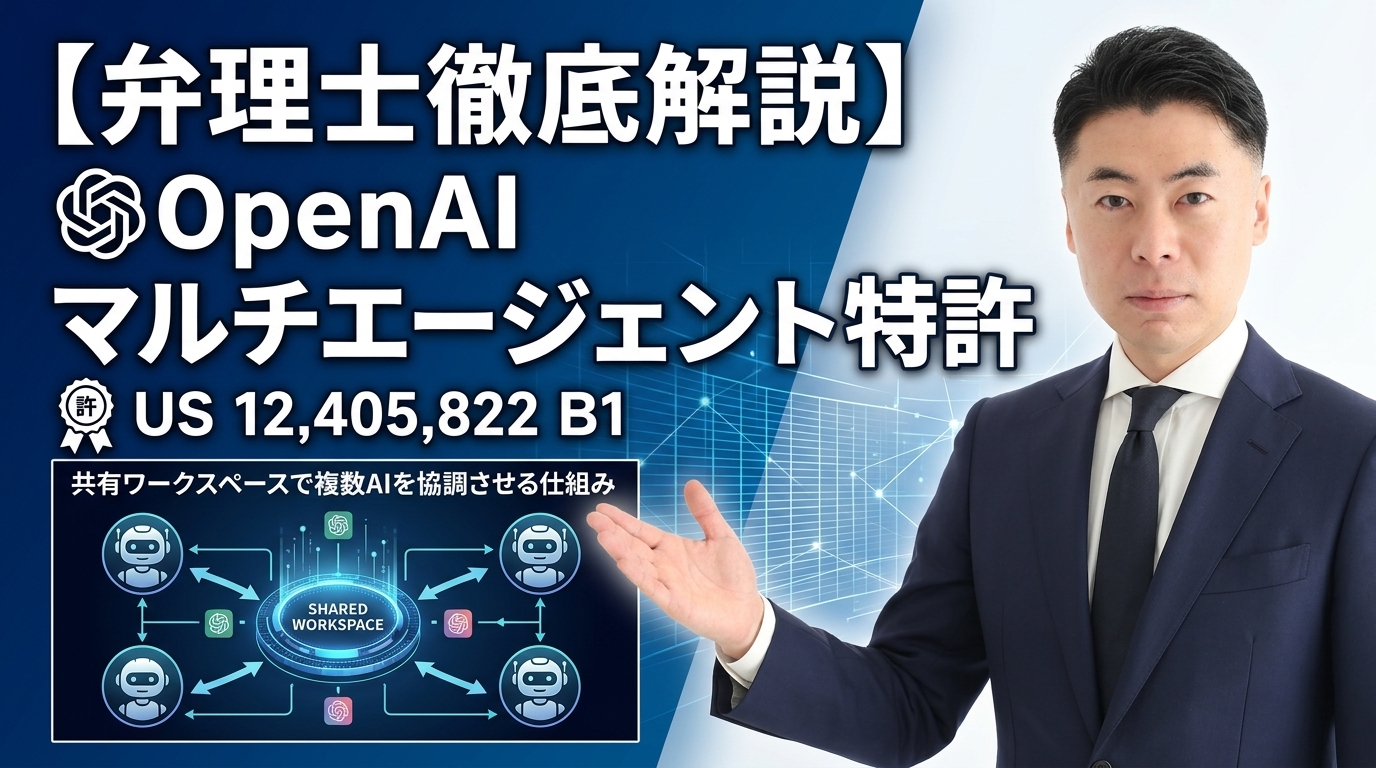 Even complex tasks that are difficult for a single AI agent to handle may be solvable if multiple agents work together. However, figuring out how to operate multiple AIs as a “team” presents challenges such as “conflicts,” “overlaps,” and “confusion.”OpenAI’s solution to this challenge is U.S. Patent No. 12,405,822 B1, “Multi-agent interactions using a shared workspace,” which we’ll explore in depth in this article.
The approach involves providing multiple AIs with a “shared blackboard (workspace)” and having them all look at it to autonomously decide whether to “act themselves or yield to others.” This design philosophy stands in contrast to Salesforce’s “hierarchical” multi-agent patent, which we explained previously.A patent attorney specializing in AI intellectual property will explain this while citing the actual claims.
💡 Key Point: This article is part of a series on AI agent patents. For a comparison with the hierarchical model, please see the explanation of the Salesforce patent; for examination practices, please refer to the case studies from Japan, the U.S., and Europe.
Table of Contents
- 30-Second Summary | Coordinating Multiple AIs via a “Shared Whiteboard”
- Basic Patent Information
- Background | How Do Multiple Agents Prevent “Conflicts” and “Overlaps”?
- Key Point 1 | Shared Workspace = A “Ledger” for Append-Only Updates
- Key Point 2 | “Operation Transformation (OT)”: The Wisdom Behind Collaborative Editing
- Key Point 3 | Coordinator, Task Agent, and Channel
- Key Point ④ | Deciding Whether to “Yield” or “Act”
- Reading Independent Claim 1 Clause by Clause
- Two Multi-Agent Designs | Hierarchical vs. Shared Workspace
- How It Will Be Evaluated in Japanese, U.S., and European Examinations
- Lessons for Your Own Applications
- Frequently Asked Questions (FAQ)
30-Second Summary | Coordinating Multiple AIs via a “Shared Whiteboard”
● What the Patent Is About: A mechanism whereby multiple AI agents collaborate via a shared workspace (ledger).
● Key Points: ① A ledger for appends only; ② Each command is an “operational transform”; ③ Coordinator + Task Agent + Channel; ④ Decides whether to “yield” or “act” based on others’ commands.
● Patent Holder: OpenAI OpCo, LLC.
● Status: U.S. registered patent (registered September 2, 2025; 18 claims total, 3 independent claims).
● Comparison: Unlike Salesforce’s “hierarchical” model, this patent employs a “shared workspace (blackboard)” model.
● Key Points: ① A ledger for appends only; ② Each command is an “operational transform”; ③ Coordinator + Task Agent + Channel; ④ Decides whether to “yield” or “act” based on others’ commands.
● Patent Holder: OpenAI OpCo, LLC.
● Status: U.S. registered patent (registered September 2, 2025; 18 claims total, 3 independent claims).
● Comparison: Unlike Salesforce’s “hierarchical” model, this patent employs a “shared workspace (blackboard)” model.
Basic Patent Information
| Item | Content |
|---|---|
| Patent Number | US 12,405,822 B1 |
| Title of the Invention | Multi-agent interactions using a shared workspace |
| Registration Date | September 2, 2025 |
| Filing Date / Priority Date | June 7, 2024 |
| Applicant | OpenAI OpCo, LLC |
| Inventors | Raphael Gontijo Lopes, Arun Vijayvergiya, Jason Wolfe |
| Number of Claims | 18 (3 independent claims: Claims 1, 10, and 17) |
| Status | Granted Patent |
Background | How Do Multiple Agents Prevent “Conflicts” and “Overlaps”?
When multiple AI agents work as a team, the same problems arise as with human teams. If it’s unclear who is responsible for what, two agents may end up duplicating each other’s work, or their tasks may conflict.
There is no single way to solve this “coordination (orchestration)” problem. This patent adopts a solution characteristic of distributed systems, in which all agents share the same “workspace” and make their own decisions based on its current state.
Key Point 1 | Shared Workspace = An “Append-Only Ledger”
At the heart of this patent is the “workspace.” The specification describes this as an “append-only ledger.”
Each agent writes commands to this ledger, and the written commands are made public to all members of the workspace. Since the ledger is append-only, past records are not erased, allowing everyone to share the same “work history and current state.” This concept is similar to that of blockchain and distributed ledgers.
Core Concept 2 | “Operational Transforms (OT)”: The Wisdom of Collaborative Editing
Claim 1 explicitly states that the commands in the ledger are “operational transforms (OT)” and that “each command specifies how the workspace is modified.” This is the technical highlight.
💡 Key Point: “Operational Transforms (OT)” are originally known as a technology that enables simultaneous editing by multiple users, similar to Google Docs. It is a mechanism that expresses “who edited what and where” as a transform and merges the changes without conflicts.This patent applies the wisdom of this collaborative editing to “collaboration among multiple AIs.” Bringing proven technology into a new domain—this concreteness serves as a strong basis for avoiding rejection of abstract ideas.
Core Concept 3 | Coordinator, Task Agent, and Channel
Agents participating in the workspace have specific roles.
| Components | Roles (based on the specification) |
|---|---|
| Coordinator Agent | An autonomous agent with general knowledge. Coordinates the overall system. |
| Task Agent | An autonomous agent trained to perform specific types of tasks |
| Workspace Manager | Facilitates invitations and participation, and provides each agent with an appropriate "view" |
| Channels | Message threads comprising a subset of workspace members |
A specific participation protocol is defined: the coordinator posts an invitation command, and task agents join the channel by responding with a join command. The Workspace Manager provides a “view” that filters out commands irrelevant to each agent.
Core Principle ④ | Deciding Whether to “Yield” or “Act”
The core of the coordination mechanism described in this patent is a system in which each agent “decides whether to yield or act in response to commands added to the ledger other than those it posted itself.”
[Coordination Flow (Claim 1)] [Coordinator] — Posts an invitation command │ (via Workspace Manager) ▼ [Task Agent] — Joins the channel with a join command │ ▼ [Coordinator] ── Adds the first command to the ledger │ Forwarded by the Manager ▼ [Task Agent] ── Makes a decision based on the first command ├─ act: Posts the second command (= decision to act) └─ yield: Leaves it to others
💡 Key points: “Respond to commands other than those you posted yourself” and “Choose between acting or yielding”—these simple yet powerful coordination primitives prevent overlap and conflicts among multiple AIs. They are explicitly stated as limitations on claims, thereby concretizing rights.
Reading Independent Claim 1 Clause by Clause
Organization of Restrictions Supporting Rights Management
| Restrictions | Technical Meaning | Reason for Effectiveness |
|---|---|---|
| Append-only ledger | Single Source of Truth for Shared State | Concretization of Data Structures |
| Operation Transformation (OT) | Conflict-Free Integration of Changes | Establishing Collaborative Editing Technology = Technical Specificity |
| Yield/Act Decision | Avoiding Duplication and Conflicts | Core of the Collaborative Protocol |
| Interaction via the Workspace API | Standardized Collaboration | Explicit Technical Implementation |
In addition to independent claim 1 (method), claims 10 and 17 are also filed as independent claims, providing multi-layered protection from different perspectives.
Two Multi-Agent Designs: Hierarchical vs. Shared Workspace
There are fundamentally different design philosophies underlying multi-agent collaboration. A comparison of the two patents discussed in this series clearly illustrates these differences.
| OpenAI (this article) | Salesforce (previously discussed) | |
|---|---|---|
| Patent | US 12,405,822 B1 | US 2025/0265443 A1 |
| Design Philosophy | Shared Workspace Model (Blackboard Model) | Hierarchical (Tree-Type) |
| Coordination Mechanism | All members view the shared ledger and make autonomous decisions (yield/act) | Managers break down tasks and assign them to subordinates |
| Core Technology | Appended Ledger + Operation Transformation (OT) | Task Decomposition + Formatting Packages |
| Analogy | Roundtable Meeting (Shared Whiteboard) | Command Structure (Top-Down) |
💡 Key Point: Even within the same concept of “coordination among multiple AIs,” contrasting architectures—such as “autonomous coordination via a shared whiteboard” (OpenAI) and “manager-led command” (Salesforce)—have each been patented separately.This is a prime example demonstrating that in the multi-agent field, there is scope for securing intellectual property rights for each specific “method” of collaboration. If your company has a unique collaboration method, it is certainly worth considering securing intellectual property rights for it.
How Will This Be Evaluated in Examinations in Japan, the U.S., and Europe?
United States (USPTO)
Rather than relying on the abstract concept of “multiple AIs collaborating,” this invention incorporates specific technical mechanisms—such as a logbook, operation conversion, a workspace API, and yield/act decision-making—making it easier to argue that it provides a “concrete solution to a technical problem” under the Alice/Mayo tests. As a result, it is currently registered.
Japan (JPO)
The specification describes a specific data structure—a “command ledger”—along with processing via operation transformation and API integration, making it a configuration that readily satisfies patent eligibility as a software-related invention. The key to demonstrating inventive step lies in the technical ingenuity of “the application of OT” and “yield/act coordination primitives.”
Europe (EPO)
This configuration can be easily positioned as a technical solution to the technical problem of conflict avoidance (operation transformation) in multi-entity coordination, and is likely to be evaluated as a technical feature even under the COMVIK approach.
A detailed comparison of examination practices for AI agent patents in Japan, the U.S., and Europe is provided in “Patent Cases and Examination Practices in Japan, the U.S., and Europe.”
Lessons for Your Own Applications
① Secure rights to the coordination “protocol.” The “coordination method” of multi-agents itself can be patented. If you have unique coordination rules, it is well worth considering.
② Apply proven technologies to new fields. The concept of bringing established technologies—such as “Operation Transformation (OT)”—into new fields (AI coordination) is effective in terms of both inventive step and patent eligibility.
③ Explicitly define simple yet powerful “primitives.” Place simple but effective control mechanisms—such as “yield/act decisions”—at the core of your claims.
④ There is scope for patent protection based on design philosophy. Separate patent opportunities exist for each architectural difference, such as hierarchical or blackboard architectures.
We will assess whether your company’s multi-agent technology is patentable.
Patent attorneys with deep expertise in the IT, software, and AI fields will provide comprehensive support—from claim drafting that incorporates coordination protocols and architectures, to a free assessment of patentability, to filing strategies in Japan, the U.S., and Europe.
Schedule a Free Initial Consultation IT & AI Intellectual Property ServicesFrequently Asked Questions (FAQ)
Q. What kind of patent is US 12,405,822 B1?
A. It is a U.S. patent registered by OpenAI that protects a mechanism whereby multiple AI agents collaborate through a “shared workspace.”The workspace is a “ledger” that is write-only; each agent observes its state and decides whether to “act” or “yield” in response to commands other than those it has posted. It was granted on September 2, 2025, and contains a total of 18 claims.
Q. What is a “shared workspace”?
A. It is a “shared workspace (blackboard)” that multiple AI agents can access collectively to view its state and write commands.In this patent, it is implemented as a read-only ledger, and each command within the ledger specifies, as an “operational transform,” how the workspace should be modified. Agents interact with this ledger via an API.
Q. Why is the “yield” mechanism important?
A. When multiple agents operate simultaneously, they may perform the same task redundantly or collide with one another. In this patent, each agent observes the commands of others to determine whether “it should act or yield to another,” thereby preventing duplication and confusion and enabling efficient collaboration.
Q. How does this differ from Salesforce’s multi-agent patent?
A. The design philosophies differ. Salesforce (US 2025/0265443) uses a hierarchical (tree-based) model where “a manager breaks down tasks and assigns them to subordinate agents.”OpenAI’s patent, on the other hand, is a shared workspace model (blackboard model) in which “all agents view a shared ledger and autonomously decide whether to act or yield.” Although both are multi-agent systems, their coordination architectures are in stark contrast.
Q. Can a multi-agent coordination protocol be patented?
A. Yes, they can. As demonstrated by this patent, if described as specific technical mechanisms—such as a shared ledger, operation transformations, yield decisions, and channels—patent protection is possible in Japan, the U.S., and Europe. Coordination protocols for multiple AIs represent a critical area for patent protection in the era of multi-agent systems.
Important Note Regarding This Article: This article provides a general explanation of technology and legal systems based on published patent applications. Although US 12,405,822 B1 is a registered patent, the actual scope of protection is determined by the wording of each claim, the doctrine of equivalents, and historical information.The cited claims, abstract, and specification are based on published patent bulletin data (Google Patents, FreePatentsOnline, etc.); however, for legally significant purposes (FTO, infringement analysis, invalidation, patent applications, etc.), please be sure to verify the USPTO official transcript and the latest prosecution history, and consult with a specialist for an individual review.The Japanese translation is provided for reference purposes only; the official text is the original English version.
Recommended Reading (AI Agent Patent Series): ・Decoding
Salesforce’s
“Hierarchical” Multi-Agent Patent ・OpenAI’s “AI Agents Learning from Videos” Patent (VPT) ・Patent Case Studies and
Examination Practices in Japan, the U.S., and Europe (Case Studies) ・Can
AI Agent Technology Be Patented? (Basics)
Salesforce’s
“Hierarchical” Multi-Agent Patent ・OpenAI’s “AI Agents Learning from Videos” Patent (VPT) ・Patent Case Studies and
Examination Practices in Japan, the U.S., and Europe (Case Studies) ・Can
AI Agent Technology Be Patented? (Basics)
Source
- US 12,405,822 B1 (Google Patents): https://patents.google.com/patent/US12405822B1/en
- Claims and Specification (FreePatentsOnline): https://www.freepatentsonline.com/12405822.html