.png?width=500&height=250&name=%E7%9F%A5%E7%9A%84%E8%B2%A1%E7%94%A3%E4%BA%8B%E5%8B%99%E6%89%80%E3%82%A8%E3%83%9C%E3%83%AA%E3%82%AF%E3%82%B9%20(500%20%C3%97%20250%20px).png)


There are two main methods for obtaining a patent overseas: the Paris Route (direct filing) and the...
Introduction: AI Expanding into the Physical World and the Importance of Intellectual Property Strategy
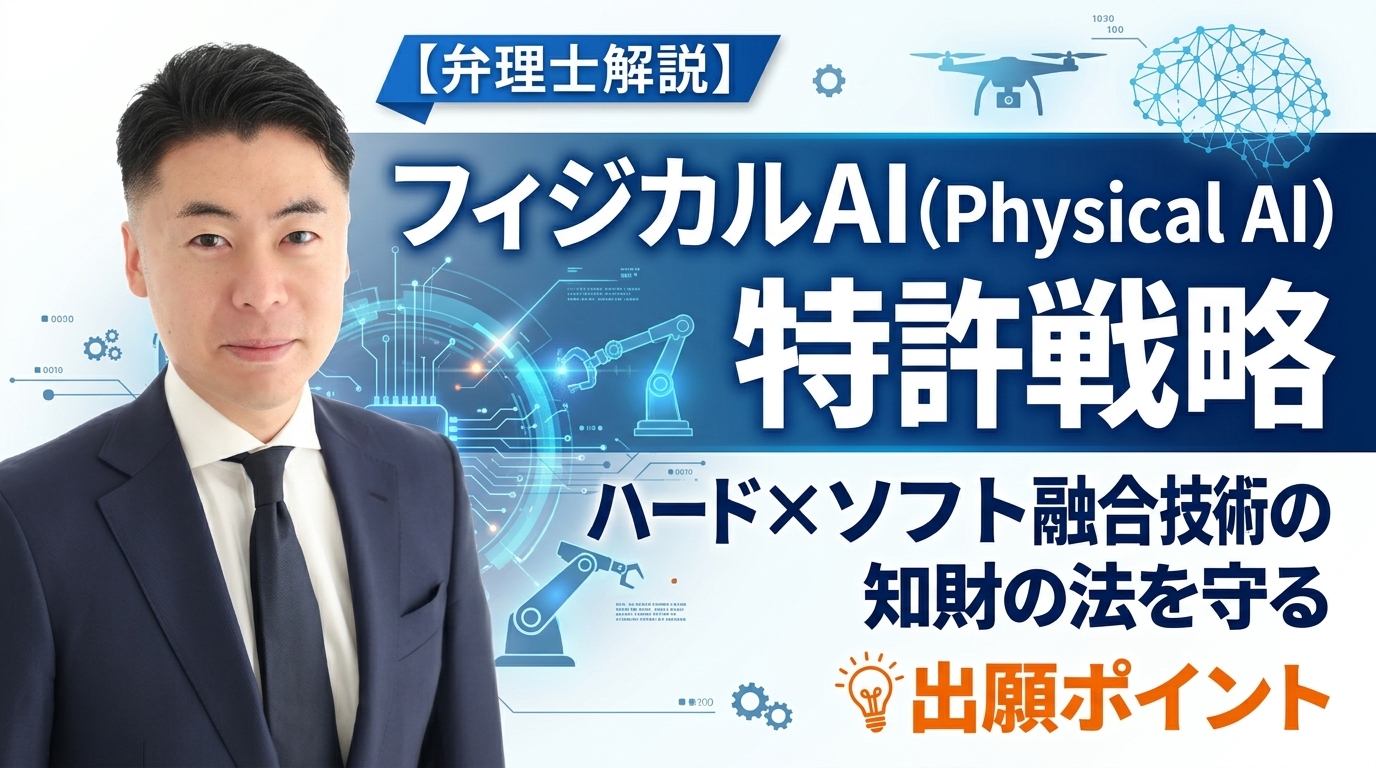 In recent years, AI (Artificial Intelligence), which has evolved in the software domain, is expanding into the “physical world” as its next main battleground. This is known as “Physical AI (Physical AI / Embodied AI).” Physical AI, which fuses robotics, sensor technology, and AI, holds the potential to fundamentally transform the structures of all industries, including manufacturing, logistics, and healthcare.
🚨 A Flawed IP Strategy Can Lead to Loss of Market Leadership
Even if you develop groundbreaking Physical AI technology, without an appropriate "patent and IP strategy," there is a risk that competitors will quickly imitate it and seize market leadership. In this article, a patent attorney well-versed in patent applications in the AI and mechatronics fields explains the unique challenges of filing for Physical AI and the IP strategies needed to robustly protect your technology.
If you are a business owner, CTO, or IP manager thinking, “I’ve launched a business utilizing physical AI but don’t know how to obtain patents,” or “I want to consult an expert about securing rights for technologies involving AI and hardware,” please be sure to read this article to the end.
Table of Contents
- What is Physical AI? The Background Behind Its Rising Popularity
- Three Reasons Why Obtaining a Patent Is Essential
- Three Challenges and Key Considerations in Filing
- A Multi-Faceted IP Strategy for Strong Physical AI Patents
- Key Factors for Selecting a Patent Attorney Specializing in Applications
- Free Consultation & Inquiries
1. What Is Physical AI? The Background Behind Its Rising Popularity
From Software AI to AI That Interacts with the Physical World
Physical AI is an AI technology that recognizes real-world situations in real time through sensors such as cameras, makes autonomous decisions, and performs "physical actions" via actuators such as robotic arms.
Conventional AI completed information processing entirely within the digital space. In contrast, Physical AI seamlessly combines “inference capabilities in cyberspace” with “physical movements in the physical space.” Thanks to improvements in computing resources, the falling cost of sensors, and advances in simulation technology, it is now transitioning into the phase of societal implementation.
Key Business Applications of Physical AI
🤖 Autonomous Humanoids
Robots that autonomously perform complex assembly tasks in factories or work in hazardous environments
🚗 Autonomous Driving and Next-Generation Mobility
Systems that instantly infer unexpected pedestrian movements and safely control vehicles
📦 Autonomous Logistics & Smart Factories
Robotic arms that autonomously recognize packages of various shapes and pick them with optimal force
🏥 Medical & Healthcare
A surgical assistance robot that learns the surgeon’s movements and supports operations with precise autonomous control
💡 The Integration of Software and Hardware Raises the Bar for Patent Applications All of these systems rely on the complex interplay of “advanced AI” and “precise hardware mechanisms.” It is precisely this characteristic of the technology that lies at the heart of the difficulty in filing physical AI patent applications.
2. Three Reasons Why Obtaining Patents Is Essential in the Physical AI Business
"Acquiring patent rights" is just as important as technological development. From the perspective of a specialized patent attorney, I summarize the reasons into three points.
① Securing Competitive Advantage and Building Barriers to Entry
The physical AI market is a fiercely competitive arena where tech companies vie for dominance. Even if you develop a groundbreaking control method, without a patent, it will be reverse-engineered and imitated by large corporations with abundant financial resources.
By obtaining a patent and securing the “exclusive right” to legally prevent others from manufacturing or selling your product, you can block competitors from launching similar products. Patents that link AI decision-making logic with hardware operations enable you to build a powerful barrier to entry.
② Strengthening Negotiating Power in Open Innovation
Since the development of physical AI requires a wide range of specialized knowledge—including AI algorithms, sensor technology, and mechanical engineering—joint research with other companies is common.
In such cases, if a company does not hold patents for its own technology, it faces “intellectual property risks,” such as having its technology misappropriated by joint research partners or being forced to accept unfavorable terms. Patents serve as the “strongest bargaining chip” for establishing an equal partnership during collaboration and preventing the company from being reduced to a subcontractor.
③ Dramatic Improvement in a Startup’s Ability to Raise Funds
For startups, patents are a key factor in dramatically enhancing their appeal to venture capital (VC) firms.
Investors rigorously scrutinize whether a technology can be imitated by competitors. Possessing a portfolio of filed patents indicates a high likelihood that the technology’s uniqueness is guaranteed by public authorities, which directly leads to increased corporate value and successful fundraising.
3. Three Obstacles and Key Considerations in Physical AI Patent Applications
To obtain strong patents, it is necessary to understand the unique "barriers" and take appropriate measures.
Hurdle 1: Increased Complexity Due to the Convergence of Hardware and Software
Traditional patents have typically focused on either “new mechanical structures” or “methods of information processing.” However, in Physical AI, the two are inseparable.
⚠️ Typical Failure Case
In the case of technology that “analyzes images using AI to control the joint angles of an arm,” there is a risk that the invention will not be recognized if the claims describe only the AI algorithm, as it is deemed to involve no physical changes. Conversely, if the claims describe only the arm’s structure, the inventive step will be denied.
The true test of a patent attorney’s skill lies in clearly articulating the coordinated process between software computation and hardware, and convincing the examiner that it constitutes an “indivisible invention.”
Hurdle 2: The Challenge of Patenting AI Algorithms Themselves
Simply stating that the invention “uses machine learning” is not sufficient to obtain a patent. A specific mechanism explaining how the invention solves the problem is required.
Items that should be described in detail in the specification:
- Preprocessing of input data (noise removal, normalization, etc.)
- Feature extraction methods (proprietary architecture)
- Model inference process (training methods, loss functions, etc.)
- Conversion of inference results into hardware control parameters
Challenge 3: Expressing how to handle "uncertainty (noise)" in the physical world
The physical space is subject to an infinite variety of noise sources, such as friction, temperature changes, and light reflection. The true value of Physical AI lies in how it addresses this noise.
✅ Key Points for Claiming Significant Advancement: In a patent application, by positioning “how AI corrects errors caused by noise specific to the physical space and controls hardware” as the patent’s problem and solution, you can assert significant advancement over existing technologies.
4. A Multi-Faceted IP Strategy for Obtaining Strong Physical AI Patents
To obtain strong patents that overcome obstacles and protect your business, we recommend the following multifaceted approach.
Strategy 1: Comprehensive Protection Through a Three-Layer Structure of Hardware, Software, and Systems
Relying on a single patent for protection is risky. It is crucial to break down the technology and build a “patent portfolio” from multiple perspectives.
1️⃣ AI Algorithm Patents
Proprietary learning methods, data generation techniques, preprocessing and inference algorithms
2️⃣ Hardware and Sensor Patents
Special mechanisms that operate under AI instructions, optimal sensor placement
3️⃣ System and Control Method Patents
The sequential process of sensor input → AI inference → actuator control
By securing rights across multiple layers, it becomes extremely difficult for competitors to circumvent your technology.
Strategy 2: The "Open & Close Strategy" for AI Patents and Trade Secrets
When a patent is filed, the technical details are made public. Therefore, a strategy to distinguish between “what is disclosed via patents (open)” and “what is kept confidential as trade secrets (closed)” is essential.
| Category | Target |
|---|---|
| ✅ What to Patent (Open) |
Robot movements, control flows, interfaces, and UI/UX that can be easily analyzed by outsiders |
| 🔒 Items to be kept confidential (closed) |
Raw training datasets that determine AI accuracy, labeling know-how, and internal weighting parameters |
Skilled patent attorneys also provide strategic IP advice on whether to file a patent application or keep information confidential.
Strategy 3: Foreign Filing Strategy with an Eye on the Global Market
Patent rights are subject to territoriality, meaning a patent obtained in Japan is only valid within Japan.
It is essential to consider “PCT international applications” from the early stages to secure patents in countries where your products are exported or where competitors exist (such as the U.S., China, and Europe). In particular, given the intense competition in AI patent development between the U.S. and China, it is crucial to draft comprehensive patent specifications from the outset that can withstand foreign applications.
💰 Up to 50% Subsidy via the INPIT Foreign Filing Grant: Small and medium-sized enterprises (SMEs) and startups can receive a subsidy covering up to 50% of PCT international filing costs (capped at 1.5 million yen per patent application) through the INPIT Foreign Filing Grant. Our firm’s application support service costs a flat fee of 50,000 yen, and our previous approval rate was 100%.
5. Key Points for Choosing a Patent Attorney Specializing in Physical AI Patent Applications
Whether the resulting patent scope is “usable in business” depends heavily on the skills of the patent attorney in charge.
⭐ 1. Deep Understanding of Both AI and Hardware
It is an absolute requirement that the patent attorney be well-versed in both software and hardware technologies and be able to engage in technical discussions on an equal footing with engineers.
⭐ 2. A business perspective for designing “strong intellectual property rights”
Choose a patent attorney who can anticipate “how competitors might circumvent the patent” and “future business developments,” and who can design and propose a broad scope of rights that will serve as a weapon for business expansion.
⭐ 3. Support Capabilities That Accompany You from the “Discovery” of Inventions
Core intellectual property often lies hidden in aspects you might dismiss as “routine processes that can’t be patented.” The ideal patent firm excels at “invention discovery”—extracting novelty through technical consultations and transforming it into patentable ideas.
Summary: For Physical AI IP Strategy and Patent Applications, Contact Our Firm
Physical AI is a next-generation core technology that highly integrates the cyber and physical worlds, serving as a source of competitiveness for all industries.
However, patent applications face hurdles such as the “integration of software and hardware,” “AI-specific disclosure requirements,” and “dealing with physical noise.” Even groundbreaking technology will fail to serve as a shield to protect your business if you adopt the wrong intellectual property strategy.
💎 Our Firm’s Strengths
Our firm employs numerous patent attorneys with deep technical backgrounds and extensive filing experience in the Physical AI field, including AI, robotics, and IoT devices. Experts in mechanical engineering and IT collaborate as a team to protect your technology from multiple perspectives.
📋 We Handle the Following Inquiries
- “It’s still just an idea, but I want to know if it’s patentable.”
- “I’d like suggestions on what patents can be obtained based on our technology.”
- “I’d like you to develop an IP strategy to prevent competitors from entering the market and enhance our appeal to VCs.”
- “I’d like you to conduct a freedom-to-operate (FTO) analysis to ensure we aren’t infringing on other companies’ patents before product launch.”
We are fully committed to helping you transform your technology into your company’s “most valuable asset” to safeguard your business.
Free Consultation & Inquiries
Free Consultation on Physical AI Patents
Please start with our “Free Initial Consultation.” We will propose the optimal IP strategy to accelerate your business. After signing an NDA and reviewing your technology, we will provide a free assessment of patentability, filing strategy, and a cost estimate.
Business Hours: Weekdays 9:00 AM – 8:00 PM
RELATED
Related Services & Articles
Please also check out our AI and patent-related services and articles
🔬
Patent Application Services
Protect your invention with strong rights →
🤝
Retained Patent Attorney
Starting at 30,000 yen/month for ongoing support →
🌐
PCT International Patent Applications
Cover 157 countries with a single application →
💰
INPIT Foreign Application Subsidy
Up to 50% subsidy →
📝
Patent Specifications Created with Claude
A hybrid of AI and patent attorneys →